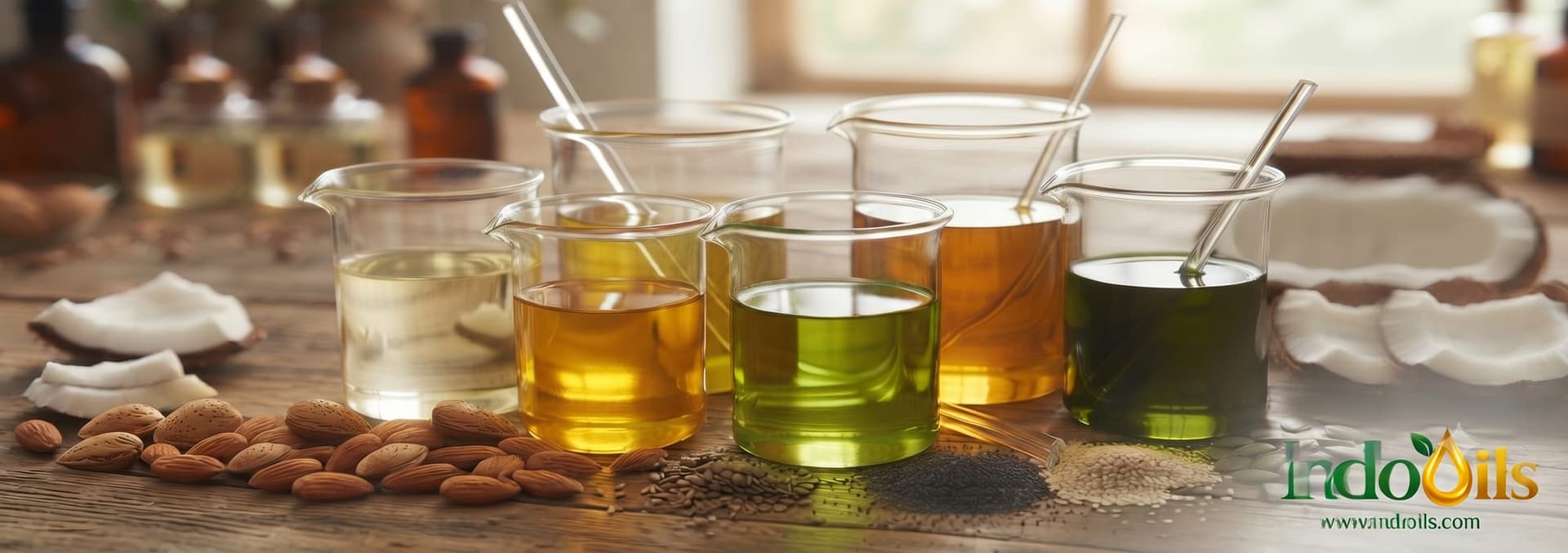
In most massage oils, face oils, hair oils and balms, the essential oil is only a small part of the formula. The rest is the carrier oil. It decides how the product feels on the skin, how quickly it absorbs, how long it stays fresh and much of what the label can say.
This guide is for formulators, contract manufacturers and brand owners who buy carrier oils in bulk. It compares the oils most often used in cosmetics, explains what to check on a test report, and covers the storage that stops a 50 kg pack from going rancid before it is used.
What a carrier oil is
A carrier oil is a fixed (non-volatile) oil pressed or extracted from seeds, kernels, nuts or fruit. Unlike essential oils, carrier oils do not evaporate, and most have little smell. They are used to:
- Dilute essential oils to a safe concentration for use on the skin
- Soften and condition skin and hair
- Carry actives such as plant extracts, vitamins and oleoresins
Most carrier oils are triglycerides: three fatty acids joined to glycerol. The mix of fatty acids decides almost everything a formulator cares about. Oils high in oleic acid (a monounsaturated fat) feel rich and resist oxidation well. Oils high in linoleic and linolenic acid (polyunsaturated fats) feel lighter and absorb faster, but go rancid sooner.
Cold pressed, virgin and refined
- Cold pressed or virgin oils are pressed mechanically without added heat. They keep more of their natural colour, scent, vitamins and antioxidants, and they suit "natural" and "unrefined" claims.
- Refined oils are filtered, bleached and deodorised. They are paler, almost odourless and more uniform from lot to lot, which suits fragrance-led products and sensitive formulas.
Neither is "better". If your product must smell only of its fragrance, a refined or naturally neutral oil is easier to work with. If the oil itself is part of the story, choose cold pressed. Our carrier oils are mostly cold pressed. Ask us if you need a refined grade.
Carrier oils compared
Light, fast-absorbing oils
Jojoba (Simmondsia chinensis). Technically a liquid wax, not a triglyceride, and close in structure to the skin's own sebum. It is non-greasy, almost odourless and very resistant to oxidation, so it has one of the longest shelf lives of any carrier. A first choice for face serums, beard oils and roll-ons.
Fractionated Coconut Oil (MCT 60/40) (INCI: Caprylic/Capric Triglyceride). Coconut oil with the long-chain fats removed, leaving a clear, light, odourless oil that stays liquid at room temperature. Very stable and easy to blend, it is widely used in perfume oils, massage blends and as a diluent for essential oils.
Apricot Kernel (Prunus armeniaca). Light and quickly absorbed, rich in oleic and linoleic acids. A good option for facial and baby-care oils.
Pomegranate Seed (Punica granatum). Unusual because most of its fatty acid is punicic acid. It is a premium "active" oil, usually used at a low percentage in serums rather than as the main base.
Rich, nourishing oils
Sweet Almond (Prunus dulcis). The classic massage oil: mild, slightly nutty, with good slip and moderate absorption. High in oleic acid. It comes from a tree nut, so many brands mention this on the pack.
Argan (Argania spinosa). From the kernels of the Moroccan argan tree, with a balance of oleic and linoleic acids and natural tocopherols (vitamin E). Popular in hair serums and face oils. Make sure you buy cosmetic argan, pressed from unroasted kernels; culinary argan is roasted and smells strongly nutty.
Avocado (Persea gratissima). A heavy, green oil pressed from the fruit pulp, rich in oleic acid and unsaponifiable matter. Used in balms, night creams and products for dry skin, usually blended with a lighter oil.
Olive (Extra) (Olea europaea). Rich and high in oleic acid, with natural squalene. A staple in soaps, balms and traditional massage oils. Its own aroma is noticeable, so it suits products where that is welcome.
Coconut (Cocos nucifera). Solid below about 24 °C and liquid above it. High in lauric acid, very stable, and the base of countless hair oils, soaps and balms. India is one of its main producers.
Indian and speciality oils
Sesame Seed (Sesamum indicum). The traditional base of Ayurvedic massage oils (abhyanga). Its natural antioxidants, sesamin and sesamol, make it more stable than its fatty acid profile suggests. Grown and pressed in India.
Moringa (Moringa oleifera). Also called ben oil. Very high in oleic acid and very stable, with a light feel. Moringa is widely grown in India, which makes it a strong origin story for natural brands.
Neem (Azadirachta indica). A dark, strong-smelling oil used in hair care, scalp treatments and soaps. Its smell is hard to hide, so it is usually used at a low percentage. Indian origin.
Black Cumin Seed (Nigella sativa). Also called kalonji oil. Dark and spicy, with thymoquinone as its best-known component. Used in hair and scalp products and in speciality skin oils.
Tamanu (Calophyllum inophyllum). A thick, dark green oil with a deep, woody smell, used in small amounts in balms and blemish care.
Sea Buckthorn Seed (Hippophae rhamnoides). Note that sea buckthorn gives two different oils. Seed oil is lighter in colour and rich in linoleic and linolenic acids. Berry oil, from the fruit pulp, is deep orange, rich in carotenoids and palmitoleic acid, and can stain skin and fabric at high doses. Check which one your formula calls for.
Borage Seed (Borago officinalis). One of the richest plant sources of gamma-linolenic acid (GLA). Valuable but easily oxidised, so it is used at low levels and stored carefully.
Browse the full carrier oils and organic carrier oils ranges for oils not listed here, such as Chia Seed, Calendula (infused), Strawberry Seed and Pistachio.
Quick selection guide
- Face serums and dry oils: jojoba, apricot kernel, MCT, with a small share of pomegranate or sea buckthorn seed
- Massage and spa oils: sweet almond, sesame, apricot kernel, MCT
- Hair and scalp oils: coconut, argan, sesame, black cumin, neem
- Balms and rich creams: avocado, olive, coconut, tamanu
- Diluting essential oils and perfume oils: MCT or jojoba, because they add almost no smell
- Long shelf life needed: jojoba, MCT, moringa, coconut
What to check on a test report
Every lot should come with a certificate of analysis (CoA). For carrier oils, the most useful figures are:
- Acid value or free fatty acids (FFA). A rising value shows the oil is breaking down. Lower is fresher.
- Peroxide value. The best early sign of oxidation. Compare it with the specification and check it again when you open a stored pack.
- Iodine value. Shows how unsaturated the oil is, and therefore how quickly it is likely to oxidise. It also helps confirm the oil is what it claims to be.
- Saponification value. Needed by soap makers to calculate lye, and another identity check.
- Fatty acid composition by GC. The strongest test of identity. It shows whether an "argan" or "pomegranate seed" oil has been diluted with a cheaper oil.
- Refractive index, specific gravity and colour. Quick physical checks against the specification.
- Heavy metals and pesticide residues, tested against the limits in your market, especially for organic claims.
Expensive oils such as argan, pomegranate seed and sea buckthorn are the ones most often diluted with cheaper oils. A fatty acid profile on the lot, together with a sample tested at your own laboratory, is the simplest safeguard. Our quality assurance page explains how we test each batch.
If an antioxidant such as tocopherol (vitamin E) has been added to the oil to extend its life, it must appear in your INCI list. Ask your supplier to confirm whether anything has been added.
Storage and shelf life
Carrier oils do not grow mould, but they do go rancid. Oxygen, light and heat attack the unsaturated fats and create an off smell. To keep a bulk pack fresh:
- Keep it cool and dark. Store away from sunlight and heat, ideally at 15–25 °C.
- Limit air. Reseal packs promptly. For large packs used over several months, decant into smaller full containers, or blanket the headspace with nitrogen.
- Use the oldest stock first and check the peroxide value on long-stored lots before production.
- Expect cold weather changes. Coconut sets solid, and some oils turn cloudy in the cold. Warm gently and mix. This is normal and not a quality fault.
Our carrier oils carry a stated shelf life of 36 months in sealed original packaging, and bulk material is packed under nitrogen where oxidation is a risk, as described on our manufacturing page.
Labelling and documents
For each carrier oil, your technical file should include the INCI name, CAS number, botanical name and country of origin. Each of our product pages lists these. For example, jojoba is Simmondsia Chinensis Seed Oil (CAS 90045-98-0) and sweet almond is Prunus Amygdalus Dulcis Oil (CAS 8007-69-0).
Each consignment ships with a CoA and safety data sheet, and standard documents are on our downloads page. If you are building a branded range, read our private label guide for brand owners and our importer checklist for cosmetic oils.
Ordering carrier oils in bulk
We supply carrier oils in 20 kg and 50 kg aluminium packs, with a minimum order of one pack. To get a quotation, send us:
Oil + grade (cold pressed, refined or organic) + quantity + application + destination country
We will reply with availability, documents and lead time. You can request a sample to test the feel and stability in your own base, send a bulk inquiry, or ask our custom formulation team to supply a ready-blended base, for example an essential oil at a set dilution in your chosen carrier. We supply manufacturers in cosmetics and personal care, aromatherapy and wellness and pharmaceuticals.
Buying in bulk?
20 kg and 50 kg packs, with a certificate of analysis for every lot.
Tell us the product, quantity and destination, and we will come back with a quotation.