Lavender is the best-selling essential oil in the world, and for most of the last century it was a European story: Provence, the Bulgarian valleys around Kazanlak, and later China and Australia. Over the last ten years, India has joined that list.
Under the CSIR Aroma Mission, often called the "Purple Revolution", the CSIR Indian Institute of Integrative Medicine (CSIR-IIIM) in Jammu brought true lavender to the hill districts of Jammu and Kashmir. Bhaderwah in Doda district is now the best-known growing area, and the institute reports more than 1,600 hectares under lavender and over 80 local distillation units, so flowers are distilled close to the field. The crop is harvested in early summer, and Bhaderwah held its fourth Lavender Festival in June 2026.
This guide covers Lavender Essential Oil India and the rest of the lavender range at IndoOils: imported origins, three absolutes and two ready-to-use oils. It explains how they differ, which specifications matter, and how to buy them in bulk.
The Lavender Range at a Glance
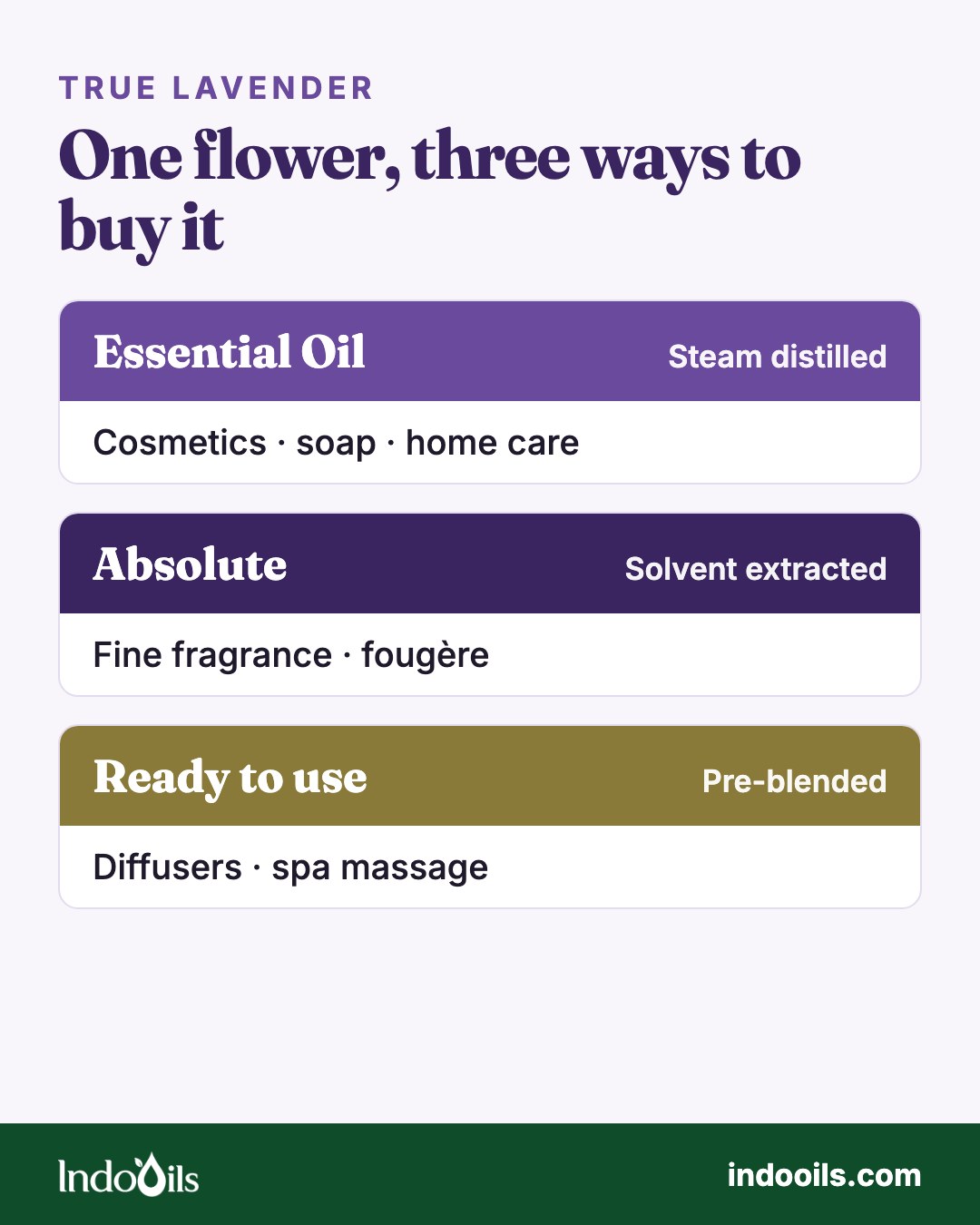
All the products below come from true lavender, Lavandula angustifolia. They differ in origin, extraction method and how ready they are to use.
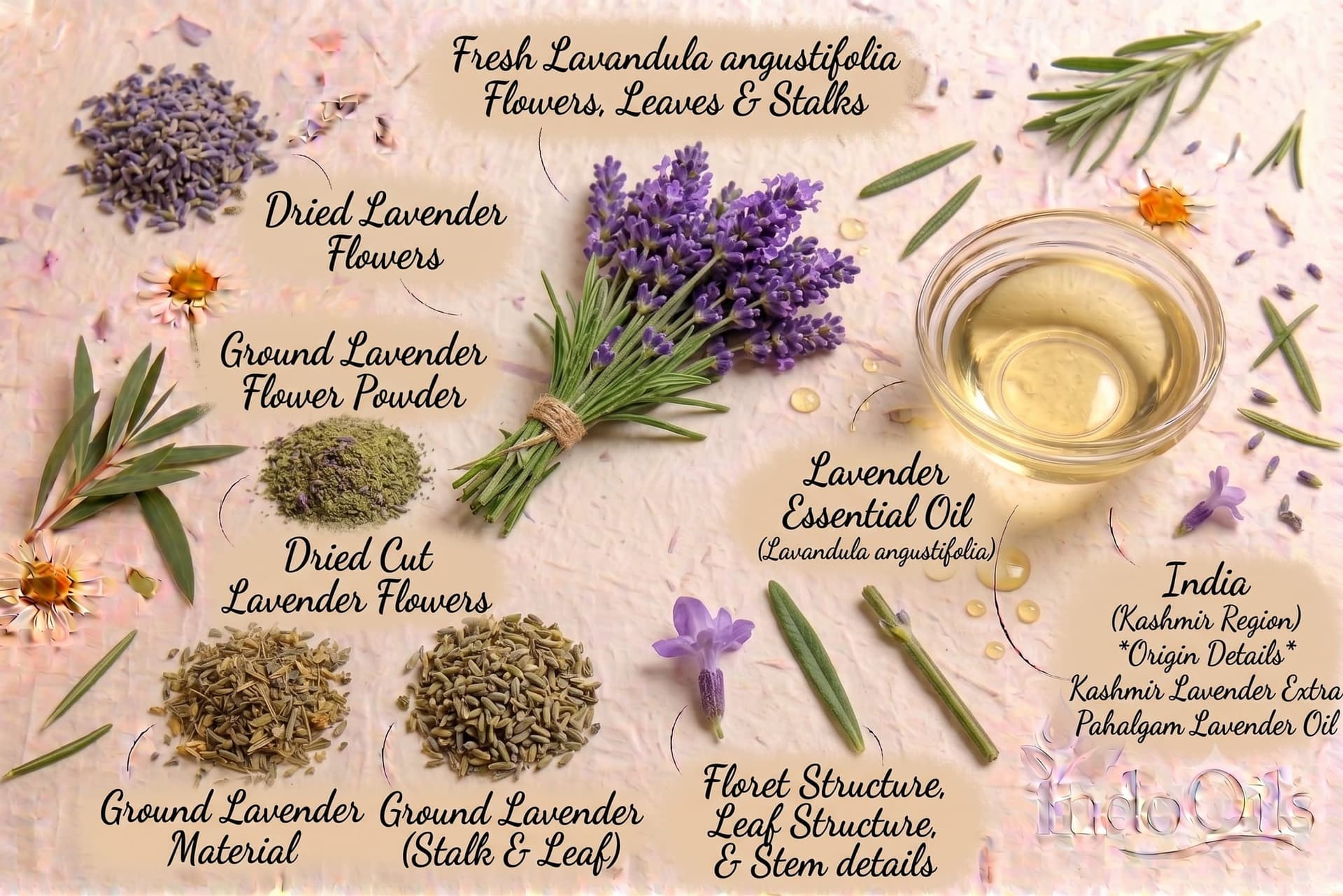
Lavender Essential Oil India
Lavender Essential Oil India is steam distilled from the fresh flowering tops of lavender grown in the Indian Himalayas. It is a clear, pale oil with the familiar sweet, floral and herbaceous lavender scent, and it is the everyday choice for cosmetics, soaps, home fragrance and aromatherapy blends.
- Botanical name: Lavandula angustifolia
- INCI name: Lavandula Angustifolia Oil
- CAS number: 8000-28-0
- HSN code: 33012990
- SKU: IND0096
- Plant part: Flowering tops
- Extraction method: Steam distillation
- Origin: India
- Shelf life: 36 months, unopened
French, Bulgarian and South African Lavender
The same species grown in different places smells different. Altitude, climate and the plant varieties grown all shift the balance between the main constituents. That is why many buyers keep more than one origin on their approved list:
- Lavender (France and Bulgaria) is the classic reference profile that most fragrance briefs are written against.
- Lavender (South Africa) is a southern-hemisphere crop, harvested at the opposite time of year to European and Indian lavender. That makes it a useful second source when northern stock runs low.
All three origins share the same INCI name and CAS number, so switching between them does not change your ingredient list. Judge them on the GC report and on a smell test against your approved sample.
Lavender Absolutes
Absolutes are solvent extracted, not distilled. They hold heavier, less volatile materials that steam leaves behind, including coumarin, which gives lavender absolute its sweet, hay-like depth. They are thicker and darker than the essential oil, and they are used in small amounts for richness and long-lasting effect, mainly in fine fragrance. All three share CAS 90063-37-9 and HSN 33012990.
- Lavender Absolute Extra: rich, sweet, coumarin-led lavender; the most rounded of the three.
- Lavender Brown Absolute: deeper, warmer and woody-herbaceous, built for fougère and woody accords.
- Lavender Green Absolute: fresh, green and crisp, suited to modern unisex and aromatic fragrances.
Browse the full absolutes range for other floral and herbal absolutes.
Ready-to-Use Lavender Oils
Not every buyer wants to formulate. Lavender Diffuser Oil is made for ultrasonic and reed diffusers, and Lavender Massage Oil is lavender oil already diluted in sweet almond oil for spa and salon use. See the aroma diffuser oils and spa oils ranges for other scents in the same formats.
What Makes Good Lavender Oil: The Chemistry
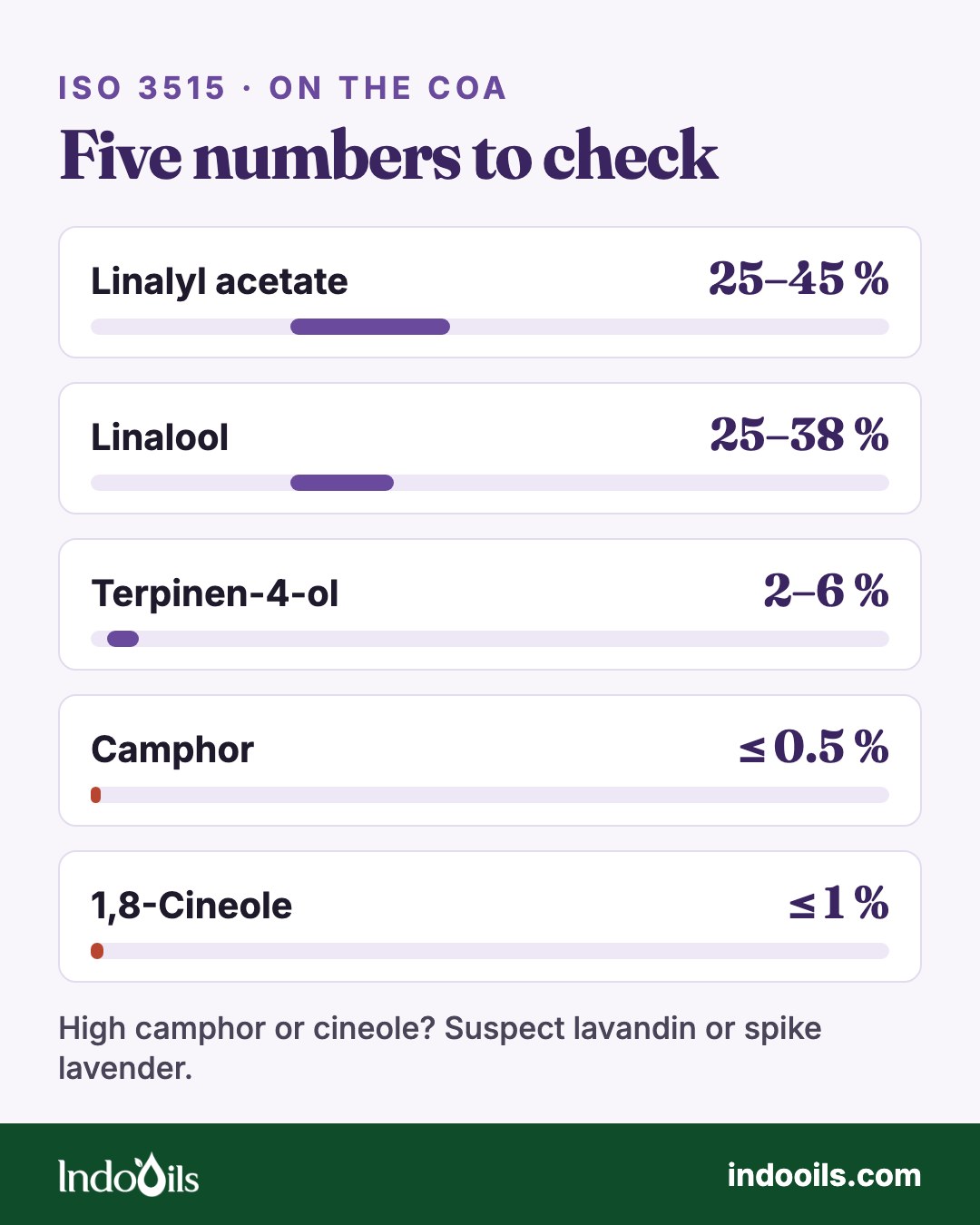
The international standard for lavender oil is ISO 3515. As summarised in published reviews of the 2002 edition, its key ranges are:
- Linalyl acetate: 25–45 %. The sweet, fruity-floral ester. A high share gives the soft, "fine" lavender that perfumers pay most for.
- Linalool: 25–38 %. The fresh floral alcohol that carries the lavender character.
- Terpinen-4-ol: about 2–6 %. A herbaceous note; very high figures change the scent.
- Camphor: 0.5 % maximum. True lavender contains very little camphor.
- 1,8-Cineole (eucalyptol): 1 % maximum. Again, true lavender is low in it.
Linalool and linalyl acetate together usually make up more than half of a good oil. Indian hill lavender is a newer origin than France or Bulgaria and was bred for local conditions, so agree the acceptance ranges for each origin in writing, based on a reference GC, before the first order.
Spotting lavandin, spike lavender and synthetic cuts
Lavender is one of the most frequently adulterated essential oils, because cheaper look-alikes exist:
- Lavandin (Lavandula × intermedia) is a high-yielding hybrid with much more camphor and cineole than true lavender. A camphor figure well above 0.5 % is the classic warning sign.
- Spike lavender (Lavandula latifolia) is high in cineole and camphor, and also pushes those two numbers up.
- Synthetic linalool and linalyl acetate can be added to lift a weak oil back into range. Natural lavender contains almost only the (R)-form of linalyl acetate and mostly (R)-linalool, so a chiral GC test showing too much of the (S)-form points to a synthetic addition.
Ask for chiral data on any lot that will carry a "pure" or "natural" claim.
Where Bulk Buyers Use Lavender Oil
Cosmetics and personal care
Lavender appears in more personal-care products than almost any other essential oil: soaps, shower gels, shampoos and conditioners, lotions, body oils, deodorants and baby-care lines. Linalool and linalyl acetate oxidise in air into skin sensitisers, so cosmetic formulas usually include an antioxidant and the allergen content must be declared. See our cosmetics and personal care page and the bulk essential oils for cosmetics importer checklist.
Fine fragrance
Lavender is the backbone of the fougère family, the classic structure of lavender, coumarin and oakmoss behind many men's fragrances. It also lifts colognes, aromatic citrus accords and modern gourmand scents. The absolutes add depth and longevity in small doses.
Home care and fragrance
Laundry detergents, fabric softeners, surface cleaners, candles, reed diffusers and room sprays all use lavender for a clean, calm, familiar scent. See home care and fragrance.
Aromatherapy, spa and wellness
Lavender is the core oil of most aromatherapy and massage ranges. Product claims in this area are regulated in most markets, so keep wording to scent and experience unless you have the evidence and approvals for anything more. See aromatherapy and wellness.
Flavour
Lavender is on the US list of essential oils generally recognised as safe for food use (21 CFR 182.20). It is used in very small amounts in teas, chocolate, bakery and confectionery. Ask for a food-grade statement before using any lot in food.
Blending Partners
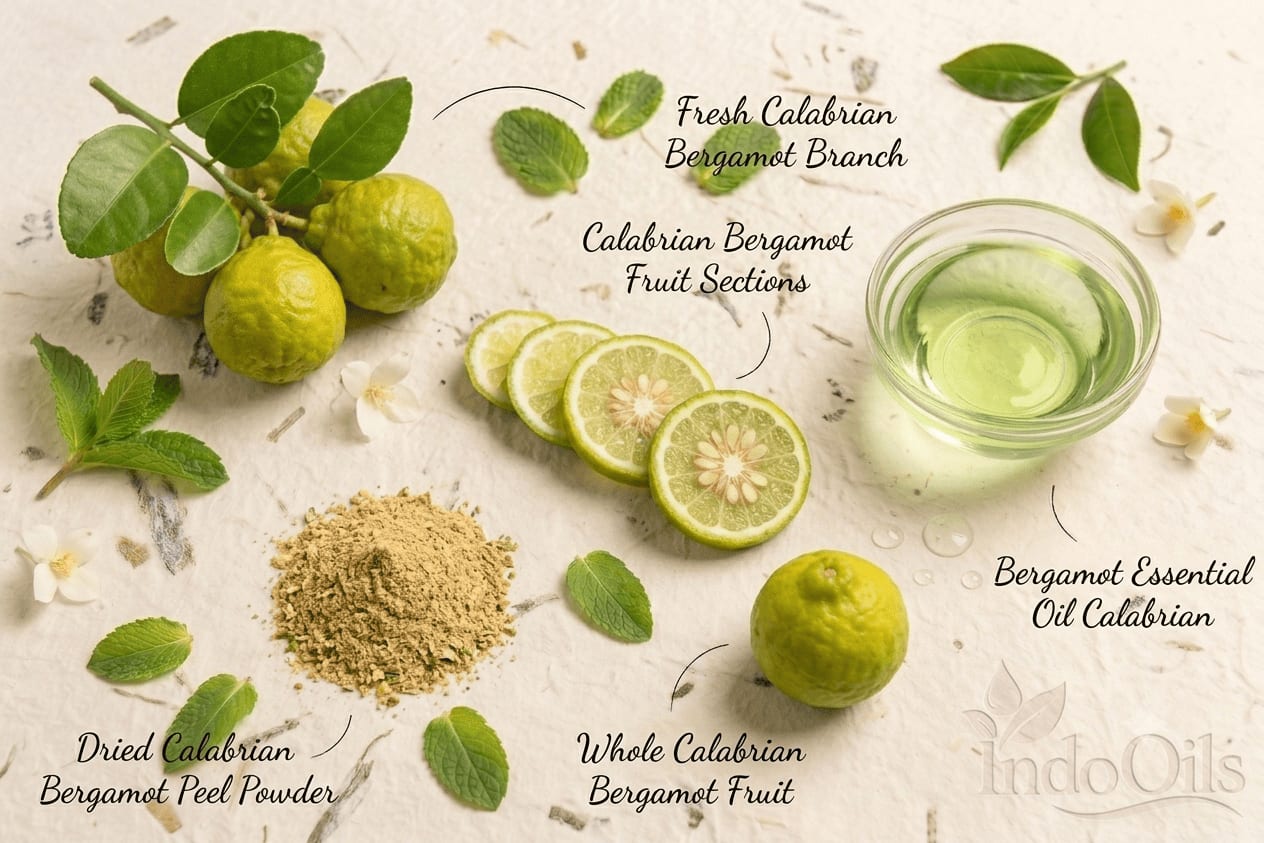
Lavender blends with almost everything, which is part of why it sells so widely. These pairings are the most common in commercial formulas, and all of them are available from the same supplier as your lavender:
- Citrus and cologne: Calabrian bergamot, sweet orange and neroli
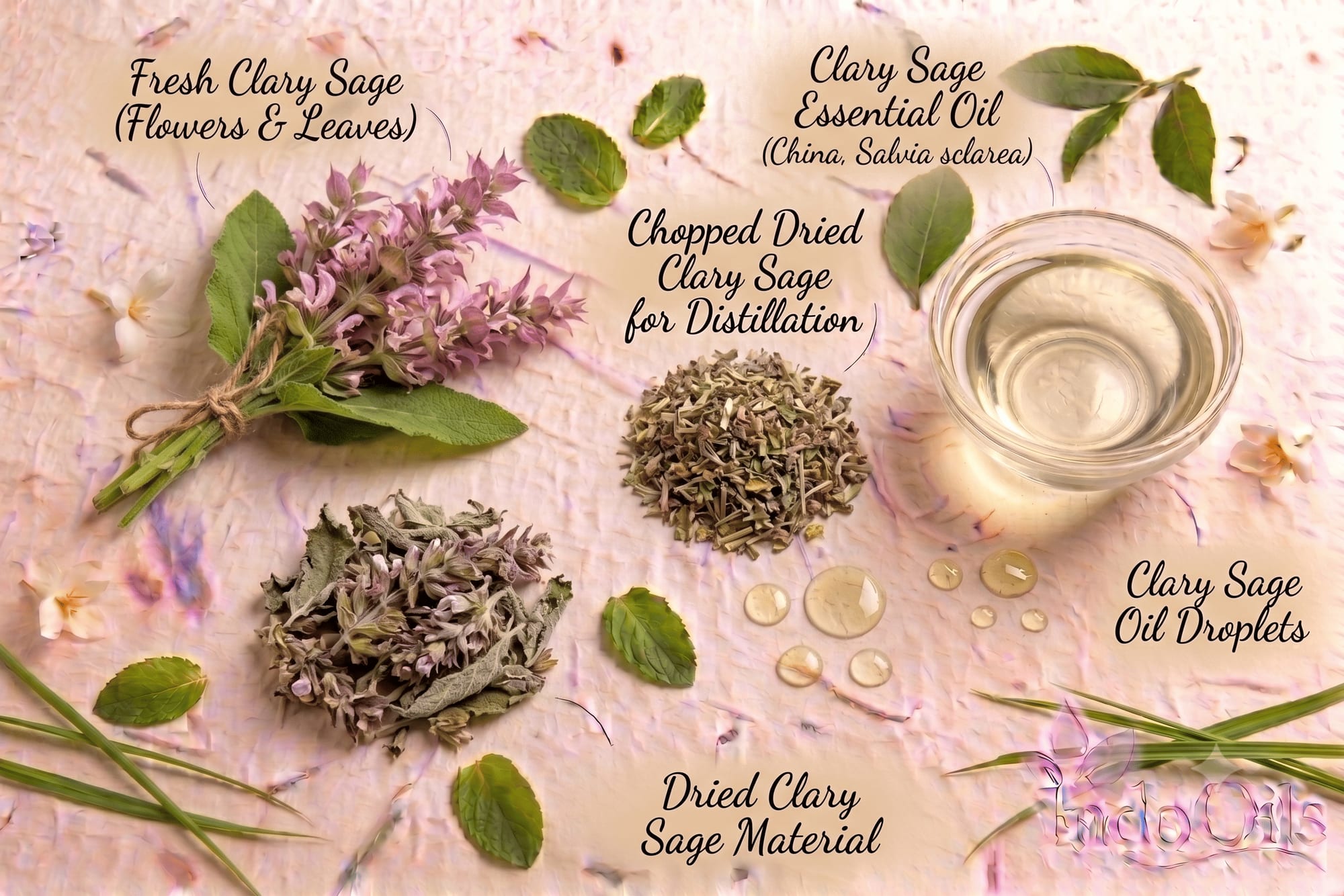
- Herbal and aromatic: clary sage, rosemary, sweet marjoram and Roman chamomile
- Floral: geranium, Bulgarian rose and ylang ylang
- Woody base notes: Himalayan cedarwood, vetiver and sandalwood
Need one finished blend instead of five separate oils, for example a sleep-mist fragrance or a lavender-bergamot soap scent? Our custom formulation team can match a target profile and supply it ready to use.
Quality Checks and Documents to Request
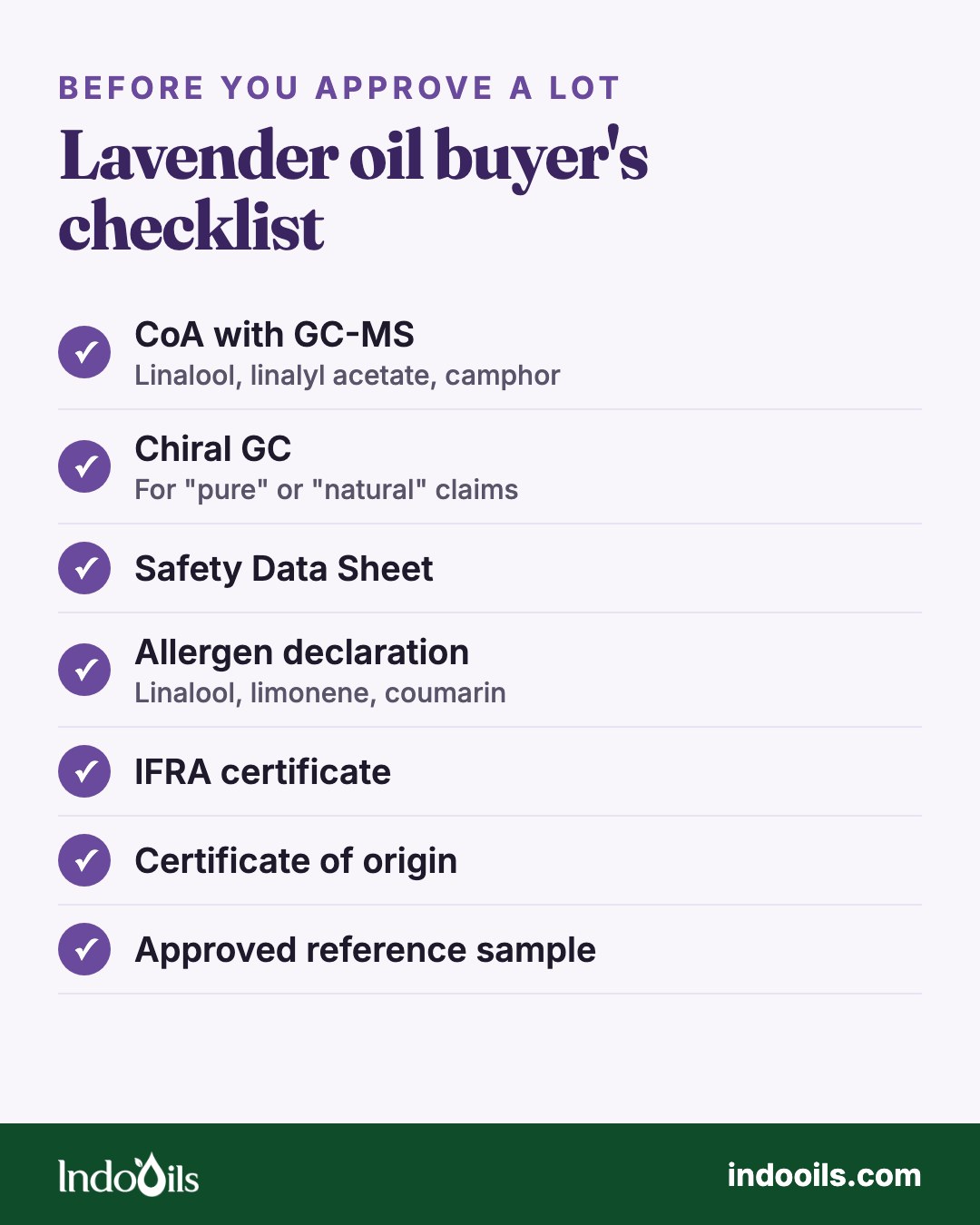
Before approving a bulk lot, ask for:
- Certificate of Analysis (CoA) with a GC-MS breakdown showing linalool, linalyl acetate, terpinen-4-ol, camphor and 1,8-cineole, plus specific gravity, refractive index and optical rotation.
- Chiral GC data if your label says "100 % pure" or "natural".
- Safety Data Sheet (SDS), needed for transport and for import into the EU, UK, US and most other markets.
- Fragrance allergen declaration for cosmetic use. Lavender oil contains linalool, limonene and geraniol, and the absolutes also contain coumarin. See fragrance allergen labelling: the documentation buyers need.
- IFRA certificate for fragrance and personal-care use.
- Certificate of origin, especially if you want to make an "Indian", "French" or "Bulgarian" lavender claim on pack.
- Batch retention and traceability, so a complaint can be traced back to the lot. See our traceability and quality assurance pages.
Standard templates are on the downloads page, and current company certifications are listed under certifications.
Supply and Seasonality
Indian and European lavender flower in early to mid summer, and most oil is distilled within a few weeks of harvest. South African lavender is harvested about six months later. A poor flowering season in one region therefore does not have to mean a supply gap, as long as your specification allows a second origin.
For steady supply:
- Book annual or half-yearly volumes so the supplier can secure oil at harvest, when quality is best.
- Approve a reference sample for each origin and keep it, so every later lot is judged against the same standard.
- Plan one pack of buffer stock for launch products.
Our climate volatility and wholesale pricing 2026 article explains how weather is reshaping botanical supply.
Storage and Handling
- Store at 15–25 °C in a dry place away from direct sunlight.
- Keep containers tightly closed. Linalool and linalyl acetate oxidise on contact with air, which dulls the scent and raises the skin-sensitisation risk.
- Use the aluminium containers as supplied. For part-used packs, top up the headspace with nitrogen if possible.
- Shelf life is 36 months unopened for the essential oil. Once opened, use within about 12 months.
- Lavender oil is flammable; keep it away from heat and open flame.
How to Order Lavender Oil in Bulk
All lavender products ship from India in 20 kg and 50 kg aluminium packs, with a minimum order of one pack. Pricing is quoted on request and depends on the product, origin, volume, destination and contract length.
- Request a quotation: send a bulk inquiry naming the product (Indian, French/Bulgarian or South African oil, or one of the absolutes), your application and the annual volume you expect.
- Try before you commit: request a sample with its CoA for lab and sensory approval.
- Launching your own brand? Our private label service covers filling, labelling and export documentation. See the private-label guide for brand owners.
Export shipments include a commercial invoice, packing list and certificate of origin as standard.
Frequently Asked Questions
Is Indian lavender oil true lavender?
Yes. Lavender Essential Oil India is distilled from Lavandula angustifolia, the same species as French and Bulgarian lavender, and carries the same INCI name and CAS number. Its exact profile reflects Himalayan growing conditions, so compare its GC report and scent with your current oil before switching.
What is the difference between lavender and lavandin oil?
Lavandin is a hybrid (Lavandula × intermedia) that yields much more oil per hectare but contains far more camphor and cineole. It smells sharper and more medicinal, and it is cheaper. It is a valid ingredient for detergents and household products, but it should never be sold as lavender.
When should I use lavender absolute instead of the essential oil?
Use the essential oil for most cosmetics, soaps, home fragrance and aromatherapy. Use an absolute in fine fragrance and premium products where you want depth, sweetness and longer-lasting lavender, usually at low levels alongside the essential oil.
What is the minimum order?
One 20 kg pack. 50 kg packs are also available, and samples can be sent before a bulk order.
For more buyer's guides, see our posts on sandalwood oil, basil oil, peppermint oil and carrier oils for cosmetics, or browse the full essential oils range.
Buying in bulk?
20 kg and 50 kg packs, with a certificate of analysis for every lot.
Tell us the product, quantity and destination, and we will come back with a quotation.