Few raw materials carry as much history as sandalwood. For centuries Indian sandalwood oil has been the soft, creamy, long-lasting heart of attars, incense, temple rituals and fine perfume. Today it is still one of the most valued base notes in fragrance, and one of the most often faked.
This guide explains what bulk buyers in the USA, Europe, the UK, the Middle East and Asia should know before ordering sandalwood oil from India: the different species, what to look for on a test report, how the oil is used, and how to order it.
What sandalwood oil is
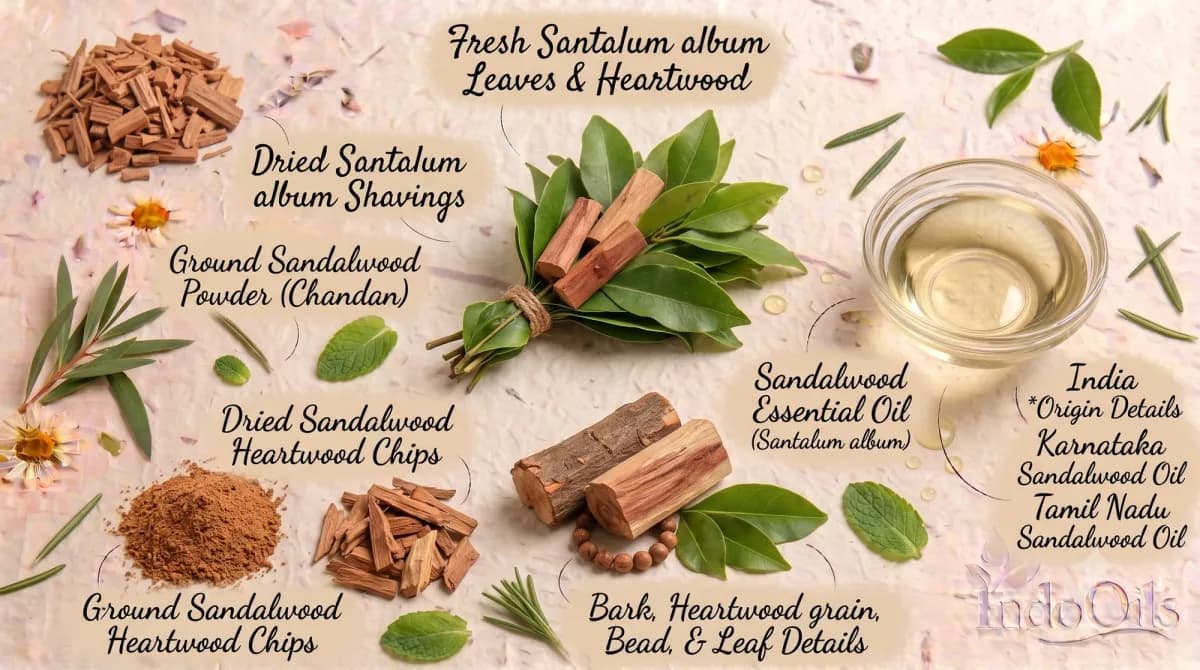
True sandalwood oil comes from the heartwood of trees in the Santalum genus. The tree has to grow for many years before it builds up a scented heartwood, which is why sandalwood oil is scarce and costly. The heartwood (and often the roots, which are also rich in oil) is chipped, powdered and steam distilled to give a pale yellow, viscous oil with a soft, sweet, woody and milky odour.
The odour comes mainly from two sesquiterpene alcohols: α-santalol and β-santalol. Together they are the single most important quality measure for sandalwood oil.
Our Sandalwood Essential Oil is steam distilled from Santalum album heartwood and is supplied with these identifiers:
- Botanical name: Santalum album
- CAS number: 8006-87-9
- Plant part: heartwood
- Extraction: steam distillation
- Origin: India / Australia
- Shelf life: 36 months in sealed original packaging
Indian sandalwood and Australian sandalwood
Buyers will usually meet two species. They are both genuine sandalwood, but they are not the same oil.
Indian sandalwood — Santalum album
Santalum album is the classic East Indian sandalwood. It has the highest santalol content and the smoothest, creamiest odour. The international standard ISO 3518 sets ranges for it of roughly 41–55% α-santalol and 16–24% β-santalol. Santalum album is native to India and is also now grown on plantations in northern Australia, which is why supply can come from either country.
Australian sandalwood — Santalum spicatum
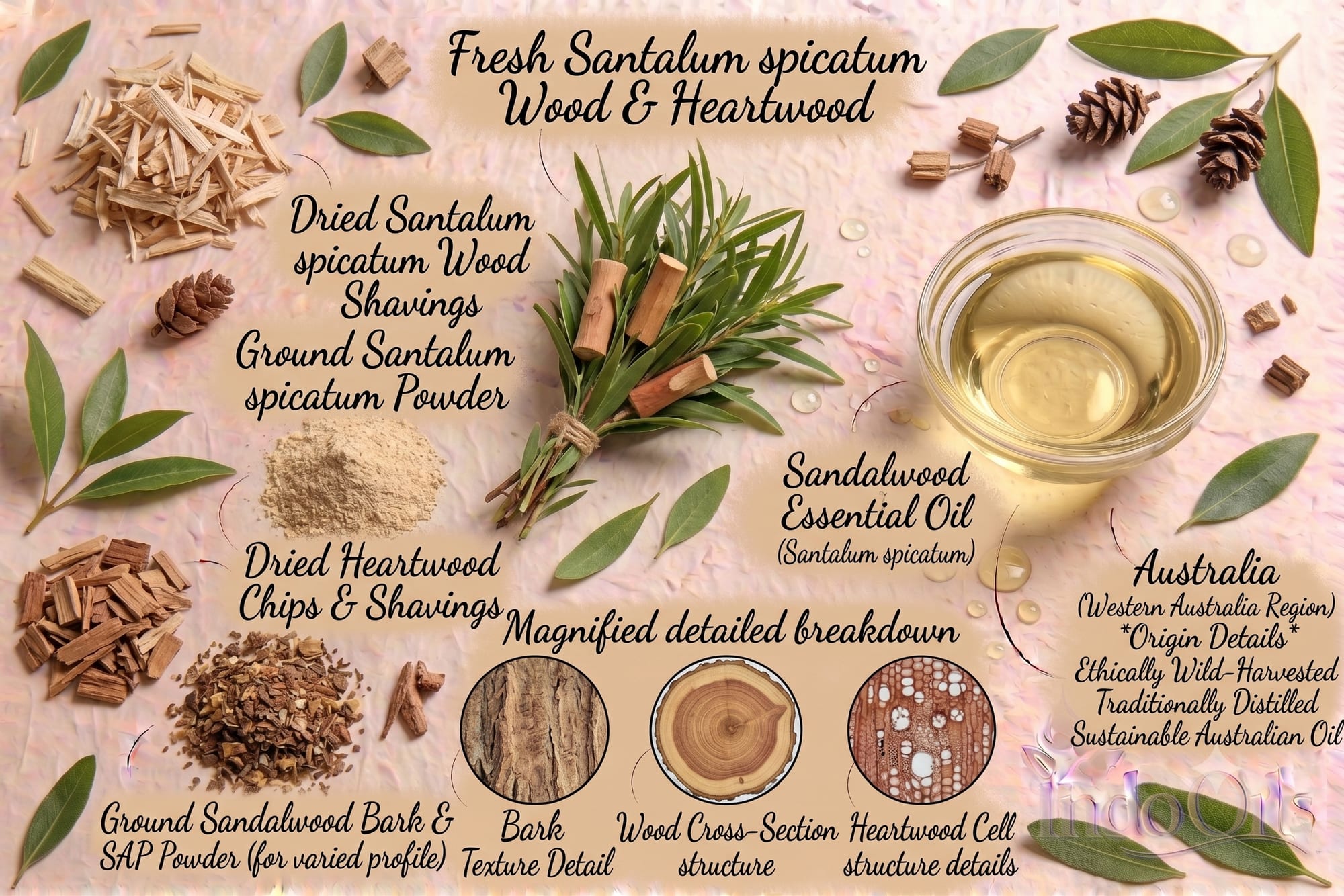
Santalum spicatum grows wild in Western Australia. Its oil has a lower santalol content and a drier, slightly sharper, more resinous woody note. It has its own ISO standard and is a good choice where cost matters and a classic East Indian profile is not essential. See our Australian Sandalwood Essential Oil (Santalum spicatum, CAS 8024-35-9).
Be careful with the name "West Indian sandalwood". This is usually amyris oil, from an unrelated tree. It has a woody note of its own but it is not sandalwood and should never be sold as such.
Sandalwood oil, sandalwood fragrance oil and ready blends
Not every product with "sandalwood" in the name is a distilled oil. Choose by what your product needs and what you must declare on the label:
- Sandalwood essential oil is the natural, steam-distilled oil. Use it when you need a natural claim, a true sandalwood profile, or a fixative in fine fragrance and natural cosmetics.
- Sandalwood Fragrance Oil is a compounded fragrance built to smell like sandalwood. It costs far less and is the practical choice for candles, incense sticks, soaps, detergents and home fragrance, where a natural claim is not needed.
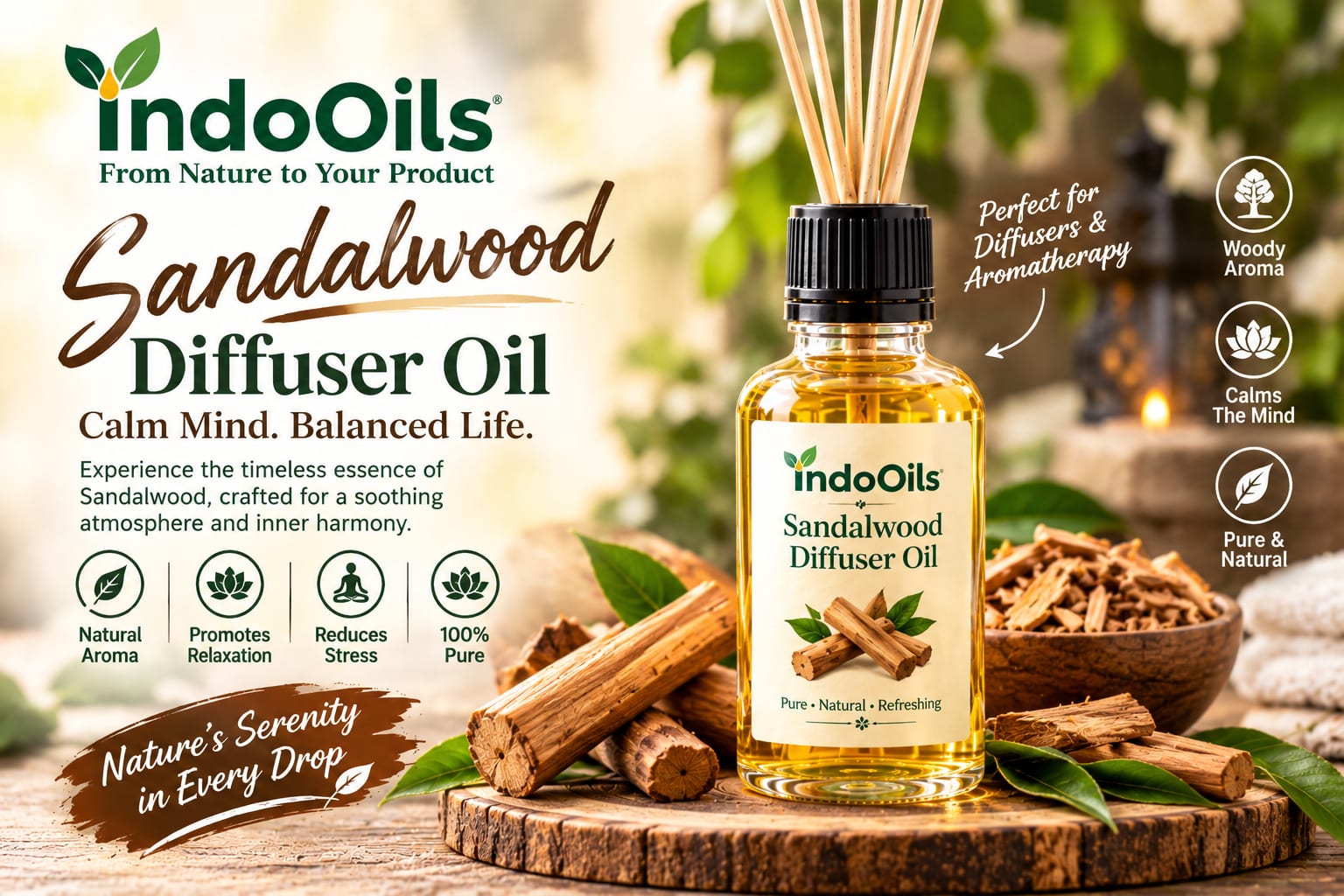
- Sandalwood Diffuser Oil is made for ultrasonic and reed diffusers, ready to fill.
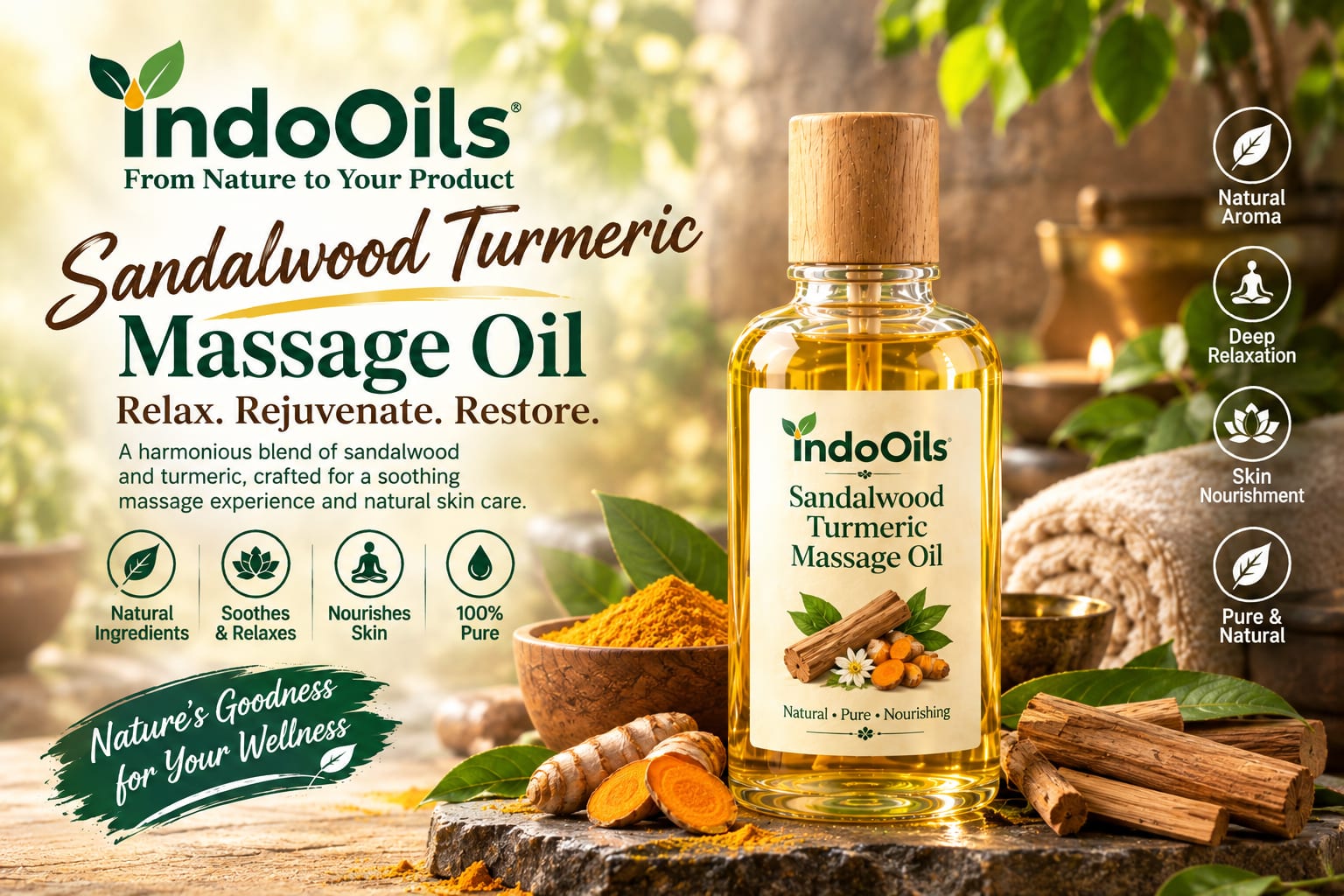
- Sandalwood Turmeric Massage Oil is a ready-to-use blend of sandalwood and turmeric in a carrier base, for spas and personal care brands.
What to check on a sandalwood oil test report
Because it is expensive, sandalwood oil is a frequent target for adulteration. Common tricks include dilution with castor oil or other cheap fixed oils, cutting with amyris oil, and "boosting" a weak oil with synthetic sandalwood aroma chemicals. A good certificate of analysis (CoA) and GC-MS report should let you rule these out.
Ask for, and check:
- GC-MS chromatogram showing α-santalol and β-santalol, with the percentages for the lot. Compare them with the ranges for the species you ordered.
- Absence of synthetic sandalwood molecules. Synthetic sandalwood aroma chemicals do not occur in natural sandalwood oil, so their presence on a GC-MS is a clear red flag.
- Physical constants — specific gravity, refractive index and optical rotation. These move outside their normal range when an oil has been diluted.
- Solubility in alcohol. Genuine sandalwood oil dissolves cleanly in ethanol; fixed oils such as castor oil make the solution cloudy or separate.
- Lot number and dates that match the label on the drum.
If you are buying for a regulated market, also ask for the safety data sheet (SDS) and, for cosmetics, an allergen declaration. Our guide to fragrance allergen labelling covers what EU and UK buyers usually need.
Where sandalwood oil is used
- Fine fragrance. Sandalwood is a classic base note and fixative. It extends the life of floral and oriental accords and blends beautifully with rose, jasmine, vetiver and amber notes.
- Attars. Traditional Indian attars, such as those from Kannauj, are made by distilling flowers or herbs into a sandalwood oil base, so attar makers are among the steadiest buyers.
- Cosmetics and skin care. Face oils, creams, soaps, shaving products and beard oils use it for both scent and a premium natural story.
- Incense and spiritual products. Agarbatti, dhoop and ritual oils, often alongside sandalwood fragrance oil for cost control.
- Aromatherapy and spa. Massage blends, diffuser blends and meditation products.
Sandalwood pairs naturally with other Indian aromatics. Popular partners include Vetiver Oil, Jasmine Sambac Essential Oil, May Rose Absolute and Himalayan Cedarwood. Our vetiver buyer's guide is a useful companion read.
Sourcing sandalwood responsibly
Santalum album is a slow-growing tree, and wild stocks have been heavily over-harvested. Sandalwood in India has long been closely regulated, and most legal supply today comes from controlled sources and plantations in India and Australia.
For your own compliance and your customers' trust, ask your supplier to state the species and country of origin clearly on the CoA and commercial documents, and to keep lot records that link the oil to its source. You can read how we approach this on our traceability and quality assurance pages.
Storing sandalwood oil
Sandalwood oil is one of the most stable essential oils, and many perfumers feel its odour softens and rounds out with age. To keep it in good condition:
- Store it in sealed, full containers, away from heat and direct light.
- Keep the headspace small. Once a pack is opened, decant the remainder into smaller containers rather than leaving a half-empty drum.
- The oil is thick, especially in cold weather. Warm it gently and mix before weighing.
Ordering sandalwood oil in bulk
We supply sandalwood oil in 20 kg and 50 kg packs, with a minimum order of one pack. Every lot ships with a certificate of analysis and a safety data sheet, and GC-MS reports and specifications are available on request. Many of our documents are on the downloads page.
To get a quotation, send us:
Product + species (S. album or S. spicatum) + quantity + application + destination country
We will come back with the most suitable grade, packaging and supply options. You can also request a sample to evaluate the oil in your own formula, or send a bulk inquiry directly. If you are launching your own sandalwood range, our private label service can fill and label it for you.
Browse the full essential oils range and our fragrances for more options.
Buying in bulk?
20 kg and 50 kg packs, with a certificate of analysis for every lot.
Tell us the product, quantity and destination, and we will come back with a quotation.