Turmeric is one of the most familiar spices in the world, and India grows most of it. For food manufacturers, beverage brands and supplement makers, though, the dried powder is often not the most practical way to use it. Its colour varies from lot to lot, it brings fibre and starch into a recipe, and large quantities are needed to get a strong shade.
Turmeric oleoresin solves those problems. It concentrates the colour and flavour of turmeric into a small, consistent dose that blends easily into a formulation. This guide explains what bulk buyers in the USA, Europe, the UK, the Middle East and Asia should know before ordering it from India.
What turmeric oleoresin is
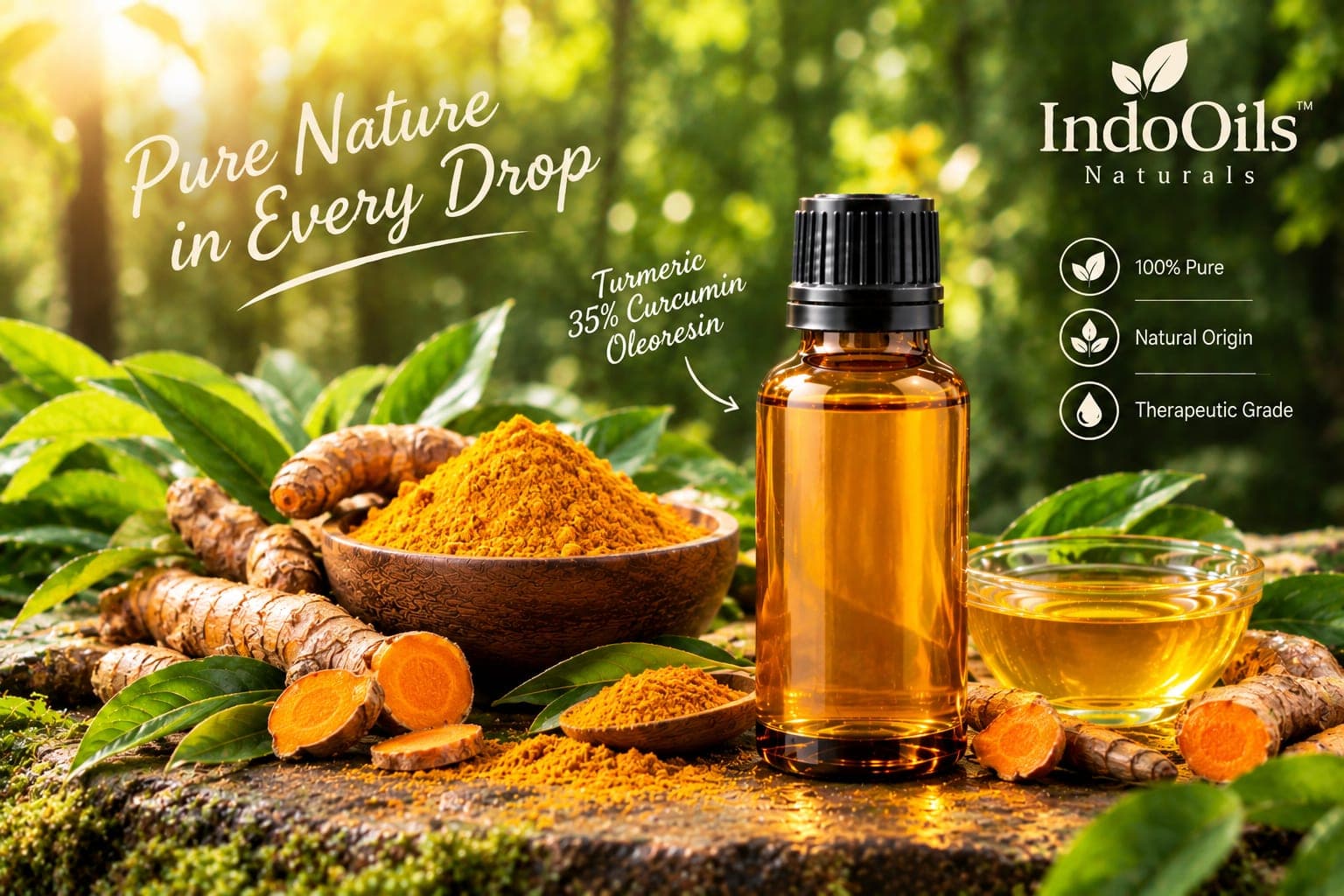
Turmeric (Curcuma longa) is a member of the ginger family. The useful part is the rhizome, the underground stem. After harvest, the rhizomes are cured (traditionally by boiling), dried and ground, and the ground turmeric is then extracted with a food-grade solvent. The solvent is removed afterwards, leaving a thick, deep orange-brown oleoresin.
The oleoresin carries the three things that make turmeric useful:
- Curcuminoids — curcumin, demethoxycurcumin and bisdemethoxycurcumin. These give the bright yellow colour and are what most buyers are paying for.
- Volatile oil — mainly turmerones, which give the warm, earthy turmeric aroma and taste.
- Resins and fixed oils, which carry the curcuminoids and the volatile oil.
Our Turmeric 35% Curcumin Oleoresin is solvent extracted from Curcuma longa rhizomes and is supplied with these identifiers:
- Botanical name: Curcuma longa
- CAS number: 84775-52-0
- Extraction: solvent extraction, with the solvent removed and tested for
- Shelf life: 36 months in sealed original packaging
Turmeric oleoresin, turmeric oil and curcumin powder
Three turmeric products are often confused. They do different jobs:
- Turmeric oleoresin contains both colour (curcuminoids) and aroma (volatile oil). It is the usual choice when you want turmeric's colour and its flavour, for example in curry blends, sauces and seasonings.
- Turmeric essential oil is steam distilled and contains the volatile oil but almost no curcumin, so it gives aroma without colour. See our Turmeric Oil.
- Curcumin powder (often sold at around 95% curcuminoids) is a further purified, crystallised product. It gives strong colour with very little turmeric flavour and is mostly used in supplements.
If you are not sure which one your formulation needs, tell us what the ingredient has to do — colour, flavour, a label claim or a supplement dose — and we will suggest the right form.
What the curcumin percentage means
Turmeric oleoresin is sold by its curcuminoid content. A "35% curcumin" oleoresin contains about 35% curcuminoids by weight, measured on the lot. Oleoresins are traded across a range of strengths, and the right one depends on how much colour you need per kilogram of finished product.
When you compare offers from different suppliers, check three things:
- The test method. Curcuminoid content is measured either by spectrophotometry or by HPLC, and the two methods can give different figures for the same sample. Compare like with like, and ask the certificate of analysis to state the method used.
- Total curcuminoids or curcumin alone. Some reports give the total of all three curcuminoids; others give curcumin only. A lower curcumin-only figure is not necessarily a weaker product.
- Volatile oil content. Two oleoresins with the same curcumin figure can taste quite different if their volatile oil content differs.
What to check on a test report
Every lot should come with a certificate of analysis (CoA). For turmeric oleoresin, a useful CoA covers:
- Curcuminoid content, with the test method stated
- Volatile oil content
- Residual solvents, to show the extraction solvent has been removed to within limits
- Heavy metals — lead, arsenic, cadmium and mercury
- Pesticide residues, tested against the limits of your destination market
- Microbiology and aflatoxins, which food and supplement buyers commonly require
Heavy metals deserve particular attention. Lead adulteration of turmeric powder has been documented in parts of South Asia, where lead chromate has been added to brighten the colour of poor-quality rhizomes. A heavy-metals result on every lot is a simple safeguard, and reputable buyers ask for it as standard.
We are happy for buyers to test samples at an independent laboratory of their choice. Ask us for a sample before you commit to a production order.
Where turmeric oleoresin is used
Food. Turmeric oleoresin is used as a natural yellow colour and a turmeric flavour in curry powders and pastes, mustard, sauces, soups, pickles, snack seasonings, bakery, dairy and ready meals. In the European Union, curcumin is permitted as a food colour under the number E 100. See how we supply the food and beverage industry.
Beverages. Turmeric oleoresin is oil-soluble, so it does not mix into water on its own. Clear and water-based drinks usually need a water-dispersible form. Tell us your application and we will discuss the right format.
Nutraceuticals. Supplement brands use turmeric oleoresin and curcumin extracts in capsules, softgels, gummies and powder blends. Here the curcuminoid figure and the test method matter most, because they support the label claim. See our work with nutraceutical manufacturers.
Cosmetics and personal care. Turmeric extracts appear in skin care and soap, where they add colour and a traditional "haldi" story to the product.
How India produces turmeric
India is the world's largest producer, consumer and exporter of turmeric. The crop is grown across several states, with Telangana, Maharashtra, Tamil Nadu, Karnataka and Andhra Pradesh among the main producing regions, and towns such as Erode, Sangli and Nizamabad serving as major trading centres. Varieties differ in their natural curcumin content; Lakadong turmeric from Meghalaya, for example, is known for being particularly rich in curcumin.
Because the raw material varies by region, variety and season, a consistent oleoresin depends on selecting the right rhizomes and testing every lot. Read more about how we approach quality assurance and traceability, and why clean-label sourcing is becoming a buying requirement.
Storage and handling
- Protect it from light. Curcumin fades under strong light, so keep oleoresin in its sealed, opaque container.
- Keep it cool and closed. Store in a cool, dry place away from heat, and reseal containers promptly after use.
- Mix before use. Oleoresin is thick and can thicken further in cold weather. Warm it gently and stir to make it uniform before weighing.
- Watch the pH. Curcumin shifts from yellow towards red-orange in alkaline conditions, so check the colour in your actual product base.
Ordering turmeric oleoresin in bulk
We supply turmeric oleoresin in 20 kg and 50 kg packs, with a minimum order of one pack. Every lot ships with a certificate of analysis and a safety data sheet, and specifications, GC-MS and other documents are available for the products where they apply. You can find many of these on our downloads page.
To get a quotation, send us:
Product + curcuminoid strength + quantity + application + destination country
We will come back with the most suitable grade, packaging and supply options. You can also request a sample or send a bulk inquiry directly.
Turmeric oleoresin sits alongside our other spice extracts, such as Deodourised Paprika Oleoresin and Green Ginger Oleoresin. Browse the full oleoresins range.
Buying in bulk?
20 kg and 50 kg packs, with a certificate of analysis for every lot.
Tell us the product, quantity and destination, and we will come back with a quotation.