Few smells are as familiar in India as camphor. Kapur is burned in homes and temples every day, packed into moth balls and blended into balms, and India is one of the largest camphor markets in the world. Most of the white tablets sold for that market are synthetic camphor, made from the pinene in turpentine.
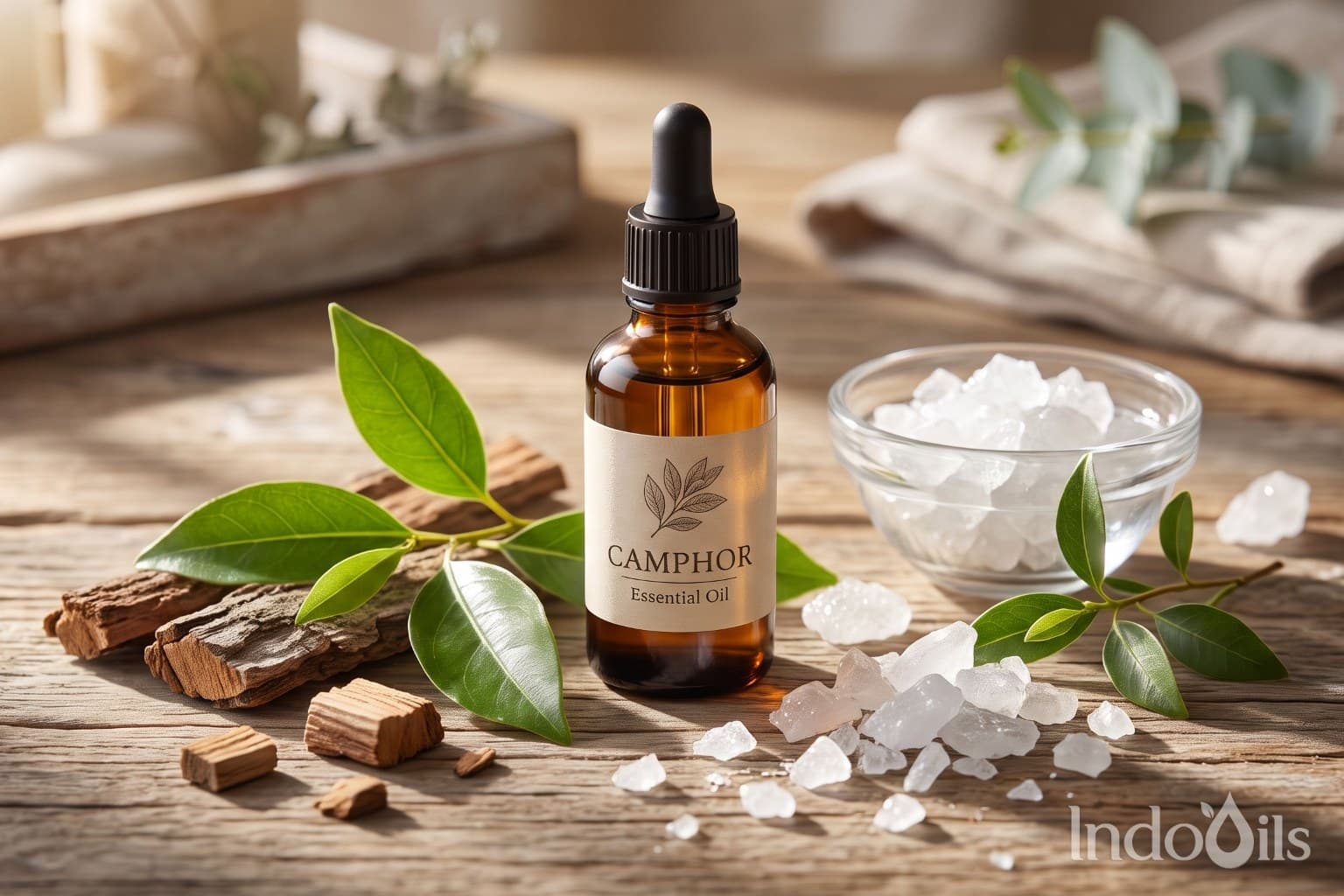
Camphor oil is a different product with a different buyer. It is an essential oil distilled from the camphor tree, Cinnamomum camphora, and bought by soap, detergent, home-care, incense and fragrance manufacturers for its fresh, sharp camphoraceous scent.
This guide covers Camphor Essential Oil from IndoOils: what it is, how it differs from camphor crystals, which grade to buy, which tests matter, and how to order it in bulk.
Camphor Oil, Camphor Crystals and Synthetic Camphor
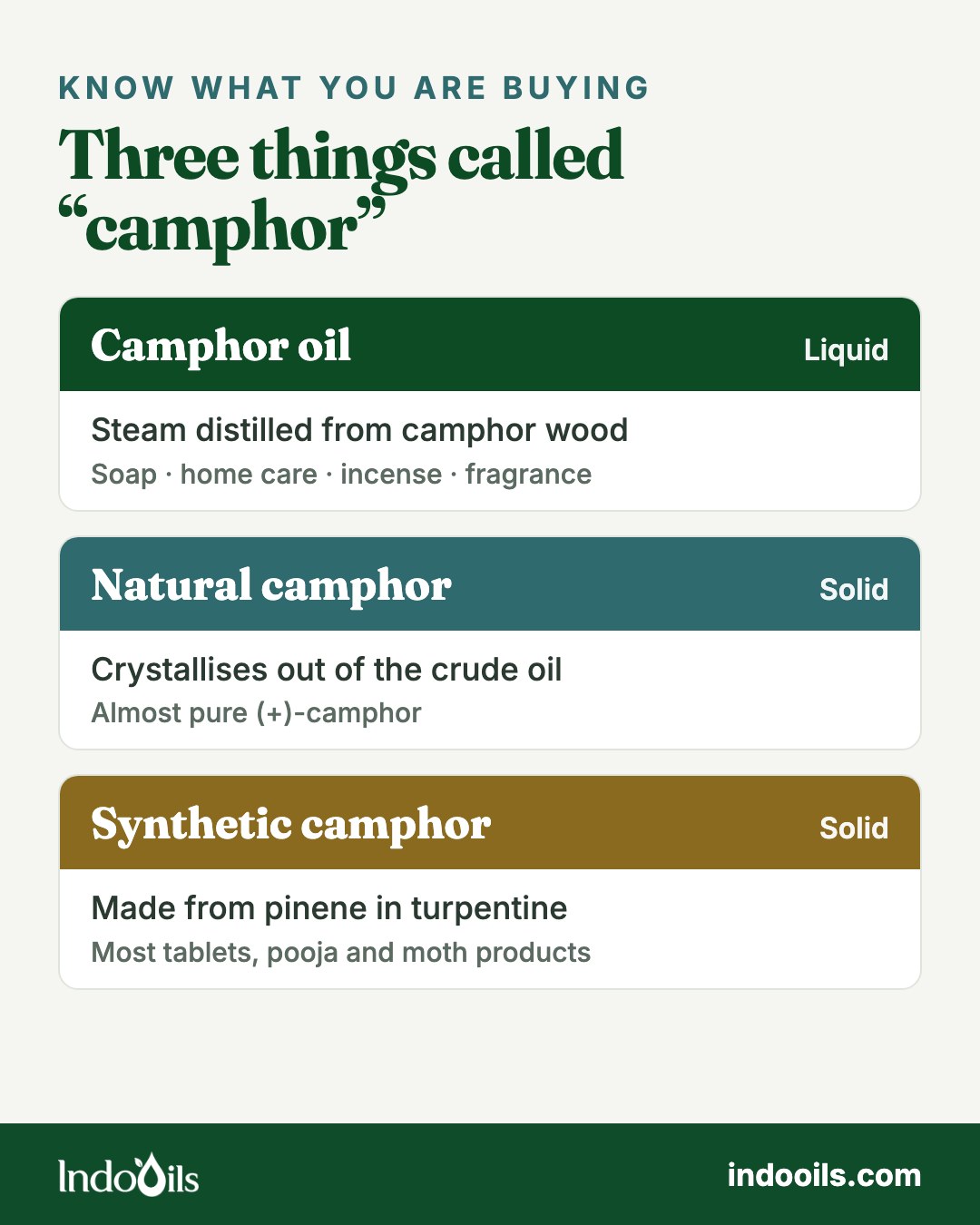
Buyers often use "camphor" for three different materials. Getting this right is the first line of any specification.
- Camphor oil is the volatile oil distilled from the wood of the camphor tree. It is a liquid, and its main constituents are 1,8-cineole, α-pinene, limonene and camphor itself.
- Natural camphor is the white, waxy solid that crystallises out of the crude oil during distillation. It is almost pure (+)-camphor, the form the tree makes.
- Synthetic camphor is made chemically from α-pinene. It is a racemic mix of the two mirror-image forms of camphor, and it supplies most of the tablet, pooja and moth-repellent market.
All three smell of camphor, but they are bought, tested, labelled and taxed as different products. This guide is about the oil.
Product identifiers
- Product: Camphor Essential Oil (white camphor oil)
- Botanical name: Cinnamomum camphora (L.) J.Presl
- INCI name: Cinnamomum Camphora Bark Oil
- CAS number: 8008-51-3
- HSN code: 33012941 (camphor oil)
- SKU: IND0032
- Plant part: Wood and bark
- Extraction method: Steam distillation, then rectification
- Origin: India
- Shelf life: 36 months, unopened
White, Brown and Yellow Camphor Oil
The crude oil that comes off the still is not sold as it is. After the solid camphor has been separated, the remaining oil is fractionally distilled into cuts with different boiling ranges, which the trade names by colour:
- White camphor oil is the lightest fraction. It is clear and colourless to pale yellow, rich in 1,8-cineole, pinene and limonene, and very low in safrole. It is the grade used in soaps, detergents, home care, incense and technical fragrance, and it is the grade IndoOils supplies.
- Brown and yellow camphor oils are heavier fractions. They are rich in safrole, a compound that is tightly restricted in cosmetics and banned as a food flavouring in many markets. They are not suitable for personal care or home fragrance.
When a quotation simply says "camphor oil", ask which fraction it is and ask for the safrole result on the CoA. A low price can mean a heavier cut.
Ravintsara and ho wood are camphor trees too
Cinnamomum camphora grows in several chemical types (chemotypes). Two of them are sold as separate oils:
- Ravintsara is the 1,8-cineole type, distilled from leaves in Madagascar. Don't confuse it with ravensara, which comes from a different tree.
- Ho wood and ho leaf are the linalool type, used as a natural source of linalool.
They share a botanical name with camphor oil, but they smell different and have their own specifications. Make sure your purchase order names the oil, not only the species.
How Camphor Oil Is Made
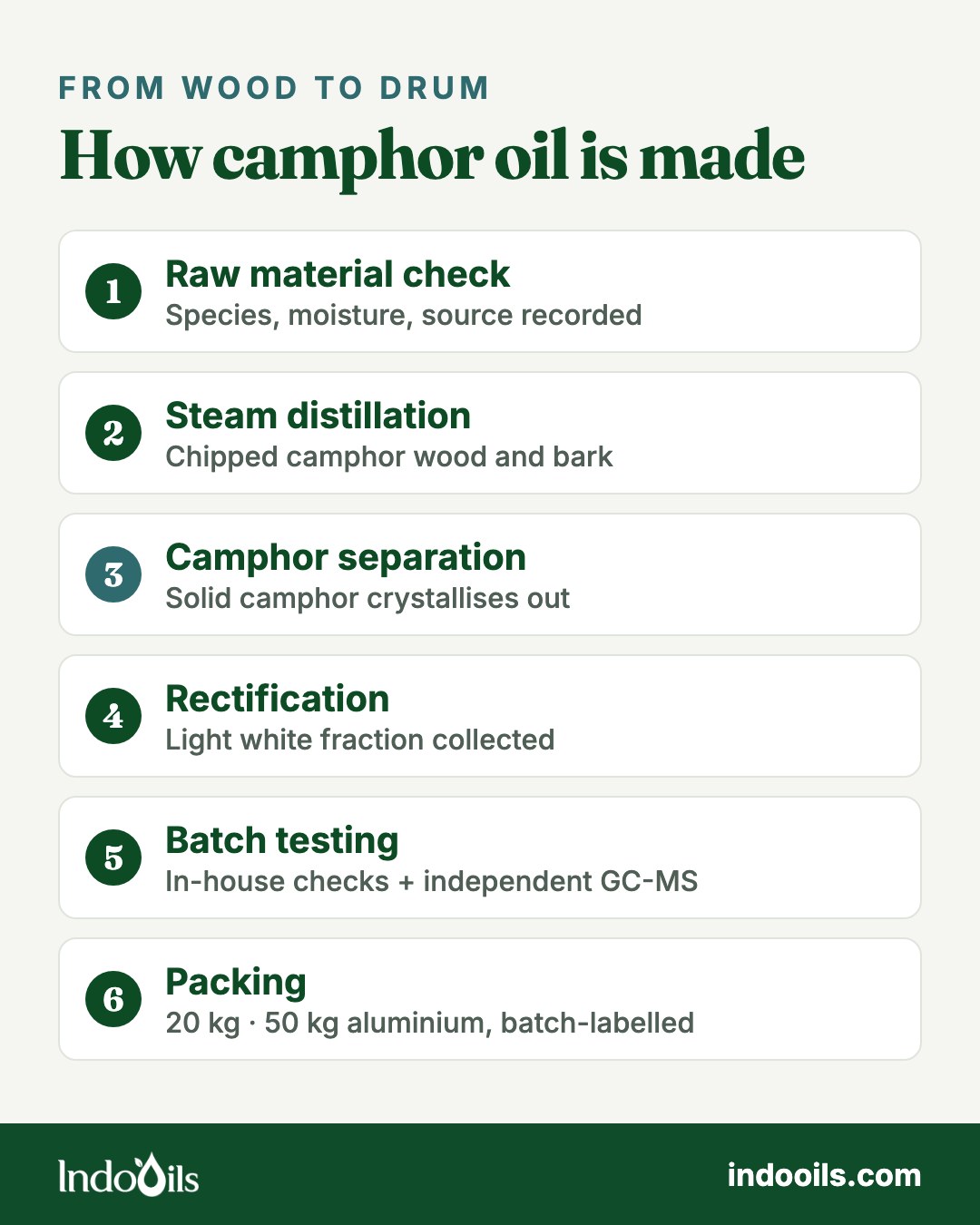
IndoOils' camphor oil is distilled in India by selected partner distillers and released only after IndoOils' own checks. The process follows the same path as our other steam-distilled oils, described on our manufacturing page, with one step that is unique to camphor.
- Raw material. Chipped wood and bark from Cinnamomum camphora is checked for species, moisture and foreign matter, and recorded with its source.
- Steam distillation. Steam passes through the chipped wood and carries the volatile oil to a condenser.
- Camphor separation. As the distillate cools, solid camphor crystallises out. It is separated from the oil and from the water.
- Rectification. The remaining crude oil is fractionally distilled, and the light white fraction is collected.
- Testing. Each batch is checked in-house and analysed by GC-MS at an independent laboratory before release.
- Packing. The oil is filled into clean 20 kg or 50 kg aluminium containers, sealed and labelled with its batch number.
Step 3 has a practical side effect for buyers: camphor oil can still deposit crystals on cold surfaces, such as the neck and cap of a container. This is normal and is covered under storage below.
What to Check on the Certificate of Analysis
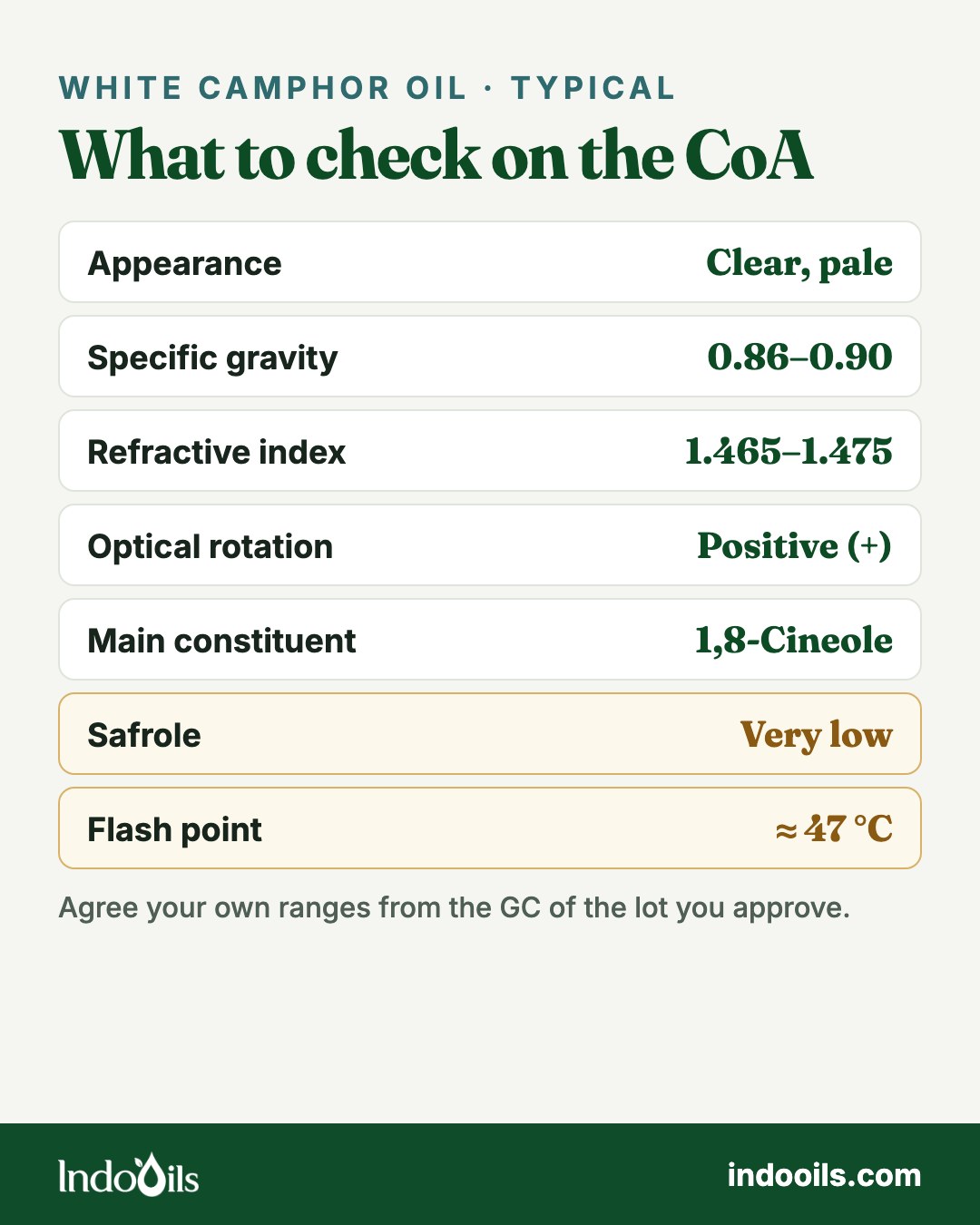
Camphor oil has no single international standard that everyone buys against, so it matters even more that you agree a written specification with your supplier. Published supplier and reference specifications for white camphor oil give these typical ranges:
- Appearance: clear, mobile liquid; colourless to pale yellow.
- Odour: fresh, sharp, camphoraceous and cineolic.
- Specific gravity: about 0.86–0.90 at 25 °C. Heavy, safrole-rich fractions are much denser, above 1.0, so a high figure is a warning sign.
- Refractive index: about 1.465–1.475 at 20 °C.
- Optical rotation: dextrorotatory (positive), typically between about +9° and +24°.
- GC profile: 1,8-cineole is usually the largest constituent, followed by α-pinene, limonene and camphor. One published GC-MS report on a commercial lot of white camphor oil found about 34 % 1,8-cineole, 16 % α-pinene, 13 % limonene and 10 % camphor.
- Safrole: reported on the GC; it should be very low for white camphor oil.
- Flash point: around 47 °C (closed cup), which makes it a flammable liquid for transport.
These figures describe the trade in general. Your contract ranges should come from the GC report on the lot you approve, and every later lot should be checked against it.
Spotting synthetic camphor and cut oils
Camphor oil is cheap compared with many essential oils, but it is still adulterated. The common tricks are:
- Synthetic camphor dissolved in turpentine or pinene. The camphor smell is there, but the GC shows the wrong balance of constituents. Chiral GC settles it: natural camphor is almost entirely (+)-camphor, while synthetic camphor is a 50:50 mix of both forms.
- Heavier fractions blended in. Raises specific gravity and the safrole figure.
- Thinning with cheaper terpenes or solvents. Shows up as a flat smell, a low cineole figure or a wrong refractive index.
Our quality assurance page explains how in-house checks and independent GC-MS work together, and the cosmetics importer checklist covers adulteration risks across the wider essential-oil range.
Where Camphor Oil Is Used
White camphor oil is a working ingredient. Most of it goes into products where a strong, clean, fresh note has to come through a demanding base:
- Soaps and detergents: bar soaps, laundry powders and liquids, where camphoraceous notes give a "clean" signal.
- Home care: phenyl and floor cleaners, toilet cleaners, disinfectant-style fragrances and room fresheners.
- Incense: agarbatti, dhoop, cones and sambrani blends, alongside resins, woods and spice oils.
- Insect-repellent and moth products: as a fragrance component. The finished product's maker holds the registration and decides what can be claimed.
- Balms, rubs and inhalers: a large Indian and Asian industry. Manufacturers use camphor oil as an ingredient under their own drug or Ayurvedic licences and are responsible for their formulas and label claims.
- Fragrance compounding: fougère, herbal, aromatic and "fresh" accords, usually in small amounts.
Camphor oil sits naturally with the other fresh, cineole-type oils in our range, such as Eucalyptus Essential Oil, Rosemary Essential Oil India, Cajeput Essential Oil and Peppermint Oil High Menthol. It also blends well with warm spice oils from its own genus, Cinnamomum: Cinnamon Leaf Essential Oil and Cinnamon Bark Essential Oil.
Safety, Regulation and Labelling
Camphor oil is a strong material, and buyers should treat it that way. The Safety Data Sheet that comes with each lot gives the full classification. Typical points for white camphor oil:
- Flammable liquid. It ships as UN 1130, Camphor oil, class 3. Keep it away from heat, sparks and open flame.
- Harmful or fatal if swallowed. Camphor is toxic by mouth, and small amounts can cause seizures in young children. Keep it, and every product made with it, out of reach of children.
- Aspiration hazard, like many terpene-rich oils.
- Skin and eye irritant, with a risk of skin sensitisation. It should never be applied undiluted.
The key regulatory points by market:
- EU cosmetics: safrole is listed in Annex II of Regulation (EC) No 1223/2009. Only its natural content in essential oils is allowed, up to 100 ppm in the finished cosmetic and 50 ppm in oral-care products, and it is not allowed in toothpaste for children. This is one reason to buy white camphor oil only, with a safrole result on the CoA.
- IFRA: safrole is also restricted under the IFRA Standards, so fragrance houses will ask for an IFRA statement.
- US over-the-counter drugs: FDA rules do not allow OTC drug products with more than 11 % camphor, and products labelled "camphorated oil" are not permitted. This matters to balm and rub makers who export to the US.
- Food: camphor oil is not a food ingredient, and IndoOils does not sell it for food or flavour use.
Labelling and claims on finished products are the manufacturer's responsibility. Use the SDS, IFRA statement and allergen information to complete your own safety assessment. Our post on fragrance allergen labelling explains how allergen declarations work for EU and UK products.
Documents to Ask For
Every IndoOils order ships with a batch-specific CoA. For camphor oil, ask for this set before approving a supplier:
- Certificate of Analysis (CoA) with appearance, specific gravity, refractive index and optical rotation, plus a GC-MS breakdown including 1,8-cineole, camphor and safrole.
- GC-MS report from the independent laboratory, and chiral GC if you need proof of natural origin.
- Safety Data Sheet (SDS) with GHS classification and transport details.
- IFRA statement for fragrance, personal-care and home-care use.
- Allergen declaration for cosmetic use in the EU and UK.
- Certificate of origin for export shipments and for any "Indian origin" claim.
Standard templates are on the downloads page. IndoOils works under an ISO 9001:2015 quality system and follows GMP; see certifications.
Packing, Storage and Shelf Life
- Supplied in 20 kg and 50 kg aluminium containers, sealed and labelled with the batch number, net weight and dates.
- Store at 15–25 °C in a dry, well-ventilated place, out of direct sunlight and away from ignition sources.
- Keep containers tightly closed and the headspace small. Camphor evaporates and sublimes easily, so a loose cap loses product and can leave crystals around the neck.
- If crystals have formed, warm the closed container gently, for example in a warm room, and roll it so they dissolve before you sample or dispense. Never use an open flame.
- Shelf life is 36 months unopened. Once opened, use within about 12 months.
How to Order Camphor Oil in Bulk
Camphor Essential Oil ships from India in 20 kg and 50 kg aluminium packs, with a minimum order of one pack. Prices are quoted on request and depend on volume, destination and contract length.
- Request a quotation: send a bulk inquiry with your application (soap, home care, incense, fragrance, balm), the annual volume you expect and any specification you already buy against.
- Approve a sample first: request a sample with its CoA for lab and sensory approval, and keep it as your reference.
- Need your own pack or blend? See our private label and custom formulation services.
Export shipments include a commercial invoice, packing list and certificate of origin, and camphor oil is packed and labelled as a class 3 flammable liquid.
Frequently Asked Questions
Is camphor oil the same as camphor crystals?
No. Camphor oil is the liquid essential oil distilled from the camphor tree. Camphor crystals are the solid that separates from that oil, or, in most Indian tablets, a synthetic version made from turpentine.
What is white camphor oil?
It is the lightest fraction of rectified camphor oil: clear, fresh, rich in 1,8-cineole and very low in safrole. It is the grade used in soaps, home care, incense and fragrance.
Is your camphor oil natural?
Yes. It is steam distilled in India from Cinnamomum camphora and analysed by GC-MS at an independent laboratory. Chiral GC can be supplied on request.
Does it contain safrole?
White camphor oil contains only a very small natural amount. The figure for your lot is shown on the GC report, so you can check it against the EU and IFRA limits for your product.
What is the HSN code for camphor oil?
India's tariff lists camphor oil under 33012941, with GST at 18 %. Confirm the code with your customs agent for your own shipments.
Can camphor oil be used in food?
No. Camphor oil is not sold for food or flavour use.
What is the minimum order?
One 20 kg pack. 50 kg packs are also available, and a sample can be sent before you order in bulk.
For more buyer's guides, see our posts on peppermint oil, lavender oil, sandalwood oil and vetiver oil, or browse the full essential oils range.
Buying in bulk?
20 kg and 50 kg packs, with a certificate of analysis for every lot.
Tell us the product, quantity and destination, and we will come back with a quotation.