Amla is one of the best-known names in Indian hair care. Brands around the world now want it on their labels too, and that is where buying gets complicated. Ask five suppliers for "amla oil" and you can receive five different things: a pressed seed oil, sesame oil with amla fruit cooked into it, a mineral-oil hair tonic, or a water-based fruit extract with no oil in it at all.
This guide is about the first of those: amla seed oil, the fixed oil pressed from the seeds of the amla fruit. It explains what the oil is and how it differs from the other "amla oils", how it is made, what is inside it, which tests matter and which documents to ask for.
It covers Amla Seed Oil from IndoOils, and it is written for formulators, buyers and brand owners in cosmetics and hair care.
What Amla Seed Oil Is
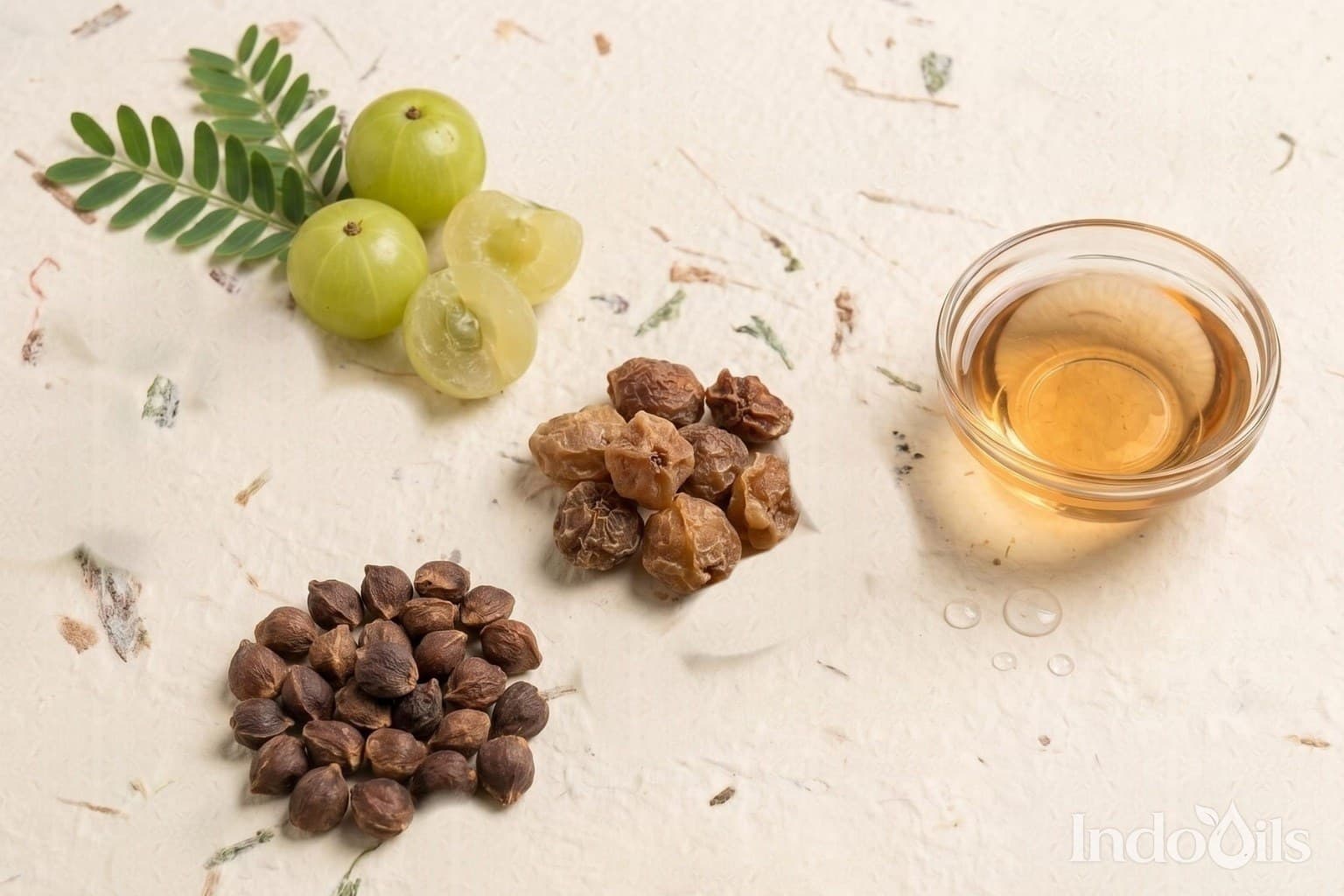
Amla (Phyllanthus emblica, formerly Emblica officinalis) is a tree native to India and South-East Asia. Its fruit is the Indian gooseberry, called amla or aonla in Hindi and amalaki in Sanskrit. The fruit is round, pale green and sour, with six faint vertical lines on the skin.
Inside each fruit is a hard, six-ribbed stone. The stone holds six small, three-sided, reddish-brown seeds, two in each of its three chambers. Those seeds hold roughly 16 to 19 per cent oil.
Amla seed oil is the fixed oil pressed from those seeds. "Fixed" means it does not evaporate: it is a vegetable oil made of triglycerides, like sesame or sunflower oil, not an essential oil.
India grows almost all of the world's commercial amla, mainly in Uttar Pradesh, Madhya Pradesh, Gujarat, Rajasthan and Tamil Nadu. The fruit is processed in large volumes for juice, powder, candy and murabba (preserve). The stones are a by-product of that processing, and the seeds inside them are the raw material for the oil.
Product identifiers
- Product: Amla Seed Oil (Cold Pressed Carrier Oil)
- Botanical name: Phyllanthus emblica (synonym Emblica officinalis)
- INCI name: Phyllanthus Emblica Seed Oil
- CAS number: 90028-28-7
- EC (EINECS) number: 289-817-3
- HSN code: 15159099
- SKU: INDO-104
- Plant part: Seeds
- Extraction method: Cold pressed
- Origin: India, stated per lot
Seed Oil, Infused Oil, Hair Oil or Extract
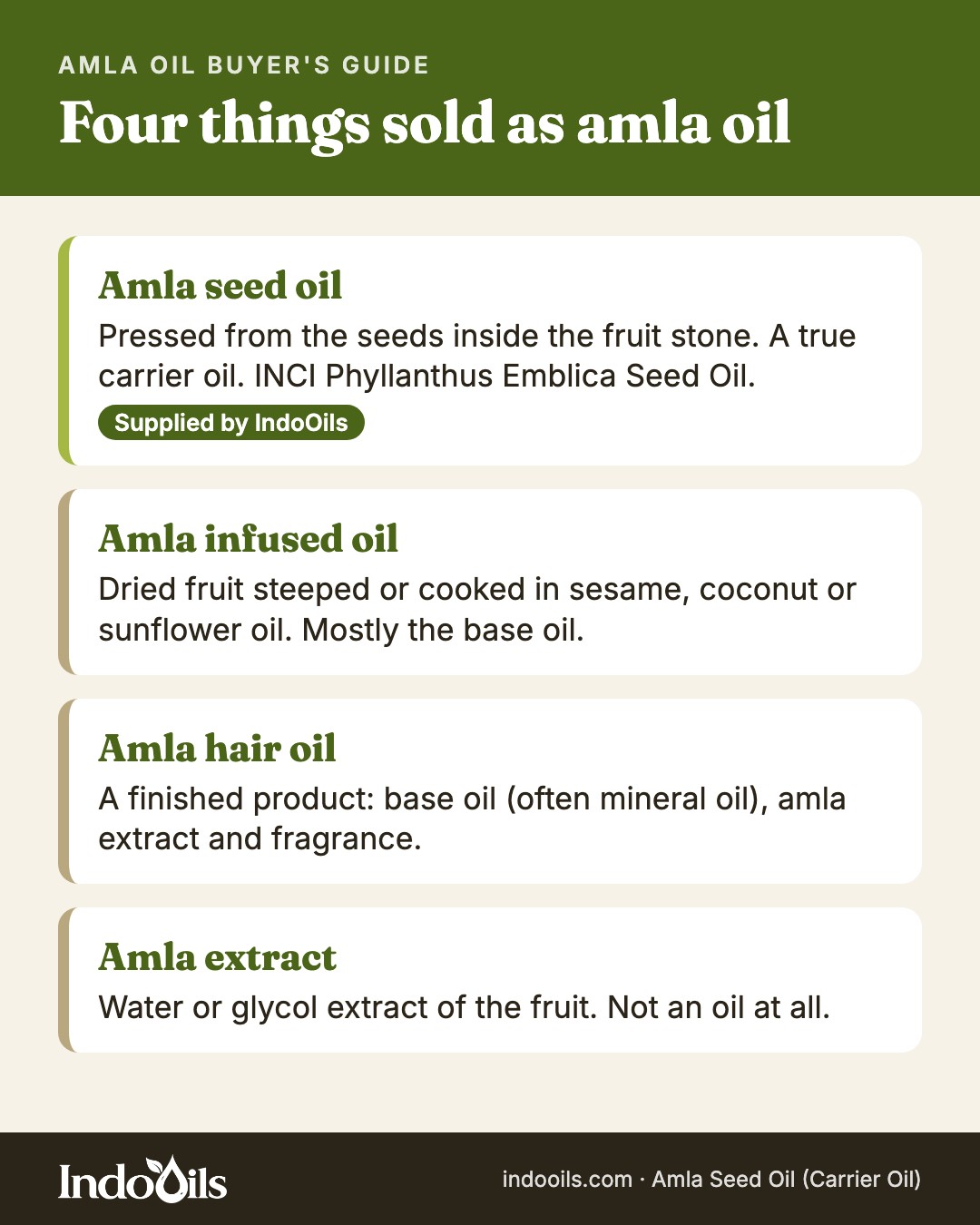
The word "amla" on an oil can mean four different products, so be precise in every enquiry:
- Amla seed oil is pressed from the seeds. It is a true carrier oil in its own right, with its own INCI name, Phyllanthus Emblica Seed Oil. This is the oil IndoOils supplies.
- Amla infused oil (also sold as amla macerated oil) is made by steeping or slowly cooking dried amla fruit in another oil, usually sesame, coconut or sunflower. Classical Ayurvedic amla oils are made this way. The result is mostly the base oil; its INCI lists the base oil and the fruit extract.
- Amla hair oil is a finished consumer product. Mass-market versions are often based on light liquid paraffin (mineral oil), with a little amla extract, colour and fragrance.
- Amla extract is a water, glycol or hydro-alcoholic extract of the fruit. It is where amla's vitamin C and tannins end up, and it is not an oil at all. IndoOils supplies it separately as Amla Extract.
Do not confuse amla with bhui amla (Phyllanthus niruri), a different, low-growing herb that shares part of the name. Our Bhuiamla Extract comes from that plant.
The practical point for a buyer: if your label says amla seed oil, your supplier's documents must show a pressed seed oil. A cheaper "amla oil" quote may be an infusion, and the fatty acid profile on a GC report will show it (more on that below).
What about vitamin C?
Amla fruit is famous for its vitamin C. That reputation does not carry over to the seed oil. Vitamin C dissolves in water, not oil, and it is in the fruit flesh, not the seed. A pressed seed oil carries no meaningful vitamin C, so it should never be marketed as a vitamin C ingredient. If vitamin C or fruit tannins are what your formula needs, use the fruit extract.
How Amla Seed Oil Is Made
The process is short, and the slow step is getting at the seeds:
- Stones. Amla stones are collected where the fruit is processed for juice, pulp, powder or preserves.
- Drying. The stones are dried, traditionally in the sun, until they crack open along their seams.
- Seed separation. The small seeds fall out of the split stones and are cleaned and sorted from the shell pieces.
- Pressing. The seeds are pressed in an expeller. For cold-pressed oil, the temperature is kept low to protect colour, smell and stability.
- Clarifying. The oil is settled and filtered.
- Testing and packing. Each lot is tested and filled into full, sealed packs.
Each fruit gives only six small seeds, and the seeds give well under a fifth of their weight as oil, so amla seed oil is a small-volume speciality oil. Plan larger orders ahead and ask about lead times when you enquire.
What Is Inside Amla Seed Oil
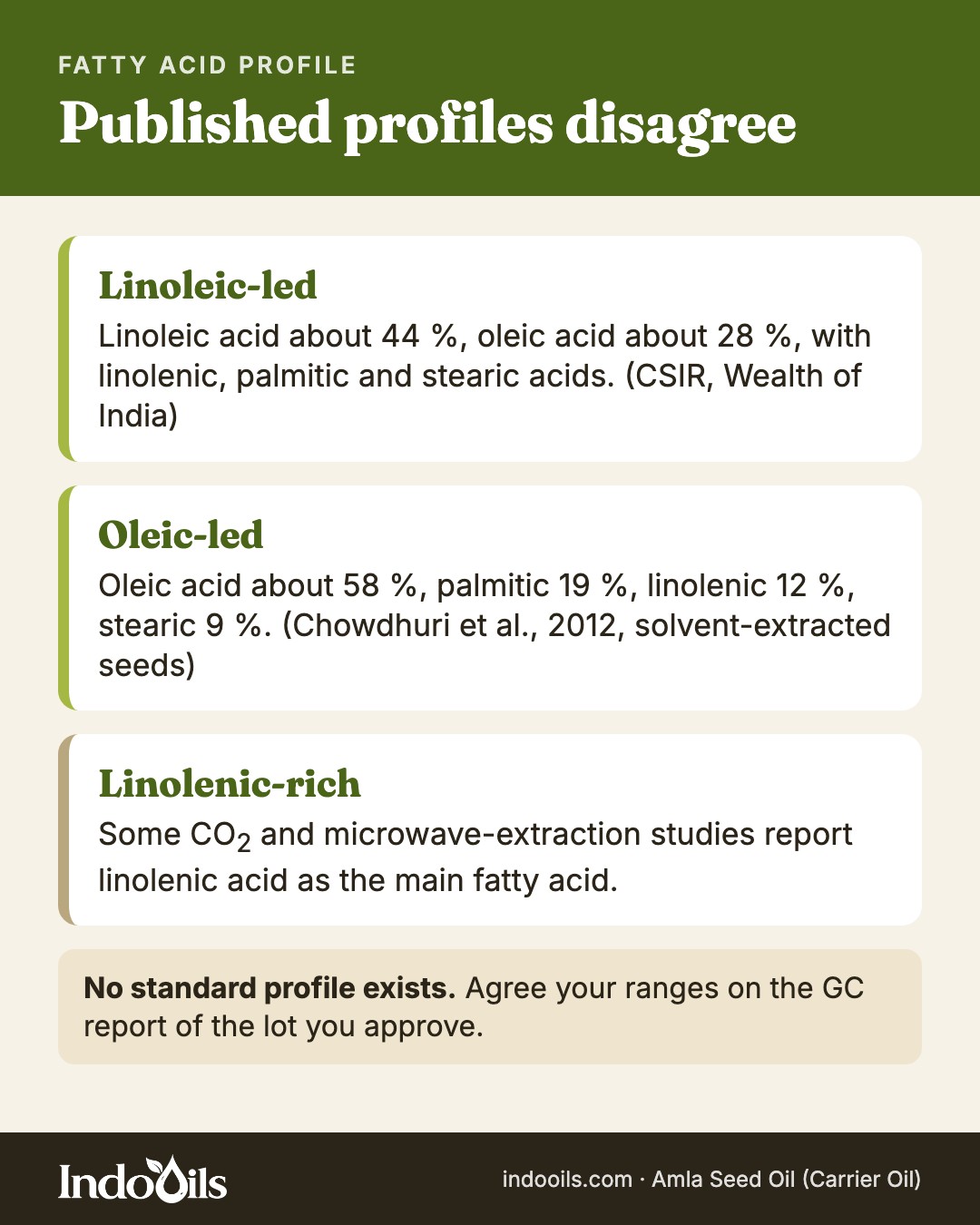
For most carrier oils a buyer can quote a textbook fatty acid profile. For amla seed oil the published sources disagree, and it is better to know that before you write a specification:
- A linoleic-led profile. The figures in India's standard botanical reference, the CSIR Wealth of India, describe an oil with about 44 % linoleic acid and about 28 % oleic acid, plus linolenic, palmitic and stearic acids.
- An oleic-led profile. A 2012 study of solvent-extracted seeds from West Bengal (Chowdhuri and colleagues) found about 58 % oleic acid, 19 % palmitic acid, 12 % linolenic acid and 9 % stearic acid.
- A linolenic-rich profile. Some studies using supercritical CO₂ or microwave-assisted extraction report linolenic acid as the main fatty acid.
The differences probably come from seed source, variety, extraction method and how the samples were handled. What every source agrees on is that the oil is highly unsaturated, and that it contains a noticeable share of polyunsaturated fatty acids (linoleic and linolenic). In practice that means two things:
- Agree your specification on a real lot. There is no Indian or international standard for amla seed oil. Approve a sample, and set your fatty acid ranges from its GC report rather than from a literature figure.
- Treat it as an oxidation-sensitive oil. Oils rich in linoleic and linolenic acid go rancid faster than oleic-rich oils such as olive or apricot kernel. Protect it from air, light and heat, and consider an antioxidant in finished products.
What to Check on the CoA
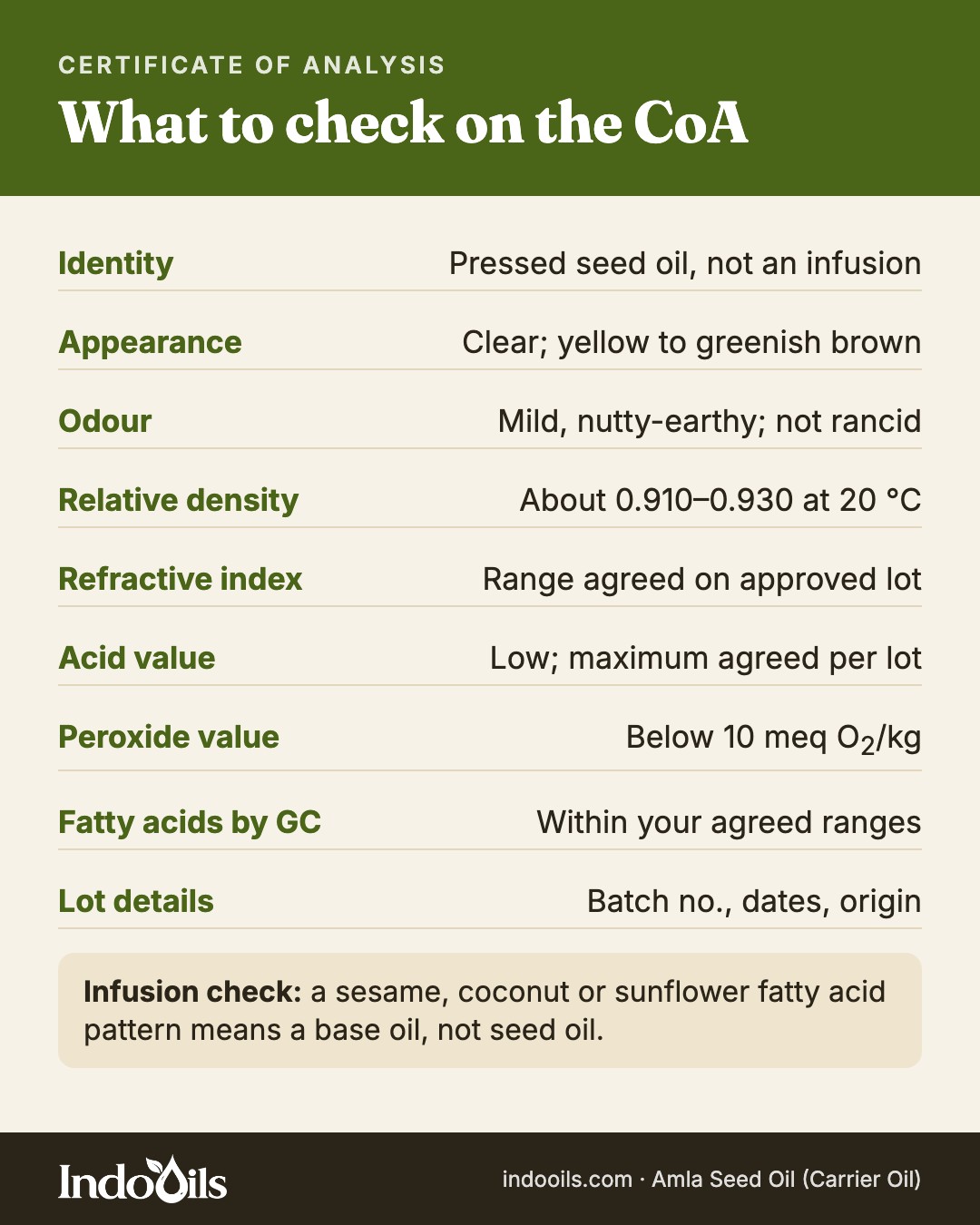
A good Certificate of Analysis for amla seed oil proves identity, freshness and traceability:
- Identity and method: the CoA or a separate statement should say the oil is pressed from Phyllanthus emblica seeds, and how (cold pressed, expeller pressed or solvent extracted).
- Appearance and colour: a clear oily liquid, yellow to greenish brown. Colour varies between lots; agree a range on your approved sample.
- Odour: mild, nutty and earthy. A sharp, paint-like or "crayon" smell means the oil has oxidised.
- Relative density: about 0.910–0.930 at 20 °C, the range Indian supplier specifications agree on.
- Refractive index: published supplier figures vary too widely to quote one range. Record the value of the lot you approve and agree a narrow window around it.
- Acid value (free fatty acids): should be low. A high or rising acid value points to old or badly stored seed, or old oil. Agree a maximum on your specification.
- Peroxide value: below 10 meq O₂/kg is a common cosmetic specification for carrier oils. It is the first number to rise as the oil ages, so recheck older stock.
- Fatty acid profile by GC: within the ranges you agreed on the approved lot.
- Lot details: batch number, manufacturing and best-before dates, and country of origin.
Seed oil or infusion: how to tell
The fatty acid profile is the quickest test. An "amla oil" that is really amla fruit infused in a base oil will show the fatty acid pattern of that base:
- Sesame oil shows roughly equal oleic and linoleic acid, around 40 % each.
- Coconut oil is mostly lauric and myristic acid, which amla seed oil does not contain in any quantity.
- Sunflower oil is either very high in linoleic acid (standard) or very high in oleic acid (high-oleic).
- Mineral oil has no fatty acids at all.
Ask for the GC report of the actual lot, keep a retained sample of every lot you receive, and compare new lots against your approved one.
Where Amla Seed Oil Is Used
Amla seed oil earns its place in a formula as a genuine amla ingredient that is also a functional carrier oil:
- Hair oils. The main use. Brands blend it with coconut, sesame, black cumin seed or neem oil, often with herbal infused oils, so the amla on the label is a real amla oil rather than only an extract.
- Pre-wash oils, hair serums and leave-in products. As part of the oil blend, usually alongside lighter oils such as jojoba or argan.
- Scalp-care cosmetics. Scalp oils and scalp massage oils, as a cosmetic product.
- Herbal and Ayurvedic-style cosmetics. Combined with amla fruit extract, shikakai or reetha extracts in hair-care ranges built around Indian botanicals.
- Skincare and body care. A minor share of the oil phase in face oils, creams, lotions, balms and body butters.
- Soap and cleansing oils. As part of the oil blend in cold-process soaps.
- Fragranced hair oils. Its mild smell sits under essential oils such as rosemary, Himalayan cedarwood, lavender and ylang ylang.
Brands building a private-label hair range on amla can read our private label guide. For the other oils we supply, see the carrier oils category and our carrier oils for cosmetics guide.
Safety and Cosmetic Rules
Handling
Amla seed oil is a vegetable oil, and we have found no GHS hazard classification for it. The practical risks are the ordinary ones for oils in a factory:
- Spills are slippery. Absorb them with sand or an inert absorbent and clean the floor.
- Oily rags can self-ignite. Cloths and absorbents soaked in an unsaturated oil can heat up as the oil oxidises, and amla seed oil is highly unsaturated. Spread them out to dry or keep them in a closed metal bin with water.
- Flash point is high, as for other vegetable oils, so the oil is not a fire risk in normal storage. Check the figure on your supplier's SDS.
Cosmetics
Use the INCI name Phyllanthus Emblica Seed Oil on your label. Older documents may say Emblica Officinalis Seed Oil; it is the same plant under its former botanical name, but use one name consistently across your product file.
Amla seed oil is not a restricted cosmetic ingredient, and it is not a fragrance allergen. As with any plant oil, include it in your product safety assessment, and patch-test the finished product.
Keep your claims cosmetic. Phrases like "conditions hair" or "adds shine" describe a cosmetic effect. Claims that a product treats hair loss, dandruff or a scalp condition turn it into a medicine in most markets, including the EU, UK and USA, whatever the ingredient.
Food
Amla seed oil is not a recognised edible oil, and IndoOils supplies it for cosmetic use only. Amla in food and supplements is the fruit, its juice or powder, not the seed oil.
Documents to Ask For
For every lot, ask for:
- Certificate of Analysis with the checks listed above.
- Fatty acid profile by GC.
- Manufacturing method statement: pressed from amla seeds, and how.
- Safety Data Sheet (SDS) in the format your country requires. European buyers can ask us for an EU-format (CLP) SDS and a REACH status statement.
- Country of origin.
- Composition statement (100 % amla seed oil, no carrier or additives, or the antioxidant used if any) and an allergen statement.
Many cosmetic buyers also ask for a pesticide-residue report and statements on GMOs, BSE/TSE and animal testing. Tell us what your regulatory file needs when you enquire. Our cosmetics importer's checklist lists the paperwork buyers usually collect.
For customs, amla seed oil is a fixed vegetable oil, not an essential oil. In India it falls under heading 1515 ("other fixed vegetable fats and oils"), with HSN 15159099, and GST at 5 %. Confirm the code with your customs agent.
Packing and Storage
IndoOils supplies amla seed oil in 25 kg and 50 kg packs and 200 kg drums, minimum order one pack. Each pack is filled full, sealed and labelled with its batch number.
Because the oil is rich in polyunsaturated fatty acids, storage matters more than for most carrier oils:
- Store it in the original closed container at 10–25 °C, in a cool, dry, dark place.
- Keep packs full. Flush part-used packs with nitrogen before closing, and use opened packs within about six months.
- Follow the shelf life on the CoA for each lot.
- Check the smell and peroxide value of older stock before you use it.
- In finished products, a low level of tocopherol (vitamin E) or another antioxidant helps the oil keep.
How to Order
- Request a sample through our sample request page (see our sample policy). Test it in your own formula, and check the smell, colour and feel.
- Approve a specification from the sample's CoA and GC report: fatty acid ranges, acid and peroxide maximums, density and refractive index.
- Send a bulk inquiry through our bulk inquiry form with the quantity, pack size, destination and documents you need. We reply with a quotation and lead time.
- Receive the lot with its CoA and SDS, and check them against your approved specification.
Frequently Asked Questions
Is amla seed oil the same as amla oil?
Not always. "Amla oil" is used for several products: pressed amla seed oil, amla fruit infused in a base oil, finished amla hair oils and even amla extracts. Amla seed oil is the oil pressed from the seeds, with the INCI name Phyllanthus Emblica Seed Oil. Ask your supplier which one you are being offered.
Does amla seed oil contain vitamin C?
No meaningful amount. Vitamin C is water-soluble and sits in the fruit flesh, not the seed, so it does not pass into a pressed seed oil. For vitamin C or amla tannins, use an amla fruit extract.
What is the fatty acid profile of amla seed oil?
Published analyses disagree: some show an oil led by linoleic acid, others one led by oleic acid with a notable share of linolenic acid. All agree it is highly unsaturated. There is no standard for this oil, so agree your ranges on the GC report of the lot you approve.
How can I tell seed oil from an infused amla oil?
Ask for a fatty acid profile by GC. An infused oil shows the pattern of its base oil: sesame, coconut, sunflower, or no fatty acids at all for mineral oil. Also ask for the manufacturing method in writing.
What is the HSN code for amla seed oil?
In India, amla seed oil falls under heading 1515. Use 15159099 for cosmetic-grade oil. It is not an essential oil, so codes under 3301 do not apply. Confirm with your customs agent.
How long does amla seed oil keep?
It keeps less well than oleic-rich oils, because it is rich in polyunsaturated fatty acids. Follow the shelf life on the CoA, store it cool, dark and closed, use opened packs within about six months, and check older stock before use.
Where does your amla seed oil come from?
Our amla seed oil is of Indian origin, pressed from seeds recovered from amla fruit processing, and reaches us through our partner network. The country of origin is stated on the CoA for every lot.
More Buyer's Guides
- Bulk Carrier Oils for Cosmetics: A Formulator's Buying Guide
- Bulk Apricot Kernel Oil: A Buyer's Guide
- Private Label Essential Oils from India: A Brand Owner's Guide
- Bulk Vetiver (Khus) Oil from India: A Buyer's Guide
- Sourcing Essential Oils for Cosmetics: An Importer's Checklist
Ready to buy? Request a sample or send a bulk inquiry, and tell us your application and the documents you need.
Buying in bulk?
25 kg, 50 kg and 200 kg packs, with a certificate of analysis for every lot.
Tell us the product, quantity and destination, and we will come back with a quotation.