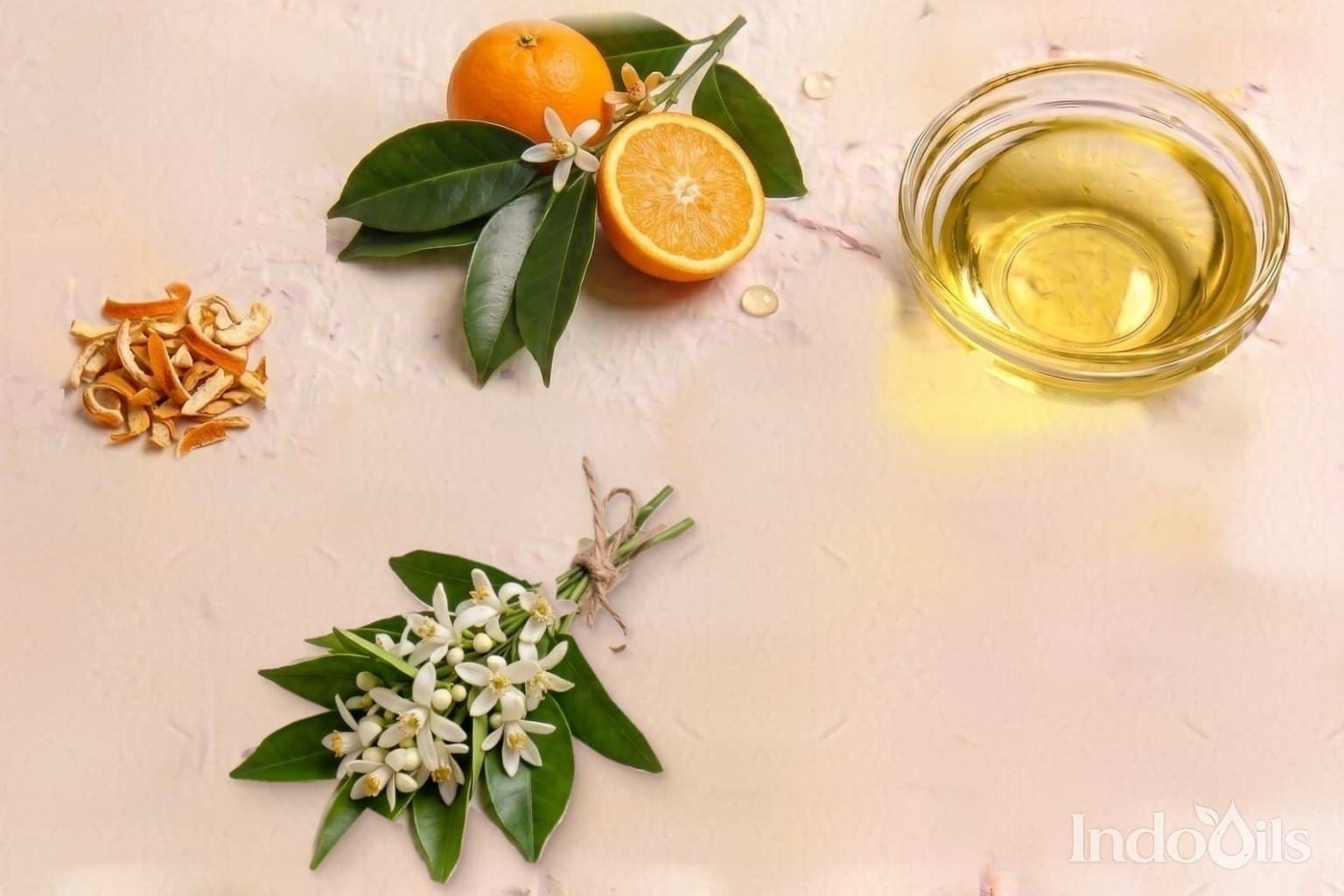
Bitter orange oil is the citrus oil behind the classic taste of orange liqueurs and marmalade, and behind the fresh, dry citrus opening of many colognes. It is pressed from the peel of the bitter orange, also called the Seville orange or bigarade: a fruit far too sour to eat fresh, grown for its peel, its juice, its blossom and its oils.
It is a much smaller market than sweet orange oil, and buyers often treat the two as interchangeable. They are not. Bitter orange oil smells different, carries a different set of minor compounds, and has a safety rule that sweet orange oil does not: it is phototoxic, so IFRA limits how much can go into leave-on skin products.
This guide covers Bitter Orange Essential Oil from IndoOils: what it is, how it is made, what is in it, which tests matter, which rules apply, where it is used and how to order it in bulk.
Bitter Orange, Sweet Orange, Neroli: Getting the Name Right
The bitter orange tree, Citrus aurantium, is one of the most useful plants in perfumery and flavour. One tree gives three different essential oils, and the fruit is often confused with its sweeter cousin:
- Bitter orange oil (this oil) is cold pressed from the peel of the fruit. Trade names include Seville orange oil, bigarade oil and orange bigarade.
- Neroli is steam distilled from the blossom of the same tree. It smells floral and honeyed, and costs many times more than the peel oil. See Neroli (Orange Blossom) Essential Oil.
- Petitgrain bigarade is steam distilled from the leaves and young twigs. It smells green and woody-floral, and most of it comes from Paraguay.
- Orange flower water is the distillation water left after making neroli. It is a food and cosmetic ingredient in its own right.
- Sweet orange oil comes from a different tree, Citrus sinensis: the common eating and juice orange. When a specification says only "orange oil", it means sweet orange. See Sweet Orange Essential Oil and our sweet orange oil buyer's guide.
Bitter orange is also sometimes called sour orange. Older texts give it the subspecies name Citrus aurantium subsp. amara, and that is where the cosmetic ingredient name comes from.
Product identifiers
- Product: Bitter Orange Essential Oil (Cold Pressed)
- Botanical name: Citrus aurantium L. (bitter orange, Seville orange)
- INCI name: Citrus Aurantium Amara (Bitter Orange) Peel Oil
- CAS number: 68916-04-1 (72968-50-4 is also used)
- EC number: 277-143-2
- FEMA number: 2823
- ISO standard: ISO 9844:2006, Oil of bitter orange
- HSN code: 33011200 (essential oils of orange)
- SKU: IND0026
- Plant part: Fresh fruit peel
- Extraction method: Cold expression
- Main constituent: d-limonene, typically 92–95 %
One Tree, Three Oils
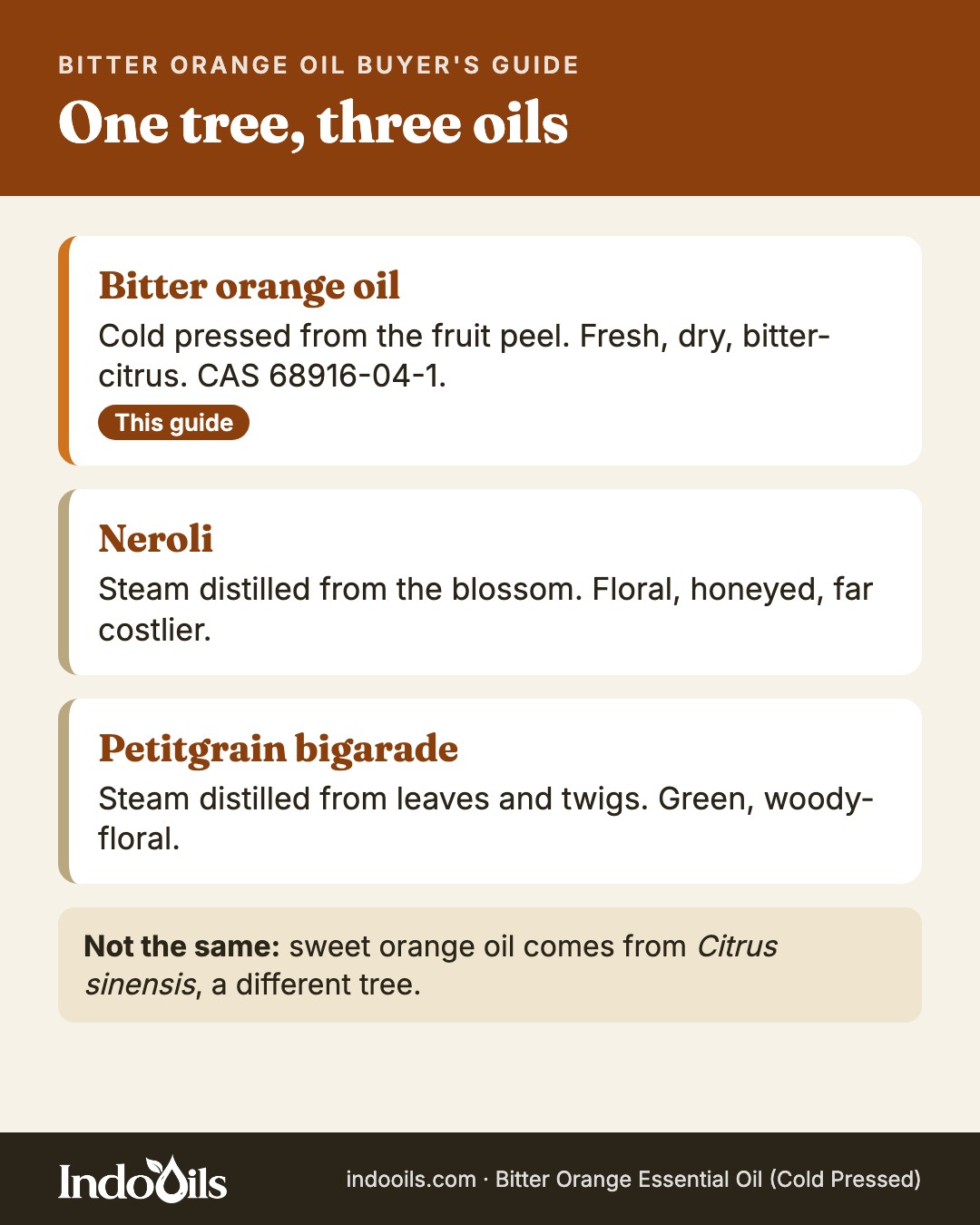
The three oils of the bitter orange tree are made in different seasons, by different methods, and for different buyers. The blossom is picked in spring for neroli. The leaves and twigs are cut from pruning for petitgrain. The fruit is picked in winter, and its peel gives bitter orange oil.
For a buyer, the point is simple: "orange oil from Citrus aurantium" could mean any of the three. Your order, your specification and every document should name the plant part and the method, not just the botanical name. A peel oil sold against a neroli specification, or a petitgrain sold as bitter orange, will fail on odour and on the GC report at once.
Bitter orange oil itself also comes in more than one form:
- Cold-pressed oil is the oil as it comes off the peel, after centrifuging, chilling and filtering. This is what IndoOils supplies, and it is the standard grade for flavour and fragrance.
- Folded or terpeneless oil has had part or all of the limonene removed under vacuum. It is stronger and more stable. IFRA asks that its phototoxicity limit be lowered in proportion to the concentration.
- Furocoumarin-free (FCF) oil has been treated to remove the compounds that cause phototoxicity. It is mostly made for bergamot; for bitter orange it is rare and should be specified and certified separately.
- Distilled oil is steam distilled from peel or pressed oil. It smells flatter and has almost no non-volatile part.
How Bitter Orange Oil Is Made
Bitter orange oil is pressed, not distilled, in much the same way as sweet orange oil:
- Harvest: the fruit is picked in winter, usually from December to March. The main producers are Spain, where Seville and the rest of Andalusia are lined with bitter orange trees, and Italy, mainly Sicily and Calabria. Smaller volumes come from Brazil and West Africa.
- Cold pressing: machines rasp or press the whole fruit or the peel to break the oil glands in the coloured outer layer. A spray of water rinses the oil off as an emulsion.
- Centrifuging: the emulsion is spun to separate the oil from the water and peel solids, then polished to clear oil.
- Winterising: the oil is chilled so that natural peel waxes settle out, then filtered. Oil that is not winterised properly turns cloudy in the cold.
- Testing and packing: each lot is tested and packed with as little air as possible.
Unlike sweet orange oil, bitter orange oil is not a by-product of a huge juice industry. The fruit is processed for marmalade, candied peel and liqueur peel, and the oil comes with that. Supply is therefore smaller and more seasonal, and a poor winter in Andalusia or Sicily is felt quickly in price and availability. Our post on climate volatility and wholesale pricing explains how to plan for swings like that.
What Is Inside Bitter Orange Oil
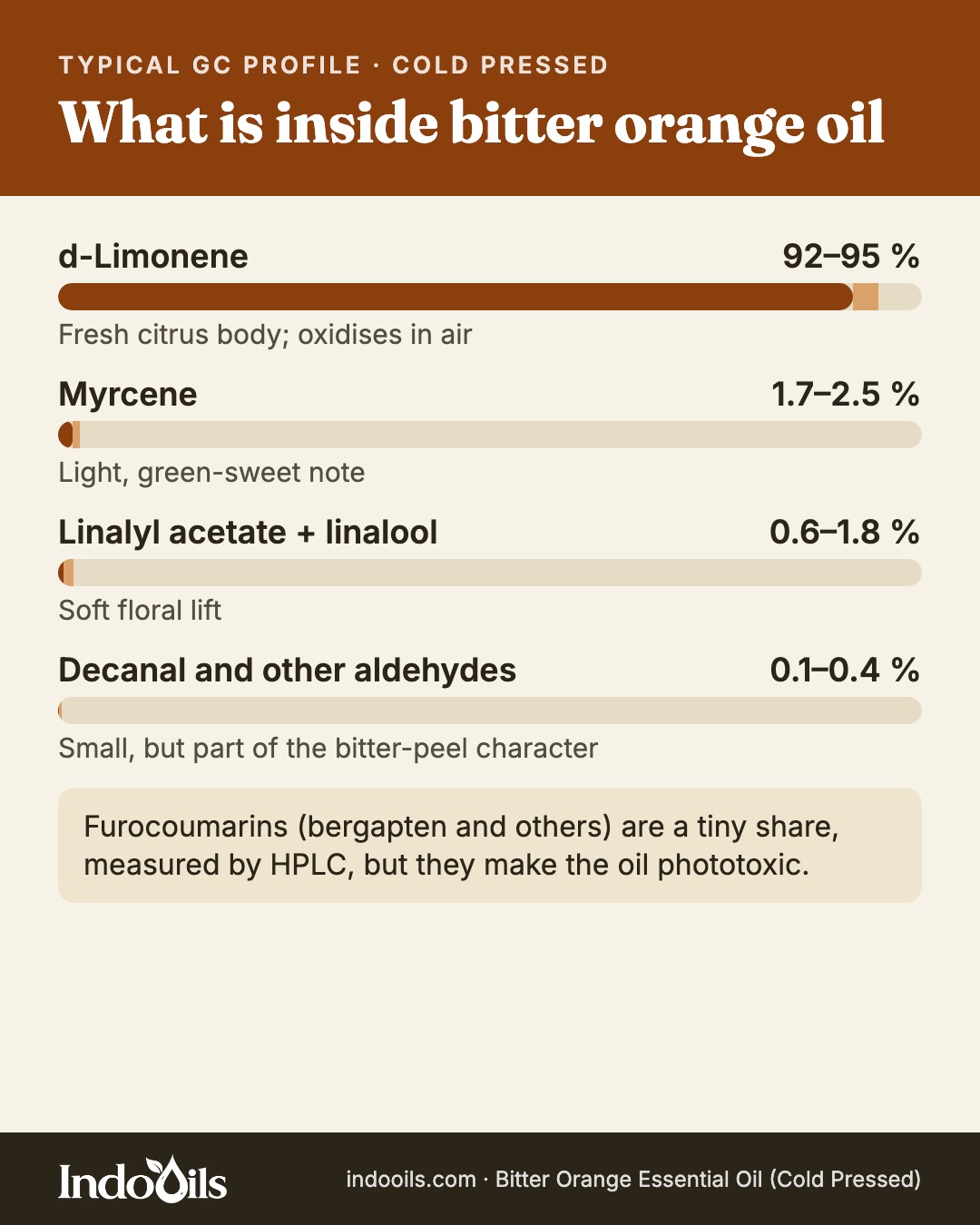
On a GC-MS report, bitter orange oil looks a lot like sweet orange oil at first glance. Most of it is limonene. The difference is in the small peaks, and those are what a buyer pays for:
- d-Limonene, 92–95 %: the fresh, clean citrus body of the oil. It is also what oxidises when the oil is exposed to air.
- Myrcene, about 1.7–2.5 %: a light, green-sweet note.
- Linalyl acetate and linalool, together about 0.6–1.8 %: a soft floral lift. Bitter orange oil usually carries more of these than sweet orange oil does, and they are part of its "dry" character.
- Decanal and other aldehydes, about 0.1–0.4 %: less than in sweet orange oil, which is one reason bitter orange smells less juicy.
- Non-volatile part: pressed oil also carries waxes, flavonoids and furocoumarins such as bergapten and epoxybergamottin. They are a tiny share of the oil and are measured by HPLC rather than on the routine GC report, but they are why the oil is phototoxic.
The figures vary with origin, season and processing. Spanish and Italian oils differ slightly, and oils from other regions differ more. Build your specification on the GC report of an approved lot, not on a textbook range.
What to Check on the Certificate of Analysis
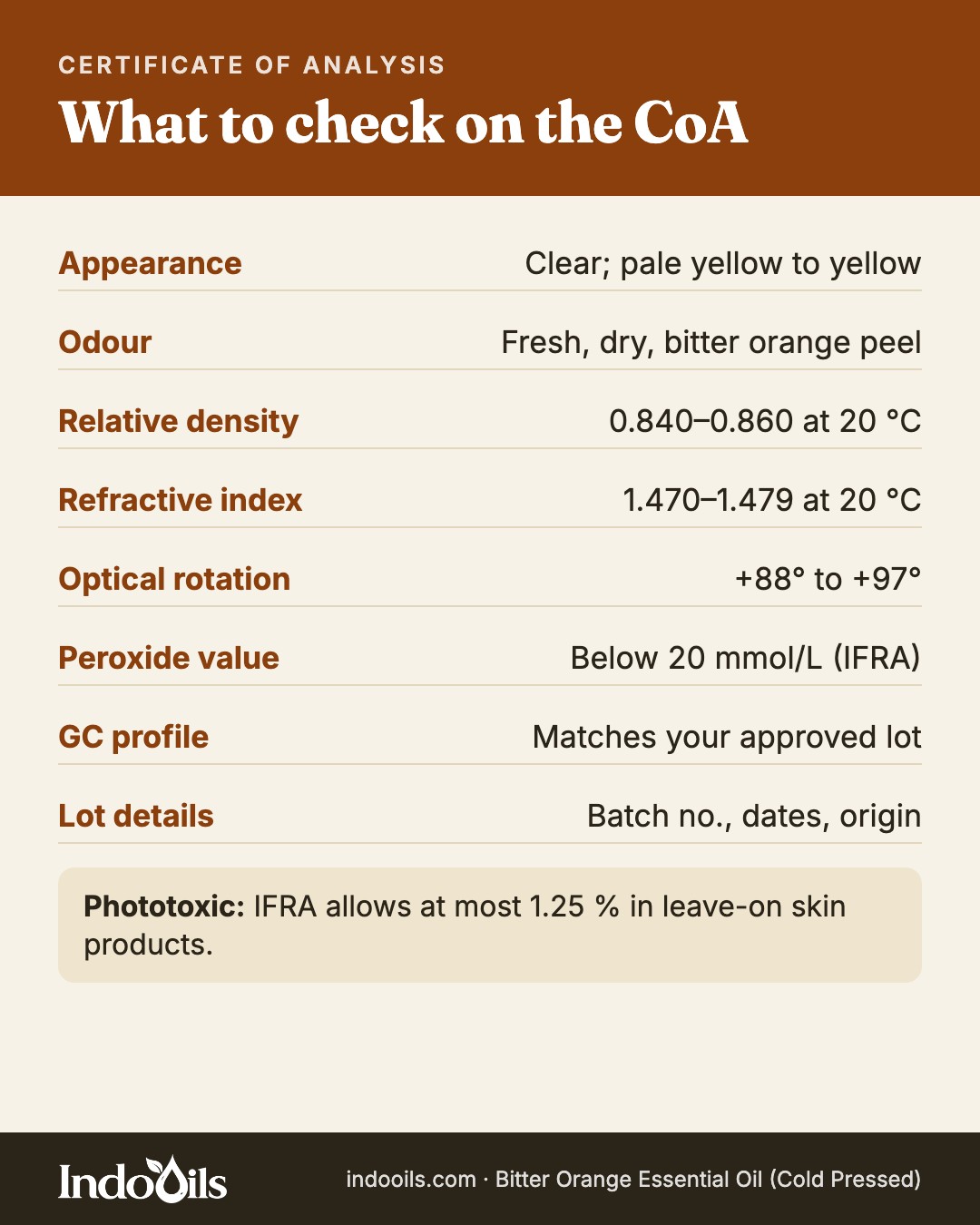
The international standard for this oil is ISO 9844:2006, Oil of bitter orange (Citrus aurantium L.). It sets the physical constants and a chromatographic profile. A CoA for cold-pressed bitter orange oil should report:
- Appearance: clear, mobile liquid; pale yellow to yellow. A slight haze in the cold can be wax.
- Odour: fresh, dry, slightly bitter orange peel, matching your approved sample. Oxidised oil smells flat and harsh.
- Relative density: about 0.840–0.860 at 20 °C.
- Refractive index: about 1.470–1.479 at 20 °C.
- Optical rotation: about +88° to +97°. Sweet orange oil usually reads a little higher, so a figure at the top of the range is a question worth asking.
- Peroxide value: a measure of oxidation. IFRA asks that limonene-rich materials stay below 20 mmol/L.
- GC profile: limonene, myrcene, linalyl acetate, linalool and decanal, compared with your approved lot.
- Lot details: batch number, production and expiry dates, and country of origin.
Cosmetic buyers should also ask for an IFRA certificate that states the phototoxicity limit, and food buyers for a pesticide residue report: pesticides used on the fruit are oil-soluble and concentrate in peel oil.
Spotting cut oils
Bitter orange oil costs more than sweet orange oil, and the two look alike in a drum. The common problems are:
- Sweet orange oil sold as bitter orange, or blended in: the most common trick. The odour loses its dry, bitter edge, linalyl acetate falls, and the aldehyde and furocoumarin patterns shift towards sweet orange. A GC fingerprint against an authentic reference, plus an HPLC check of the non-volatile part, usually shows it.
- Added limonene or orange terpenes: cheap and hard to see in an oil that is mostly limonene anyway. A flat odour, low minor compounds and a low evaporation residue are the signs.
- Synthetic linalyl acetate or linalool added to fake the floral lift. Chiral GC and carbon-14 testing can show synthetic material.
- Old, oxidised oil: not adulteration as such, but common. A high peroxide value and a harsh odour mean it has been badly stored.
The protection is the same as for any oil: approve a sample, keep a retained sample, and compare every lot's GC report and peroxide value with the approved one.
Where Bitter Orange Oil Is Used
Bitter orange oil is a specialist material. It is used where the dry, slightly bitter note matters, and where sweet orange would taste or smell too juicy:
- Liqueurs and spirits: orange liqueurs such as triple sec and curaçao, bitters, aperitifs and flavoured gins. This is the classic use of the oil, alongside the dried peel itself.
- Beverages: bitter-citrus and tonic-style soft drinks and syrups, as an emulsion or with folded oil for clear drinks.
- Confectionery and bakery: marmalade and candied-peel flavours, chocolate orange, sweets, cakes and biscuits. See our food and beverage page.
- Flavour houses: a base for bitter orange, marmalade and mixed-citrus flavours, often with sweet orange, lemon, lime and grapefruit oils.
- Fine fragrance: a fresh, sophisticated top note in colognes and eaux de toilette. The classic eau de cologne pairs it with bergamot, neroli, lavender and rosemary; chypre and floral accords add jasmine, ylang ylang, geranium and vetiver.
- Personal care: soaps, shower gels and shampoos. Rinse-off products are not restricted by the IFRA phototoxicity limit. See cosmetics and personal care.
- Home care: cleaners, air fresheners and candles. See home care and fragrance.
In warm "orange and spice" profiles, bitter orange pairs well with clove bud, cinnamon bark, nutmeg, ginger and coriander seed.
Safety, Food and Cosmetic Rules
Handling
- It is flammable. The flash point is typically about 45–50 °C (closed cup), so it is classed as a flammable liquid for storage and transport. Keep drums away from heat, sparks and flames, and earth them when transferring.
- It is a skin irritant and can cause skin allergy. Fresh limonene is a weak sensitiser, but the hydroperoxides formed as it oxidises are strong ones.
- It is an aspiration hazard. It may be fatal if swallowed and it enters the airways.
- It is very toxic to aquatic life. Keep spills out of drains.
Wear gloves and eye protection, and read the Safety Data Sheet supplied with each batch for the full GHS classification and transport details.
Phototoxicity: the IFRA limit
This is the rule that sets bitter orange oil apart from sweet orange oil. The furocoumarins in the oil can cause a skin reaction when treated skin is exposed to sunlight. The IFRA Standard for bitter orange peel oil expressed (Amendment 49) therefore sets a maximum of 1.25 % in the finished product for leave-on skin products and other product types that stay on skin. Rinse-off products such as soaps, shower gels and shampoos, and candles, are not restricted. Some household products, including certain sprays, are still limited to 1.25 %, so check the IFRA category of your product.
Two further points matter in formulation:
- Combinations: if the product also contains other phototoxic citrus oils, such as bergamot, lemon, lime or grapefruit, the limits are shared. Add up each oil's level as a percentage of its own IFRA limit; the total must not pass 100 %.
- Concentrated grades: for folded or terpeneless bitter orange oil, the 1.25 % limit must be lowered in proportion to the concentration.
Our Calabrian bergamot oil guide explains how the same rule works for bergamot, the most phototoxic citrus oil.
Food and flavour
Bitter orange peel oil is an established flavouring. In the US it has FEMA number 2823 and is listed as generally recognised as safe (21 CFR 182.20, "orange, bitter, peel"). In the EU it is used as a natural flavouring preparation under Regulation (EC) No 1334/2008. Our post on clean-label traceability explains how buyers document natural flavourings.
Bitter orange oil should not be confused with bitter orange fruit extracts sold for dietary supplements. Those are made from the dried unripe fruit and standardised to synephrine, a non-volatile compound. Synephrine does not distil or press out into the oil, and the oil is not sold or tested for it.
Cosmetics and fragrance
- EU allergens: the oil contains limonene and linalool, which must be named on EU cosmetic labels when they pass the labelling limits (0.001 % in leave-on and 0.01 % in rinse-off products). See our post on fragrance allergen labelling.
- EU cosmetics rules: citrus peel oils, including bitter orange, are listed in Annex III of the EU Cosmetics Regulation, the list of restricted substances. Ask your regulatory team to check the current entry against your formula.
- IFRA peroxides: as with every limonene-rich material, IFRA asks that the peroxide value stay below 20 mmol/L.
Documents to Ask For
For a bulk order of bitter orange oil, expect:
- A Certificate of Analysis for the actual lot, with the constants above, limonene and peroxide value
- A GC-MS report from an independent laboratory
- A Safety Data Sheet in GHS format, with the flash point and transport classification
- An IFRA certificate stating the phototoxicity limit, and an EU allergen declaration
- A food-grade statement and a pesticide residue report, for food and flavour use
- A certificate of origin, showing the country where the oil was produced
Our quality assurance and certifications pages describe how IndoOils tests and documents every lot.
Packing, Storage and Shelf Life
IndoOils supplies bitter orange oil in 25 kg, 50 kg and 200 kg packs, each with its own batch number.
Oxidation is the main enemy:
- Store packs closed, at 15–25 °C, away from sunlight and heat.
- Keep the headspace small. Once a pack is opened, blanket it with nitrogen or decant the oil into smaller full containers.
- If the oil turns cloudy in the cold, warm it gently to room temperature and mix. Peel waxes cause this; it is not a defect.
- Use stainless steel, glass or aluminium for handling. Limonene softens some plastics and rubbers.
Shelf life is 24 months unopened. Use opened packs within six months, and check the peroxide value of older stock before using it in fragrance or personal-care products.
How to Order Bitter Orange Oil in Bulk
- Send your specification, or ask for ours: grade (cold-pressed single-fold), origin preference, limonene and peroxide limits, and the documents you need, including the IFRA certificate.
- Approve a sample. Request one through our sample request page and test it in your own lab and your own product.
- Ask for a quotation through our bulk inquiry page, with your annual volume and delivery schedule. Supply follows the winter harvest, so ask about forward cover if you need a fixed price for a season.
- Order: the minimum order is one 25 kg pack; 50 kg and 200 kg packs are also available.
If you sell bitter orange oil under your own brand, our private label service can fill and label it for you.
Frequently Asked Questions
Is bitter orange oil the same as sweet orange oil?
No. Bitter orange oil comes from the peel of Citrus aurantium, the Seville orange; sweet orange oil comes from Citrus sinensis. Bitter orange smells drier and more bitter, has more linalyl acetate and less aldehyde, and is phototoxic, so it has an IFRA limit that sweet orange oil does not.
Is bitter orange oil the same as neroli?
No. Both come from the bitter orange tree, but neroli is steam distilled from the blossom and bitter orange oil is cold pressed from the fruit peel. Neroli is floral and far more expensive. Petitgrain, the third oil of the tree, is distilled from the leaves and twigs.
Is bitter orange oil phototoxic?
Yes. Cold-pressed bitter orange oil contains furocoumarins that can cause a skin reaction in sunlight. IFRA limits it to 1.25 % in leave-on skin products, and less when it is combined with other phototoxic citrus oils. Rinse-off products are not restricted.
What is the CAS number of bitter orange oil?
68916-04-1 is the most common, and 72968-50-4 is also used; IFRA lists both. The EC number is 277-143-2. Check that your documents don't carry the CAS number of another oil.
Can bitter orange oil be used in food?
Yes. It has FEMA number 2823 and US GRAS status (21 CFR 182.20), and it is a classic flavour in orange liqueurs and marmalade. Ask for a food-grade statement and a pesticide residue report.
What is the HSN code for bitter orange oil?
33011200, "essential oils of citrus fruit: of orange", with GST at 18 %. The heading covers both sweet and bitter orange oil. Confirm the code with your customs agent for your own shipments.
What is the minimum order?
One 25 kg pack. 50 kg and 200 kg packs are also available, and a sample can be sent before you order in bulk.
For more buyer's guides, see our posts on sweet orange oil, Calabrian bergamot oil, jasmine sambac absolute, Bulgarian rose otto and essential oils for cosmetics, or browse the full essential oils range.
Buying in bulk?
25 kg, 50 kg and 200 kg packs, with a certificate of analysis for every lot.
Tell us the product, quantity and destination, and we will come back with a quotation.