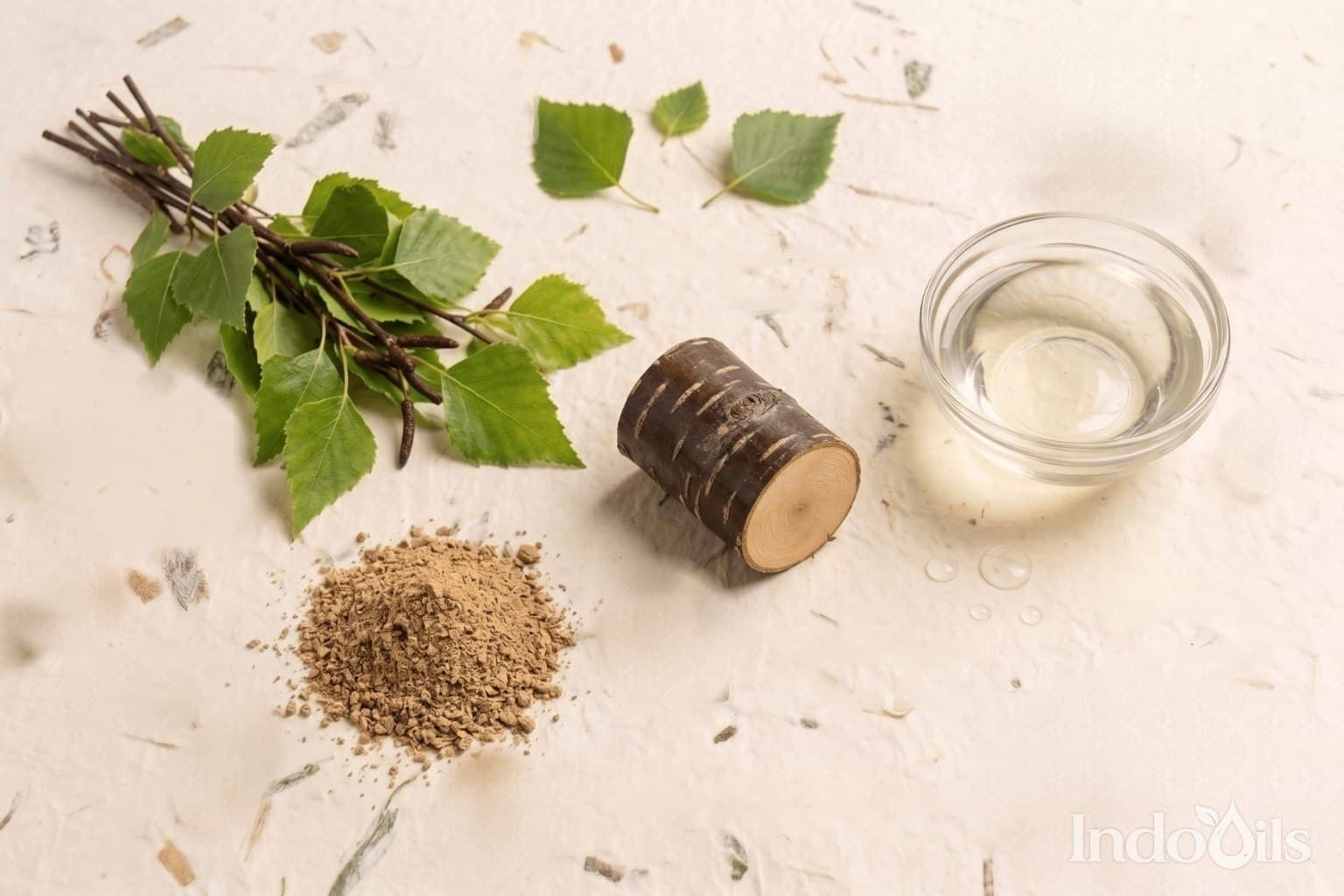
Sweet birch oil smells of wintergreen: sweet, sharp and cool, the smell of old-fashioned birch beer, wintergreen chewing gum and red-striped toothpaste. It is one of the oldest flavour oils of North America, distilled from the bark of a forest tree in the Appalachian mountains since the nineteenth century.
It is also one of the simplest essential oils in the world. Almost all of it, usually 98 per cent or more, is a single compound: methyl salicylate. That makes it easy to use and easy to test, but it also creates the two problems every buyer of this oil has to solve. First, the same compound is sold as wintergreen oil and as a cheap synthetic, so "sweet birch" on a label proves very little. Second, methyl salicylate is a restricted substance in cosmetics and harmful if swallowed, so the rules matter.
This guide covers Sweet Birch Essential Oil from IndoOils: what it is, how it is made, what is in it, how to tell natural oil from look-alikes, which rules apply, where it is used and how to order it in bulk.
Sweet Birch, Black Birch, Birch Tar: Getting the Name Right
Several quite different products are sold as "birch oil", so make sure supplier and buyer mean the same thing:
- Sweet birch oil is steam distilled from the bark and young twigs of Betula lenta L., the sweet birch of the eastern United States. The same tree is also called black birch or cherry birch, because its dark bark looks like cherry bark. This is the oil this guide is about.
- Birch tar oil is made by heating birch wood and bark without air (dry distillation), then cleaning the tar oil. It is dark, smoky and leathery, and it has nothing in common with sweet birch oil except the tree family. IndoOils lists it as Birch Tar Oil (Rectified), with its own buyer's guide.
- Birch leaf and bud extracts from European silver birch (Betula pendula) are cosmetic extracts, not wintergreen oils.
The quickest check is the CAS number on the quotation: 68917-50-0 for sweet birch oil, 8001-88-5 for birch tar oil.
Product identifiers
- Product: Sweet Birch Essential Oil
- Botanical name: Betula lenta L. (sweet birch, black birch, cherry birch)
- INCI name: Betula Lenta Bark Oil
- CAS number: 68917-50-0
- Main compound: methyl salicylate (CAS 119-36-8), 98 % or more
- FEMA number: 2154 (sweet birch oil)
- HSN code: 33012990 (other essential oils)
- SKU: IND0023
- Origin: eastern United States
- Plant part: bark and young twigs
- Extraction method: steam distillation after soaking in water
Sweet Birch, Wintergreen and Synthetic Methyl Salicylate
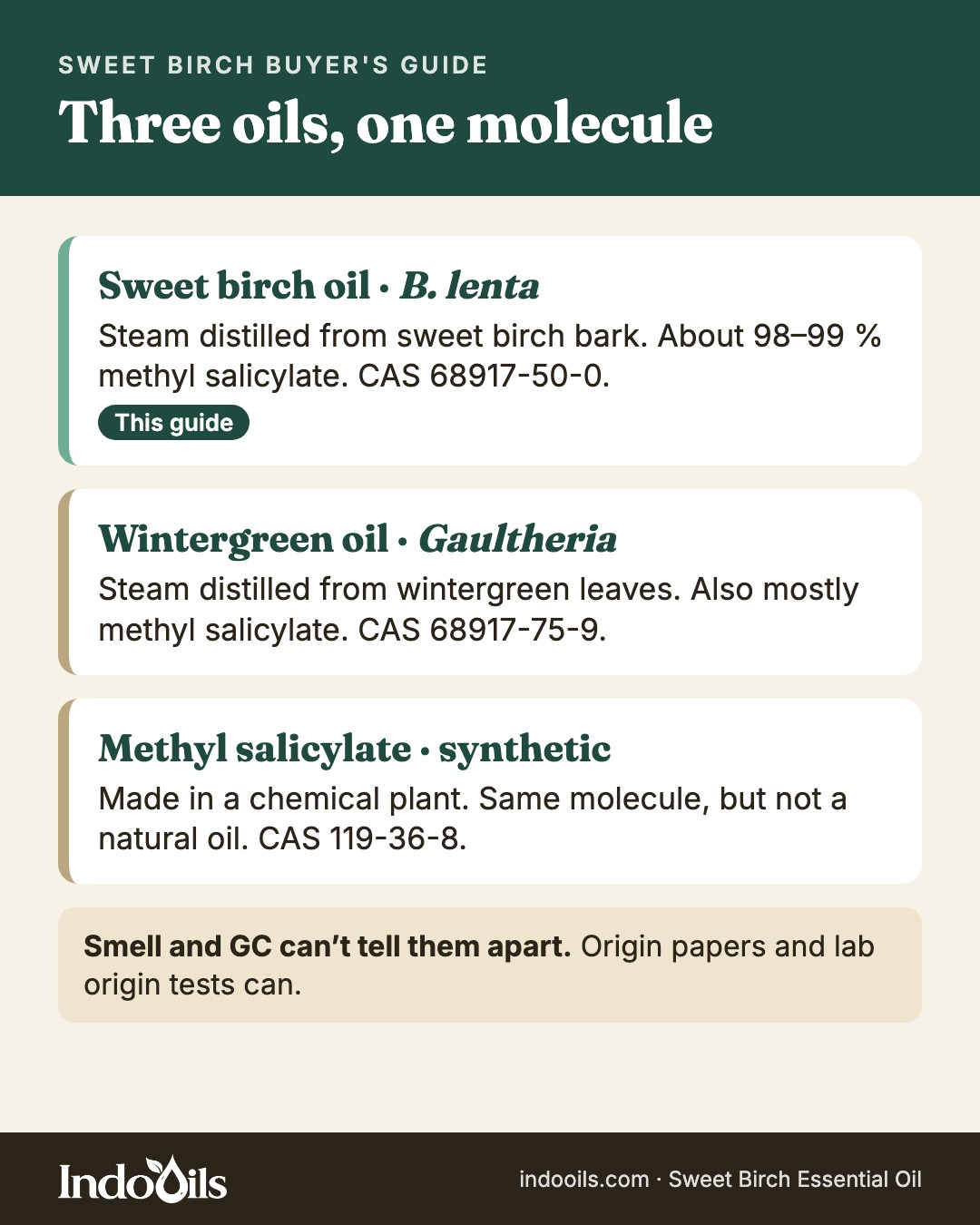
Three materials are sold for the wintergreen note, and on a smelling strip they are almost impossible to tell apart:
- Sweet birch oil is distilled from the bark of Betula lenta. It is a natural essential oil, made in small amounts by a few distillers.
- Wintergreen oil is distilled from the leaves of wintergreen, Gaultheria procumbens in North America, or related Gaultheria species in China and Nepal. It is also mostly methyl salicylate, and it is the oil sweet birch is most often compared with, or swapped for.
- Synthetic methyl salicylate is made in a chemical plant from salicylic acid and methanol. It is the same molecule, sold at a fraction of the price of either natural oil. It is often called "oil of wintergreen" in trade, which adds to the confusion.
All three are close to pure methyl salicylate, so a standard GC report will show nearly the same picture for each. For a perfumer working on a detergent, that may not matter. For a buyer who sells a product as "natural", or who pays for natural sweet birch oil, it matters a great deal. The CoA section below explains what to ask for.
There is also a supply reality. True sweet birch oil is made in small quantities, mostly in the Appalachian region of the United States. Much of what is sold worldwide as "birch oil, sweet" is synthetic methyl salicylate, or wintergreen oil, with a birch label. A supplier who sells large volumes of "sweet birch" with no botanical source and no origin on the documents should be asked how they know what it is.
How Sweet Birch Oil Is Made
Sweet birch is a medium-sized forest tree of the eastern United States, common from New England down the Appalachian mountains to Georgia. Its bark and twigs smell of wintergreen when scratched, which is the old field test for telling it apart from other birches.
The oil is made in a slightly unusual way, because the bark does not hold it ready-made:
- Bark and twigs are collected and chipped small, usually from trees cut for timber or thinning.
- The chips are soaked in warm water for several hours. The bark holds methyl salicylate bound to a sugar, as a compound called gaultherin. Soaking lets an enzyme in the bark split the gaultherin and free the methyl salicylate. Without this step the yield is very low.
- The soaked bark is steam distilled. Steam carries the methyl salicylate out of the bark.
- The oil is separated. Unlike most essential oils, sweet birch oil is heavier than water (relative density about 1.18). It sinks to the bottom of the separator and is drawn off from there.
- The oil is filtered, tested and packed.
The yield is low, well under one per cent of the bark weight, and the work is seasonal and done by small distillers. That is why genuine sweet birch oil is always more expensive than synthetic methyl salicylate, and why its supply is limited.
What Is Inside Sweet Birch Oil
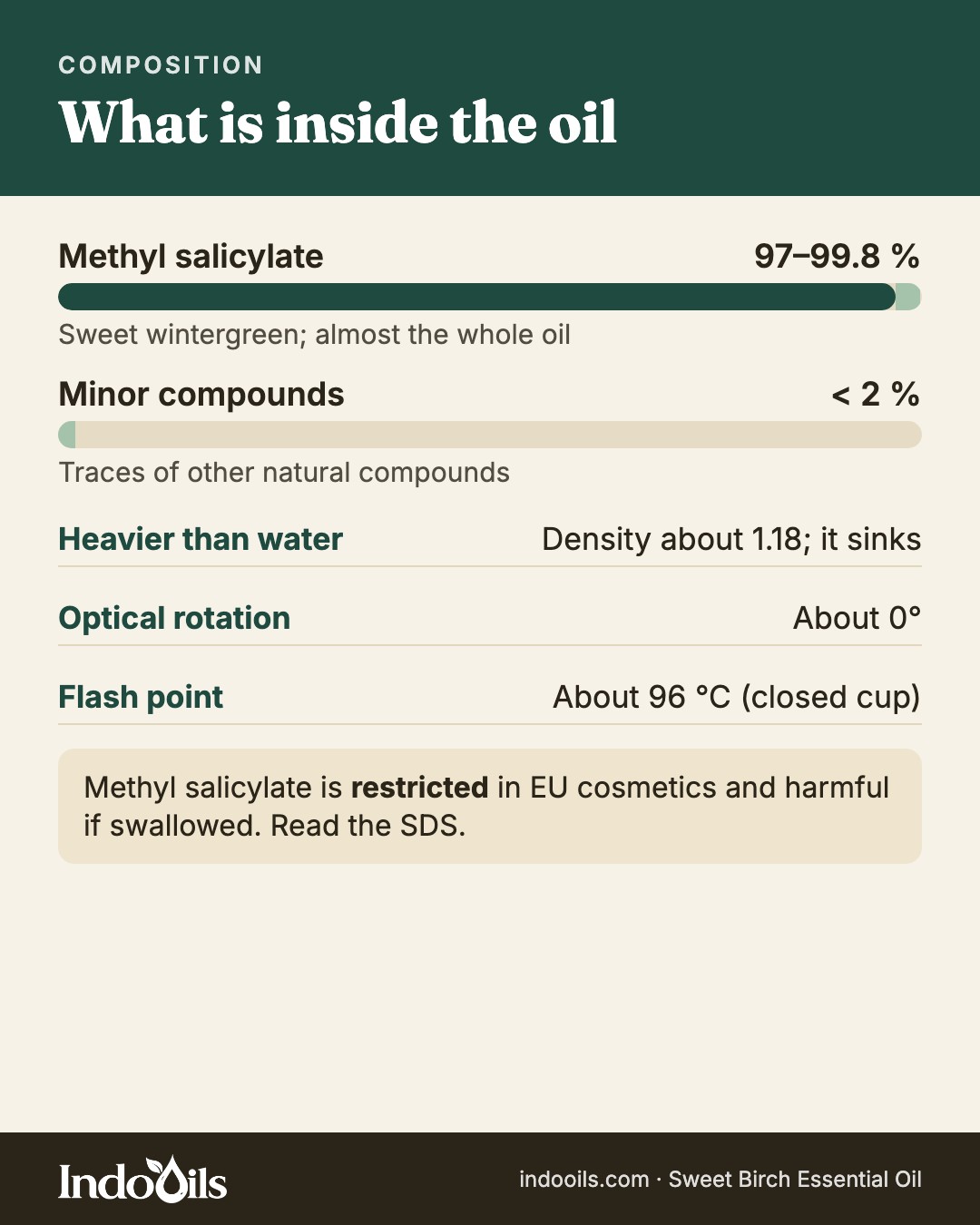
The composition is simple:
- Methyl salicylate, usually 98 to 99.8 per cent. It gives the oil its sweet, intense wintergreen odour and its cool, minty taste.
- Minor compounds, usually well under 2 per cent in total: traces of other natural compounds from the bark. They give natural oil a slightly rounder, fruitier note than the pure synthetic, and they are part of what origin laboratories look at.
Because the oil is nearly a single compound, its physical constants sit close to those of methyl salicylate: relative density about 1.18, refractive index about 1.533 to 1.538 at 20 °C, and an optical rotation close to zero. It is colourless to pale yellow, and it can darken slowly with age and light.
What to Check on the Certificate of Analysis
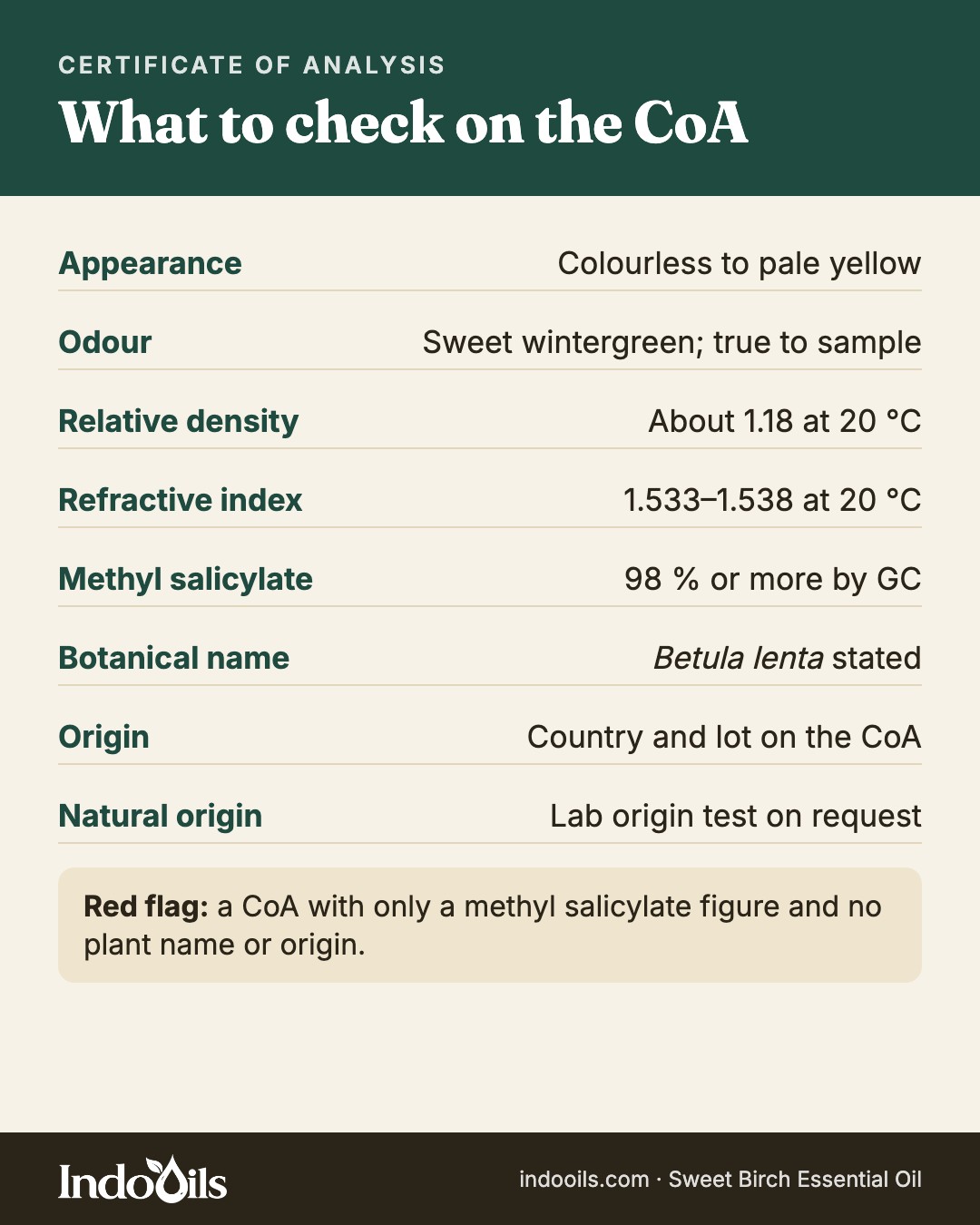
A CoA for sweet birch oil should give, for each lot:
- Appearance and odour, compared with the approved sample.
- Relative density (about 1.175 to 1.190 at 20 °C) and refractive index (about 1.533 to 1.538 at 20 °C).
- Methyl salicylate by GC, usually 98 per cent or more. This is the figure you will use for cosmetic limit calculations.
- The botanical name, Betula lenta, and the country of origin.
- Batch number, manufacturing date and best-before date.
These checks confirm that the oil is good methyl salicylate. They do not prove that it is sweet birch.
Natural or not: what to watch for
Because natural and synthetic methyl salicylate are the same molecule, ordinary tests can't separate them. If natural origin matters to you, use these:
- Radiocarbon (14C) test. Natural oils contain carbon-14 from the living plant. Synthetic methyl salicylate made from petrochemicals contains almost none. A biobased-carbon test (for example to ASTM D6866) shows quickly whether an oil is natural, synthetic or a mix.
- Stable isotope ratios (carbon and hydrogen, measured by IRMS) can separate natural from synthetic material and sometimes point to the source plant.
- Trace profile. A detailed GC-MS of the minor peaks shows the small natural compounds that pure synthetic material lacks, and the by-products that some synthetic grades carry.
- Documents. A named distiller, a certificate of origin and a natural-origin statement for every lot.
A very low price is the plainest warning. Natural sweet birch oil costs many times more than synthetic methyl salicylate. An offer close to the synthetic price is very unlikely to be natural.
Where Sweet Birch Oil Is Used
Almost every use of sweet birch oil is a use of its wintergreen note.
Beverages and confectionery
- Birch beer and root beer. Sweet birch is the traditional flavour of birch beer, a soft drink from the north-eastern United States, and a part of many root beer flavours, alongside vanilla, anise and wintergreen.
- Chewing gum, mints and hard candy. Wintergreen gum and mints are among the largest flavour uses of methyl salicylate.
- Flavour houses use it in wintergreen, mint and root beer compositions, often with peppermint, spearmint, aniseed, clove, cinnamon bark and vanilla.
Natural sweet birch oil is used where a buyer needs a natural source of the wintergreen note, for example in a product labelled with natural flavourings. Where natural status doesn't matter, most food makers use synthetic methyl salicylate.
Oral care
Toothpastes and mouthwashes have used the wintergreen note for more than a century, usually blended with mint oils such as high-menthol peppermint oil and eucalyptus. In the EU these are cosmetic products, so the methyl salicylate limits below apply.
Fragrance and home care
Perfumers use methyl salicylate in small amounts for a fresh, green-sweet lift in fougère and chypre accords and in floral bases, where it occurs naturally in flowers such as tuberose and ylang ylang. Larger amounts appear in household cleaners and air care with a "fresh mint" profile. In fragrance, the synthetic is far more common; natural sweet birch oil is chosen for natural perfumery and for brands that need every ingredient to be natural.
Methyl salicylate is also an active ingredient in some over-the-counter medicines. Those are regulated as medicines, need pharmaceutical-grade material and documents, and are outside the scope of this guide.
Safety, Food and Cosmetic Rules
Sweet birch oil is easy to handle in a factory, but it is not a harmless oil. Every rule below follows from its methyl salicylate content.
Handling hazards
Methyl salicylate has an EU harmonised classification: harmful if swallowed, may cause an allergic skin reaction, suspected of damaging the unborn child and harmful to aquatic life with long-lasting effects. Many SDSs add skin and eye irritation. Because the oil is nearly pure methyl salicylate, it carries the same warnings. The SDS supplied with each lot gives the full classification.
The most serious risk is swallowing by children. A teaspoon of concentrated methyl salicylate can poison a small child, which is why wintergreen and birch oils sold to the public face packaging rules. The oil is not a flammable liquid under GHS (its flash point is about 96 °C), but it is combustible.
EU cosmetics rules
Since 17 December 2022, methyl salicylate has been restricted in EU cosmetic products under Annex III, entry 324 of Regulation (EC) No 1223/2009 (added by Regulation (EU) 2022/1531). The entry sets a separate maximum for each product type. For example:
- 0.06 % in most leave-on skin products and in rinse-off skin and hair products
- 0.6 % in mouthwash for adults and children over 10, in hand wash and in hydroalcoholic fragrances
- 2.52 % in toothpaste
- much lower limits in eye make-up, lip products and spray products
Products for children under six years may not contain methyl salicylate at all, except toothpaste. The figures apply to methyl salicylate in the finished product, so calculate from the methyl salicylate percentage on the CoA. Check the current consolidated Annex III before you formulate: the SCCS has reviewed the children's limits again, and the UK has set some different figures.
Methyl salicylate is also one of the fragrance allergens added to EU labelling rules by Regulation (EU) 2023/1545. It must be named on the label above 0.001 % in leave-on and 0.01 % in rinse-off products, with transition periods for existing products. Our guide to fragrance allergen labelling explains the rules.
IFRA
Follow the IFRA certificate supplied with each lot for the IFRA amendment you work to. Methyl salicylate has been under review at IFRA, so check the certificate whenever a new amendment is published.
US packaging rule
In the US, household liquids that contain more than 5 % methyl salicylate must be sold in child-resistant packaging (16 CFR 1700.14, under the Poison Prevention Packaging Act). Sweet birch and wintergreen oils in bottles without child-resistant closures have been recalled several times. This does not affect bulk drums, but it applies to any brand that repacks the oil into retail bottles.
Food rules
Sweet birch oil has a FEMA number (2154) and methyl salicylate has its own (2745), so both are recognised as safe flavouring materials in the US at normal use levels. In the EU, methyl salicylate is an authorised flavouring substance. Use the oil only as a flavouring, at the low levels flavour houses use, and ask for food-grade documents if the oil will go into food or drink.
Documents to Ask For
For each lot, a serious supplier should be able to give you:
- Certificate of Analysis with methyl salicylate by GC
- GC report, and a detailed GC-MS when you approve a new source
- Safety Data Sheet (GHS, 16 sections)
- IFRA certificate for the current amendment, and an EU allergen declaration
- Natural-origin statement, and a 14C (biobased carbon) report on request
- Certificate of origin
- Food-grade statement, for flavour buyers
Our checklist for importing essential oils for cosmetics covers the wider paperwork.
Packing and Storage
IndoOils supplies sweet birch oil in 25 kg and 50 kg aluminium packs and 200 kg drums. Minimum order is one pack. Every pack carries its own batch number. Because the oil is heavy, a 25 kg pack holds only about 21 litres.
Sweet birch oil is one of the more stable essential oils, because methyl salicylate is a stable ester:
- Keep it closed, cool and dark. Store at 15–25 °C, away from light and heat. Light slowly yellows the oil.
- Use the right materials. Methyl salicylate attacks some plastics and rubbers, including polystyrene. Stainless steel, glass, aluminium and lined containers are safe; check gaskets and hoses.
- Shelf life is 36 months unopened. Use opened packs within 12 months.
- Label and store it as a hazardous material, out of reach of anyone not trained to handle it.
How to Order Sweet Birch Oil in Bulk
- Tell us your use. Beverages, confectionery, oral care or fragrance: the use decides which documents and limits apply.
- Tell us if natural origin matters. If it does, say so at the start, and we will include the origin documents and tests in the quotation.
- Ask for a sample with its CoA, and test it in your own lab.
- Approve the sample and set your acceptance specification: methyl salicylate by GC, density, refractive index, and any origin tests.
- Send a bulk inquiry through the product page with the quantity and pack size. Prices are quoted on request.
- Receive the lot with its CoA, GC report, SDS, IFRA certificate and certificate of origin.
Frequently Asked Questions
Is sweet birch oil the same as wintergreen oil?
Not quite. Both are mostly methyl salicylate and smell almost the same, but sweet birch oil is distilled from the bark of Betula lenta and wintergreen oil from the leaves of Gaultheria plants. They have different CAS numbers (68917-50-0 and 68917-75-9) and should be named correctly on documents.
Is sweet birch oil the same as birch tar oil?
No. Birch tar oil is made by dry distillation of birch wood and is dark, smoky and leathery. Sweet birch oil is clear, smells of wintergreen and is almost all methyl salicylate. See our birch tar oil buyer's guide.
How can I tell natural sweet birch oil from synthetic methyl salicylate?
Not by smell or a standard GC. Ask for a radiocarbon (14C) or stable isotope test, a detailed GC-MS of the minor peaks, and a certificate of origin naming the distiller. A price close to synthetic methyl salicylate is a strong warning sign.
Can I use sweet birch oil in a body lotion?
Only within the EU limit for methyl salicylate in that product type, which is 0.06 % for most leave-on skin products, and never in products for children under six. Calculate the limit from the methyl salicylate figure on the CoA.
Is sweet birch oil a flammable liquid?
No. Its flash point is about 96 °C, above the GHS flammable-liquid range. It is combustible, so keep it away from heat and open flames, and follow the transport details on the SDS.
What HSN code applies to sweet birch oil?
In India, sweet birch oil falls under 3301 29 ("other essential oils"), tariff item 33012990, with GST at 18 %. It is not birch tar (3807) and not methyl salicylate (2918). Confirm the code with your customs agent.
What is the minimum order?
One pack: 25 kg, 50 kg or 200 kg. Samples are available for lab approval before you order in bulk.
More Buyer's Guides
Buying in bulk?
25 kg, 50 kg and 200 kg packs, with a certificate of analysis for every lot.
Tell us the product, quantity and destination, and we will come back with a quotation.