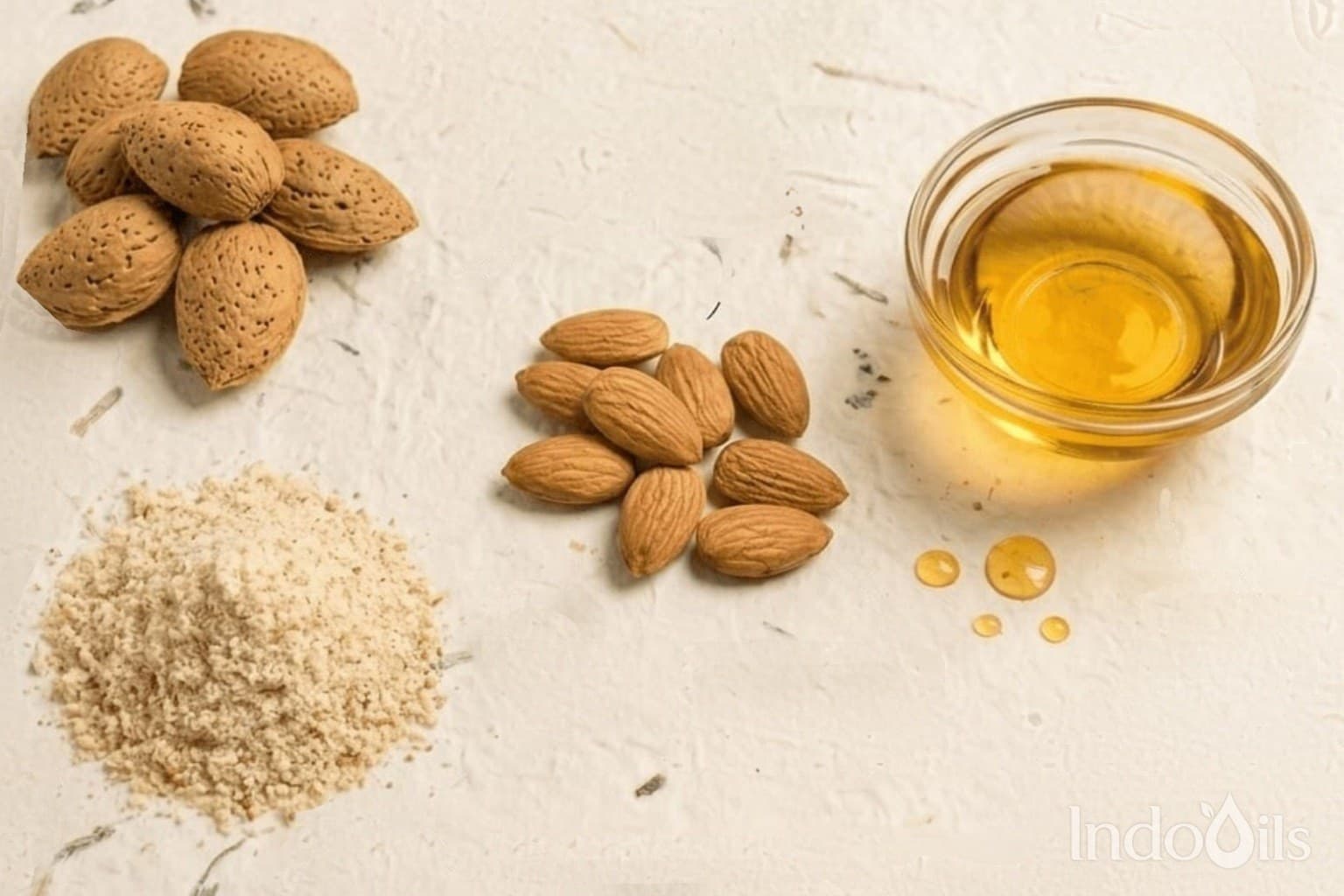
Few smells are as easy to name as bitter almond. It is the taste of marzipan, amaretto, Bakewell tart and the cherry in a cherry cola. Almost all of it comes from one compound, benzaldehyde, and the classic natural source of that compound is bitter almond oil.
Bitter almond oil is also the one essential oil whose crude form is a poison. The kernels it comes from release hydrocyanic acid, better known as prussic acid, and the crude oil carries a few per cent of it. Every lot sold to the flavour and fragrance trade must have that acid removed. That oil is called FFPA: free from prussic acid.
This guide covers Bitter Almond Essential Oil (FFPA) from IndoOils: what it is, how it is made, what is inside it, which tests matter, which rules apply, where it is used and how to order it in bulk.
One Name, Several Kernels
"Bitter almond oil" sounds like it should come from bitter almonds only. In trade it does not:
- Bitter almonds (Prunus dulcis var. amara, also written Prunus amygdalus var. amara) are the wild-type almond. They look like sweet almonds but contain amygdalin, the compound that gives the oil. They are the classic source.
- Apricot kernels (Prunus armeniaca) contain the same amygdalin and give the same oil. Most bitter almond oil traded today is distilled from apricot kernel press cake, which is easier to buy in volume.
- Peach kernels (Prunus persica) are a third, smaller source.
All three give an oil that is mostly benzaldehyde and smells the same. The US list of essential oils that are generally recognised as safe (21 CFR 182.20) names all three species under "almond, bitter (free from prussic acid)". What matters for a buyer is that the CoA states which kernel was used, so the paperwork, the label and the INCI name all agree.
Product identifiers
- Product: Bitter Almond Essential Oil (FFPA)
- Botanical name: Prunus dulcis var. amara; apricot (Prunus armeniaca) kernels are also used, stated per lot
- INCI name: Prunus Amygdalus Amara Kernel Oil (check against your supplier's documents)
- CAS number: 8013-76-1
- FEMA number: 2046
- HSN code: 33012990
- SKU: IND0017
- Plant part: Kernels (press cake after the fixed oil is removed)
- Extraction method: Steam distillation, then removal of hydrocyanic acid and redistillation
- Main constituent: Benzaldehyde, typically 97–99 %
- Origin: Mediterranean, stated per lot
- Shelf life: 24 months, unopened
FFPA Oil, Crude Oil and Benzaldehyde
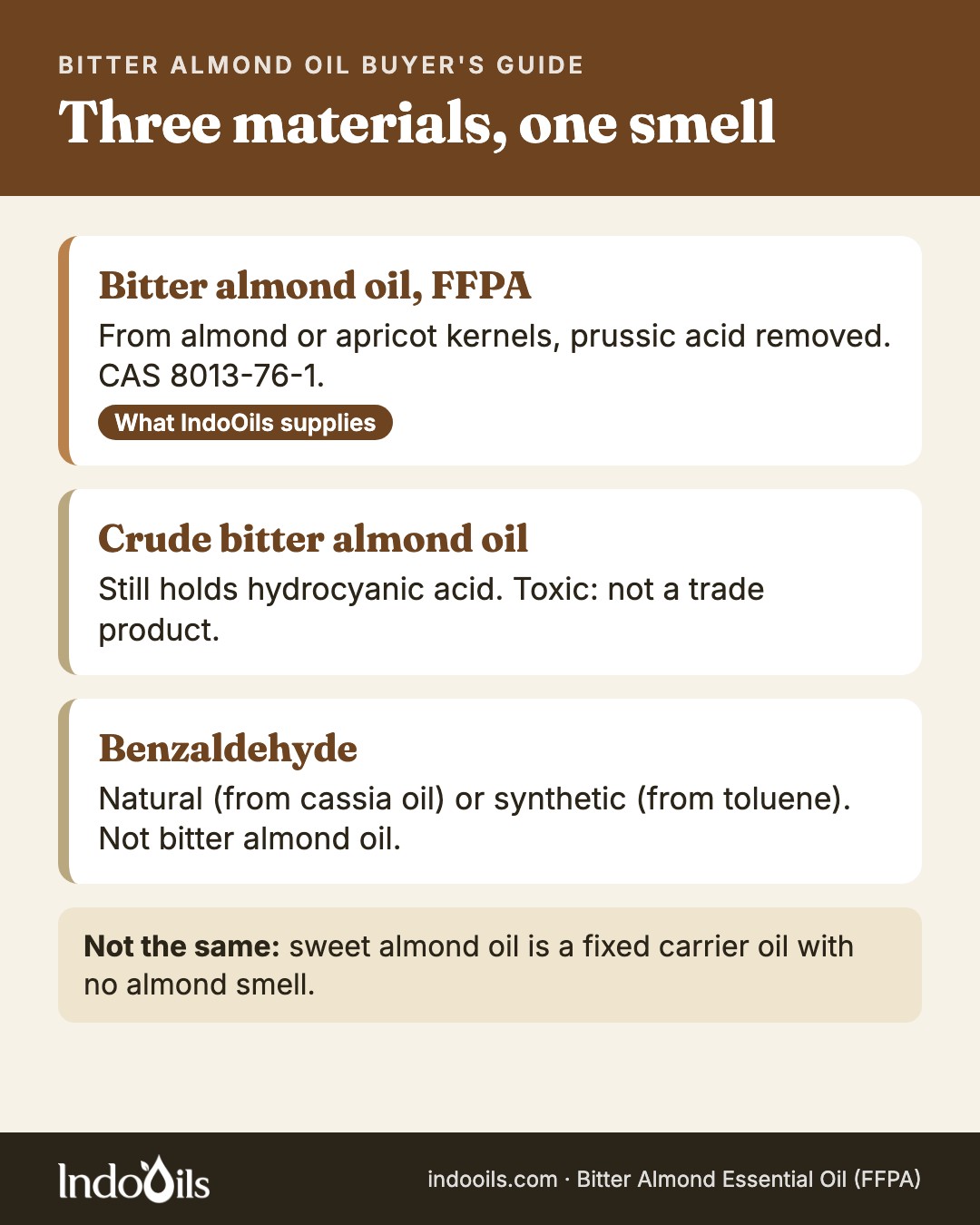
An enquiry for "bitter almond oil" can be answered with several very different materials, so it pays to be precise:
- Bitter almond oil, FFPA (CAS 8013-76-1) is the natural oil distilled from the kernels, with the hydrocyanic acid removed. It is 97–99 % benzaldehyde, with traces of other natural compounds that round off the smell. This is what IndoOils supplies.
- Crude bitter almond oil is the same oil before the hydrocyanic acid is removed. It is toxic, and no reputable supplier sells it into flavour or fragrance.
- Natural benzaldehyde is usually made from cassia or cinnamon oil: cinnamaldehyde is split into benzaldehyde by a natural process. It qualifies as a natural flavouring substance, but it is not bitter almond oil and should not be sold as one.
- Synthetic benzaldehyde is made from toluene, a petrochemical. It is pure, cheap and widely used, but it is not natural.
The price gap between these materials is large, which is why benzaldehyde, natural or synthetic, is the main way bitter almond oil is adulterated. More on the tests below.
One more name to keep apart: sweet almond oil. It is a fixed carrier oil pressed from sweet almonds, used in cosmetics and massage oils, with almost no smell and a different CAS number (8007-69-0). We sell it separately as Sweet Almond Carrier Oil. It is not a substitute for bitter almond oil in any formula, and the two must never share an INCI name on paperwork.
How Bitter Almond Oil Is Made
Bitter almond oil is not in the kernel waiting to be pressed out. It forms during production:
- Pressing. The kernels are pressed to take off their fixed oil, which is sold as a carrier oil. What remains is a dry press cake.
- Maceration. The press cake is ground and soaked in warm water for several hours. An enzyme in the kernel, emulsin, splits amygdalin into glucose, benzaldehyde and hydrocyanic acid.
- Steam distillation. Steam carries the benzaldehyde and the hydrocyanic acid into the condenser. The crude oil is heavier than water and collects below it.
- Removing the prussic acid. The crude oil is treated, traditionally with lime and iron salts, to bind the hydrocyanic acid, and is then distilled again. The result is FFPA oil.
- Testing. Each lot is tested for hydrocyanic acid and benzaldehyde content and analysed by GC-MS at an independent laboratory before release.
- Packing. The oil is filled into clean containers, kept full, and sealed with its batch number.
IndoOils' bitter almond oil is of Mediterranean origin and reaches us through our partner network. It is released only after IndoOils' own checks, described on our quality assurance page, and the kernel source and country are recorded for each lot, as explained on our traceability page.
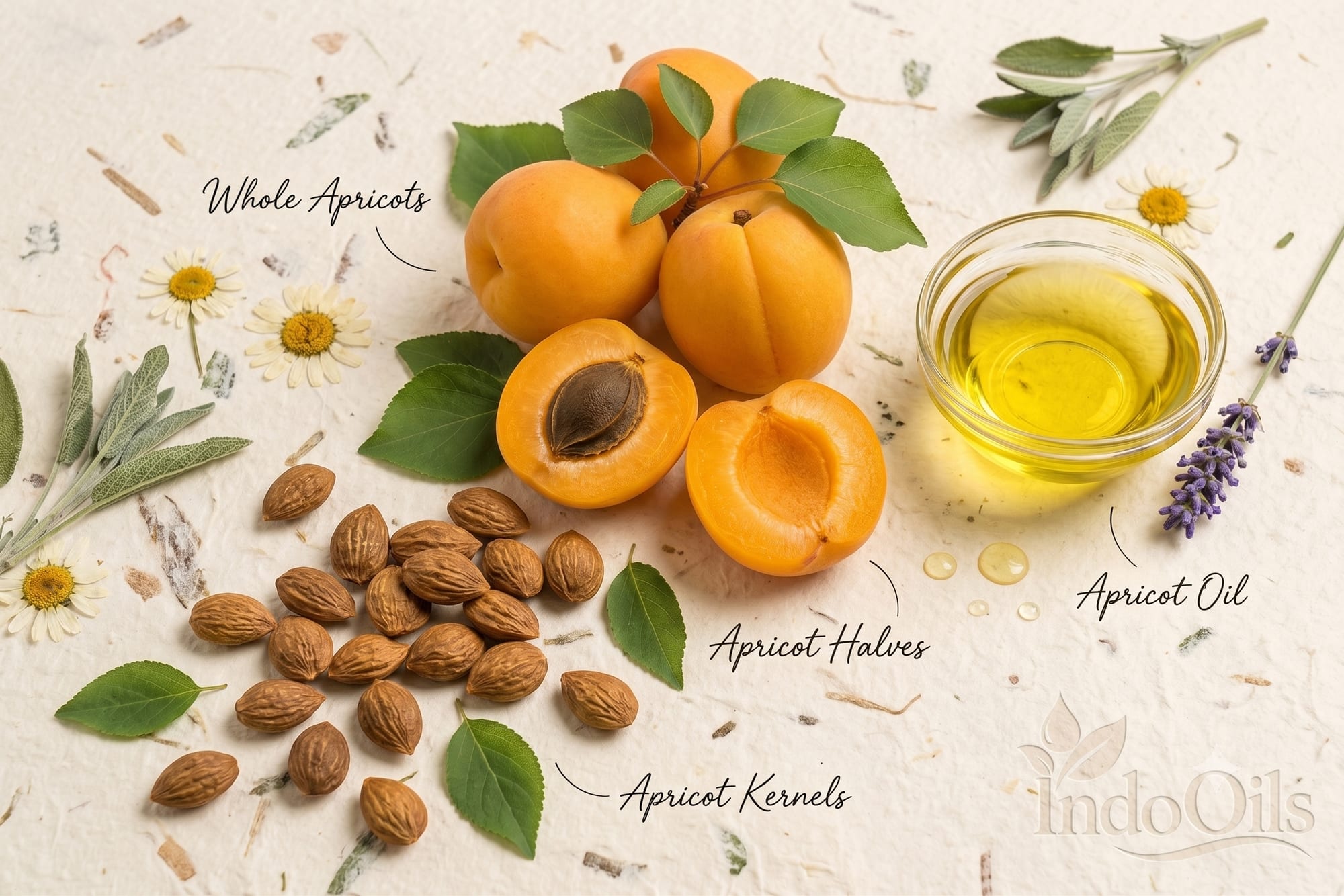
Because the oil comes from the press cake, it is a co-product of the kernel oil trade. The fixed oil goes to cosmetics as Apricot Kernel Carrier Oil and the cake goes to the still. Supply and price therefore follow apricot and almond harvests and the demand for kernel oil, not just the flavour market.
What Is Inside Bitter Almond Oil
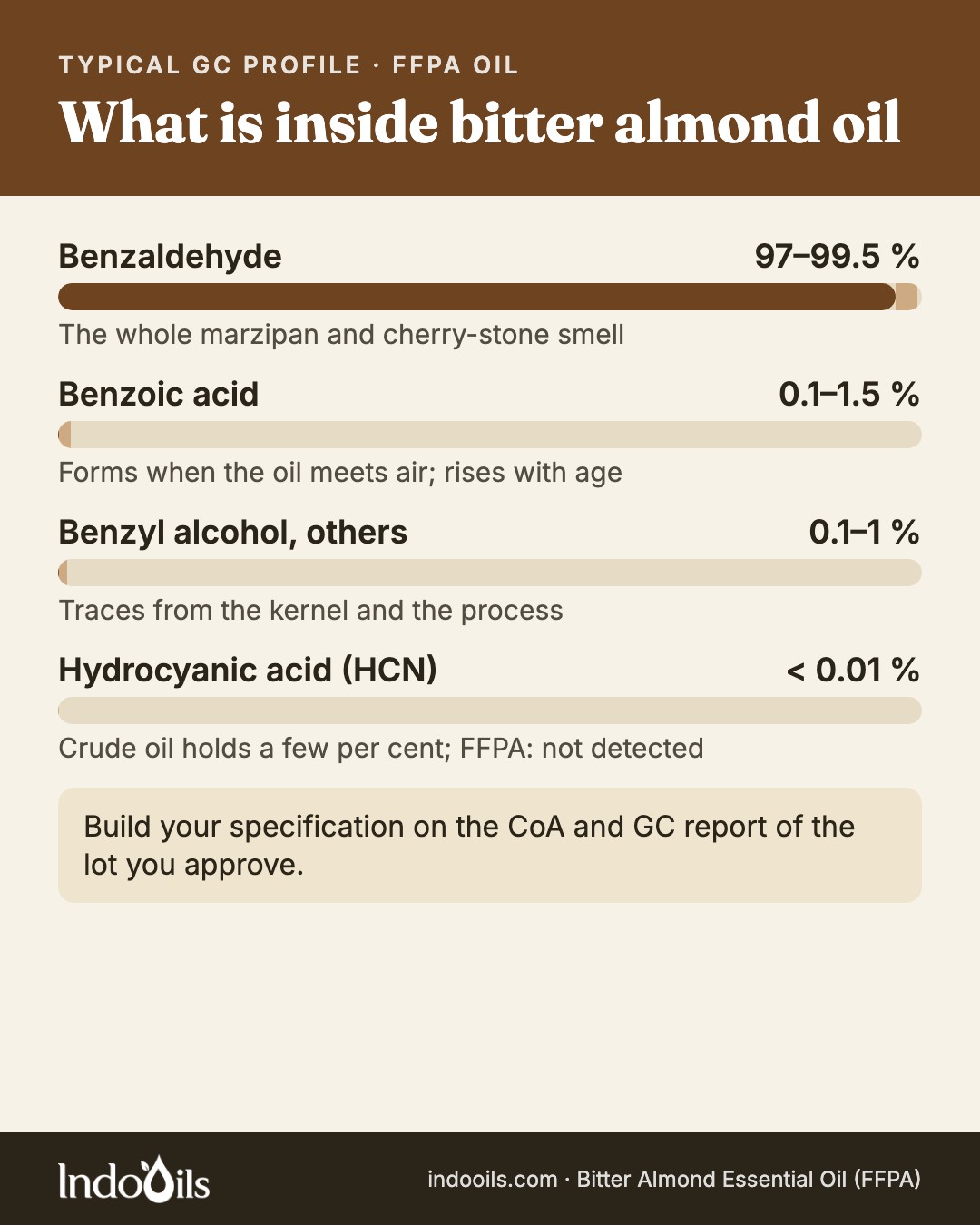
Bitter almond oil is the simplest essential oil in the catalogue: one compound makes up nearly all of it.
- Benzaldehyde is 97 to 99 per cent or more. It carries the whole marzipan, cherry-stone and amaretto character.
- Benzoic acid forms when benzaldehyde meets air. Fresh oil has very little; old or badly stored oil has more, and it can show as white crystals in the container and a flatter, sourer smell.
- Benzyl alcohol and other traces come from the kernel and the process. They are small, but they are part of what makes the natural oil smell rounder than pure benzaldehyde.
- Hydrocyanic acid should be absent. Crude oil holds a few per cent of it; FFPA oil should be "not detected" on the CoA.
Because the oil is almost one compound, GC alone cannot tell natural oil from pure benzaldehyde. That is the job of the origin tests in the next section.
What to Check on the CoA
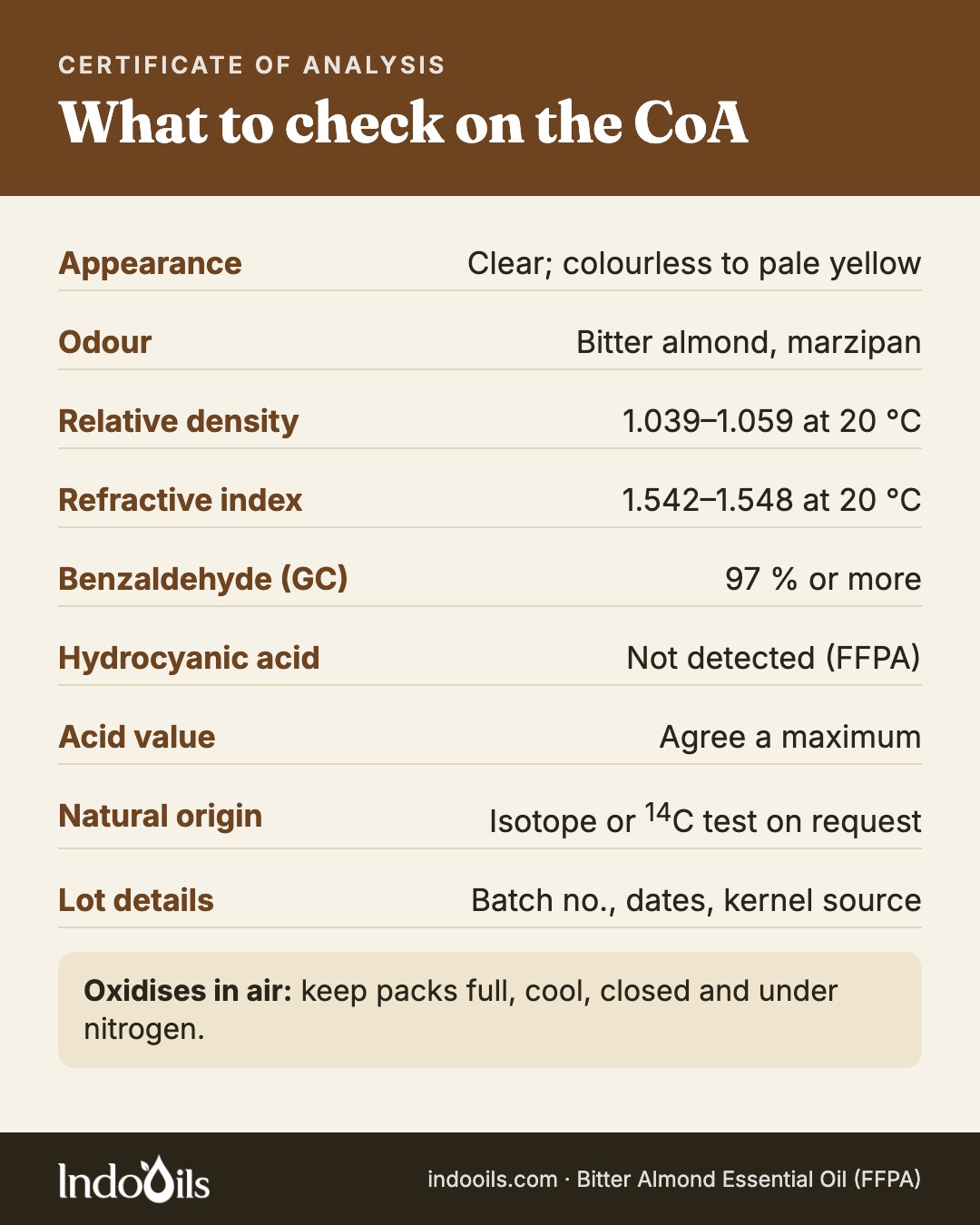
Ask for a CoA for every lot and check these lines:
- Appearance: clear, colourless to pale yellow. A darker yellow or brown oil, or crystals, points to age or poor storage.
- Odour: clean, intense bitter almond. A sharp, solvent-like note can point to synthetic benzaldehyde; a cinnamon or cassia note to natural benzaldehyde from cassia.
- Relative density: about 1.039–1.059 at 20 °C.
- Refractive index: about 1.542–1.548 at 20 °C.
- Optical rotation: inactive, about 0°.
- Benzaldehyde by GC: 97 per cent or more.
- Hydrocyanic acid: not detected. This is the FFPA line. Do not accept a lot without it.
- Acid value or benzoic acid: agree a maximum with your supplier, so oxidised oil is rejected.
- Lot details: batch number, production and expiry dates, kernel source and country.
Adulteration and how it is found
The usual fraud is to sell benzaldehyde, or bitter almond oil cut with it, as natural bitter almond oil. A pure benzaldehyde passes every line above, so origin needs other tests:
- Synthetic benzaldehyde made from toluene often carries traces of chlorinated by-products, such as chlorobenzaldehyde, that natural oil never has. GC-MS can find them.
- Radiocarbon (¹⁴C) testing separates petrochemical benzaldehyde, which has no ¹⁴C, from anything plant-based.
- Isotope ratio testing (IRMS or SNIF-NMR) can separate bitter almond oil from natural benzaldehyde made from cassia, which ¹⁴C cannot, because both are plant-based.
These tests are not needed for every lot. Run them on your approval sample and from time to time after that, and ask your supplier for a natural-origin statement with each lot. Our post on clean-label traceability explains how buyers build this into their supplier approval.
Where Bitter Almond Oil Is Used
Bitter almond oil is a flavour material first and a fragrance material second. It is very strong, so it is always used at low levels and usually as part of a larger flavour or fragrance.
Food and drink
- Bakery and confectionery: marzipan, almond paste, nougat, macarons, biscuits, cake and pastry fillings.
- Liqueurs and drinks: amaretto- and kirsch-style liqueurs, cherry and almond syrups, colas and soft drinks.
- Dairy and desserts: ice cream, yoghurt, puddings and almond-flavoured milk drinks.
- Fruit flavours: cherry, maraschino, apricot and peach, where it gives the stone-fruit note.
For flavour buyers, see our food and beverage page.
Fragrance and personal care
- Fine fragrance and toiletries: almond, cherry, heliotrope and gourmand accords, often with vanilla, tonka and balsams.
- Soaps, candles and home fragrance: the classic almond and cherry notes, at low levels. See our home care and fragrance and cosmetics and personal care pages.
Bitter almond oil is not used in aromatherapy or for diffusing: it is a manufacturing material.
Oils it is often bought with
Bitter almond oil works with warm, sweet and balsamic materials. Buyers often order it with:
- Cassia Spice Oil and Cinnamon Bark Essential Oil for cherry and cola flavours
- Clove Bud Essential Oil for spiced cherry and bakery flavours
- Benzoin Resinoid and Balsam Tolu for gourmand and oriental fragrances
- Sweet Orange Essential Oil, Bergamot Essential Oil and Neroli Essential Oil to lift almond and cherry accords
- Bulgarian Rose Otto and Sandalwood Essential Oil in almond-floral and woody perfumes
See the full range in our essential oils category.
Safety, Food and Cosmetic Rules
Handling
- Only FFPA oil. Check the hydrocyanic acid result on the CoA for every lot before it enters production.
- Harmful if swallowed. Benzaldehyde is classified as harmful if swallowed, and most SDSs add skin, eye and respiratory irritation. Wear gloves and eye protection and work with good ventilation.
- Combustible. The flash point is about 63 °C. Keep the oil away from heat and open flames.
- Environment. Avoid release to drains. Your supplier's SDS gives the full GHS classification and transport details.
Food
- United States: bitter almond oil free from prussic acid has FEMA number 2046 and is on the GRAS list for essential oils (21 CFR 182.20).
- European Union: hydrocyanic acid may not be added to food as such, and Regulation (EC) 1334/2008, Annex III, sets maximum levels in finished foods, for example 50 mg/kg in nougat and marzipan, 35 mg/kg in alcoholic drinks and 5 mg/kg in canned stone fruit. FFPA oil with HCN "not detected" makes these limits easy to meet, but your own product still has to comply.
- Natural labelling: in the EU a "natural bitter almond flavouring" must get at least 95 per cent of its flavouring from bitter almond. Natural benzaldehyde from cassia does not qualify for that name, which is one reason origin testing matters.
Cosmetics and fragrance
- Use bitter almond oil within the IFRA limits for your product type and ask for an IFRA conformity statement.
- Ask for an allergen declaration and check it against the expanded EU fragrance allergen list. Our post on fragrance allergen labelling explains the 2023 rules.
- Make sure the INCI name on your label is the bitter almond oil name, not the sweet almond carrier oil name. Mixing the two up is a common paperwork error.
Documents We Provide
For each lot of bitter almond oil, IndoOils can supply:
- Certificate of Analysis with benzaldehyde content and the hydrocyanic acid result
- GC-MS report from an independent laboratory
- Safety Data Sheet with the full GHS classification
- FFPA statement for the lot
- IFRA statement and allergen declaration
- Natural-origin statement, with isotope testing on request
- Food-grade statement on request
- Certificate of origin and standard export documents
Sample documents are on our downloads page, and our certifications are listed on the certifications page.
Packing and Storage
Bitter almond oil is supplied in 25 kg and 50 kg aluminium packs and 200 kg drums, minimum order one pack. Each pack is filled full, sealed and labelled with its batch number.
Benzaldehyde reacts with air, so storage matters more than for most oils:
- Keep packs full, tightly closed and at 15–25 °C, away from light and heat.
- Flush part-used packs with nitrogen before closing them.
- Use stainless steel, glass, aluminium or lined steel for handling. Keep the oil away from strong oxidisers and alkalis.
- Shelf life is 24 months unopened. Use opened packs within about six months, and check the acid value of older stock before use.
How to Order
- Request a sample through our sample request page (see our sample policy). Test it in your own application and run any origin tests on it.
- Approve a specification from the sample's CoA: benzaldehyde minimum, HCN not detected, acid value maximum and the physical constants.
- Send a bulk inquiry through our bulk inquiry form with the quantity, pack size, destination and documents you need. We reply with a quotation.
- Receive the lot with its CoA, SDS and FFPA statement, and check them against your approved specification.
Frequently Asked Questions
Is bitter almond oil poisonous?
Crude bitter almond oil is, because it contains hydrocyanic acid. The oil sold to the flavour and fragrance trade is FFPA, with the hydrocyanic acid removed and tested for on every lot. It is still a strong, concentrated material that is harmful if swallowed neat and is only for use in manufacturing.
What does FFPA mean?
FFPA stands for "free from prussic acid". Prussic acid is another name for hydrocyanic acid. An FFPA oil has had it removed and redistilled, and its CoA shows hydrocyanic acid as not detected.
Is bitter almond oil made from almonds?
Sometimes. It can be distilled from bitter almonds, apricot kernels or peach kernels, and most of today's supply comes from apricot kernels. All give the same oil, which is mostly benzaldehyde. The kernel source is stated on the CoA.
Is bitter almond oil the same as sweet almond oil?
No. Sweet almond oil is a fixed carrier oil pressed from sweet almonds, with almost no smell. Bitter almond oil is an essential oil, almost all benzaldehyde, with a strong marzipan smell. They have different CAS numbers and INCI names.
Is bitter almond oil just benzaldehyde?
Chemically it is 97 to 99 per cent benzaldehyde, but it is natural and comes from the kernel. Pure benzaldehyde, natural or synthetic, is a different product. Isotope and radiocarbon tests can tell them apart.
Can bitter almond oil be used in food?
Yes, if it is FFPA and food-grade. It has FEMA number 2046 and is on the US GRAS list. In the EU, finished foods must stay within the hydrocyanic acid limits in Regulation 1334/2008. Ask for a food-grade statement when you order.
Why does old bitter almond oil form crystals?
Benzaldehyde reacts with air and slowly turns into benzoic acid, which can crystallise out. Keep packs full, closed and cool, flush part-used packs with nitrogen, and check the acid value of older stock before use.
More Buyer's Guides
- Bulk Allspice (Pimento) Oil: A Buyer's Guide
- Bulk Sweet Orange Oil: A Buyer's Guide
- Bulk Cardamom Oil from India: A Buyer's Guide
- Bulk Bulgarian Rose Otto: A Buyer's Guide
- Bulk Carrier Oils for Cosmetics: A Buyer's Guide
Ready to buy? Request a sample or send a bulk inquiry, and tell us your application and the documents you need.
Buying in bulk?
25 kg, 50 kg and 200 kg packs, with a certificate of analysis for every lot.
Tell us the product, quantity and destination, and we will come back with a quotation.