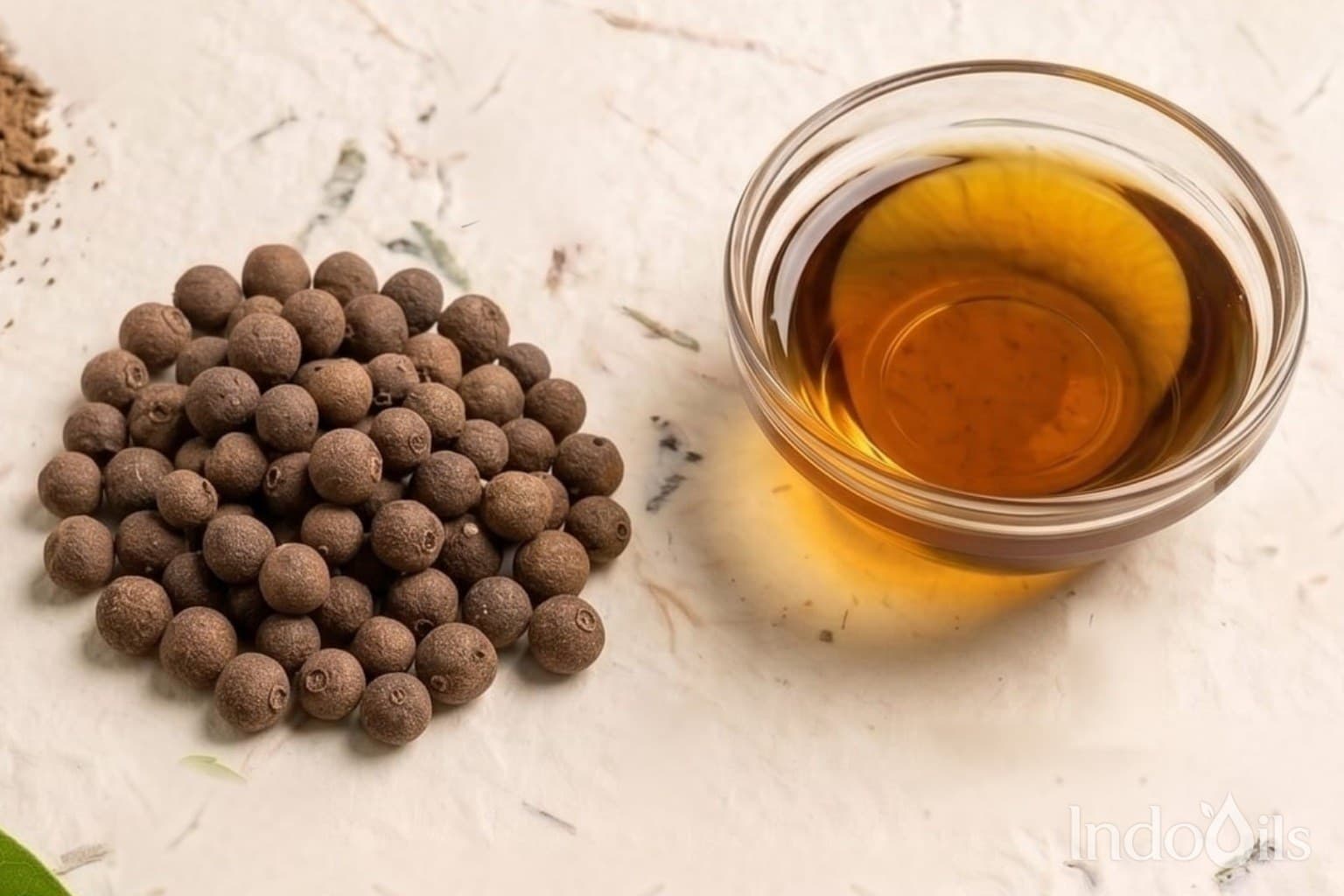
Allspice is one spice that tastes like several. Its small, dried, reddish-brown berries smell of clove, cinnamon, nutmeg and black pepper at once, which is how the spice got its English name. It is the backbone of Jamaican jerk seasoning, a standard ingredient in European sausages, pickles and ketchup, and part of almost every "mixed spice" and pumpkin-spice blend.
The essential oil, allspice oil or pimento berry oil, delivers that aroma in a clean, concentrated, consistent form. Food, flavour and fragrance manufacturers buy it in bulk, and it is a classic material in spicy and oriental perfumes.
This guide covers Allspice Essential Oil from IndoOils: what it is, what is in it, which tests matter, which rules apply, where it is used and how to order it in bulk.
One Berry, Several Names
Allspice goes by different names in different markets, and some of them overlap with other spices:
- Allspice: the usual English name, in recipes, retail packs and US trade.
- Pimento or pimenta: the trade name in Jamaica and much of Europe. "Pimento berry oil" is a common name on European specifications. It has nothing to do with the red pimento pepper (a capsicum) used to stuff olives.
- Jamaica pepper and myrtle pepper: older names, still used on some documents.
- Pimenta dioica: the botanical name. Older documents use Pimenta officinalis for the same plant.
Allspice is a tree of the myrtle family (Myrtaceae), the same family as clove. That is why both oils are rich in eugenol and smell related. Allspice is not a blend of other spices, and it is not the same as West Indian bay oil, which comes from a close relative, Pimenta racemosa.
Product identifiers
- Product: Allspice (Pimento Berry) Essential Oil
- Botanical name: Pimenta dioica (L.) Merr.; synonym Pimenta officinalis
- INCI name: Pimenta Dioica Berry Oil
- CAS number: 8006-77-7 (berry oil)
- FEMA number: 2018
- HSN code: 33012950 (spice oils not elsewhere specified)
- SKU: INDO-0002
- Plant part: Dried unripe berries
- Extraction method: Steam distillation
- Origin: Jamaica
- Shelf life: 36 months, unopened
Berry Oil or Leaf Oil?
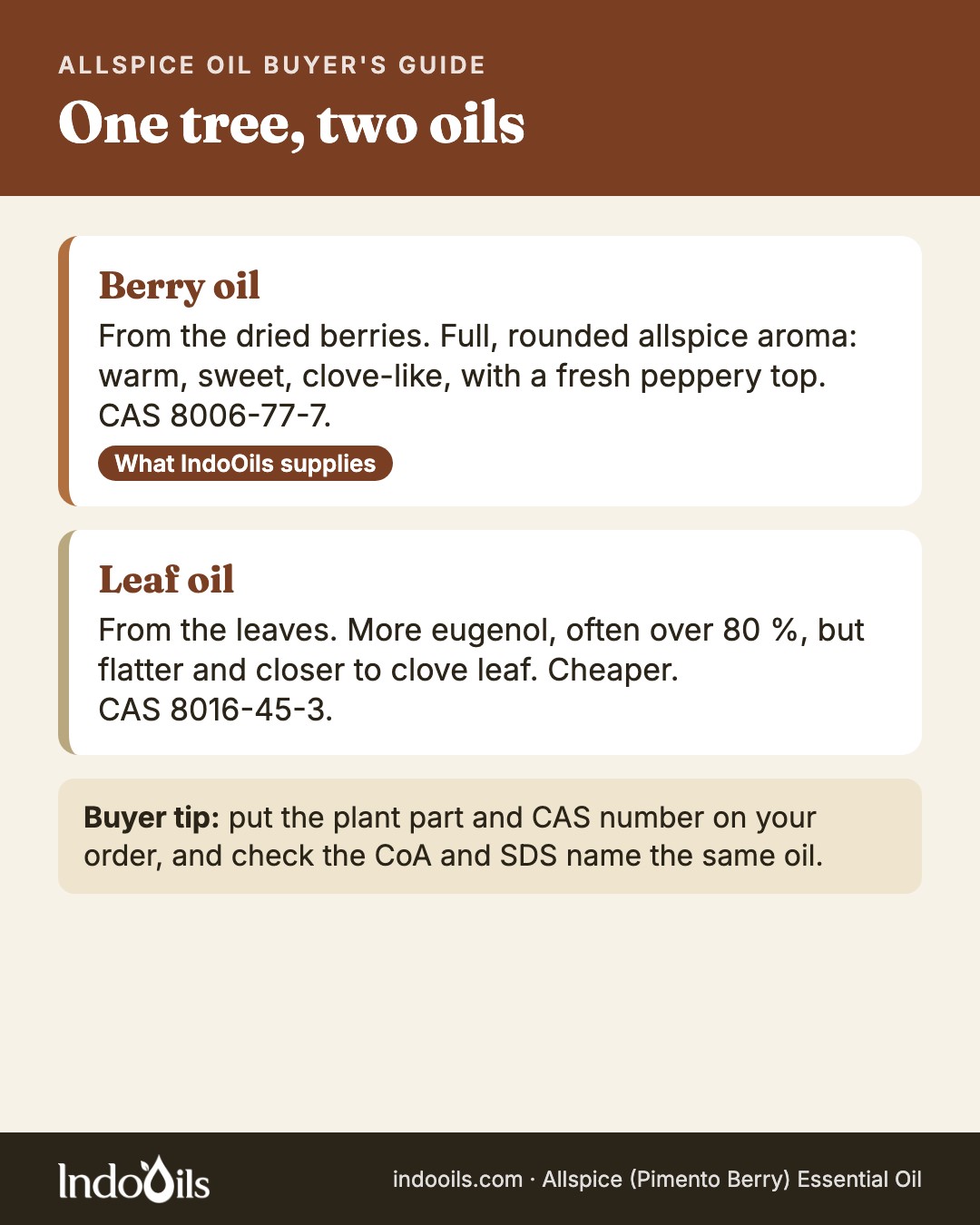
The allspice tree gives two essential oils, and an enquiry for "allspice oil" can be answered with either, so it pays to be precise:
- Berry oil (pimento berry oil, CAS 8006-77-7) is distilled from the dried berries. It has the full, rounded allspice aroma: warm, sweet and clove-like, with peppery and slightly fresh top notes. It is the oil flavourists and perfumers mean when they say "allspice". This is what IndoOils supplies.
- Leaf oil (pimento leaf oil, CAS 8016-45-3) is distilled from the leaves. It contains even more eugenol, often over 80 per cent, but it smells flatter and more like clove leaf oil. It is cheaper and is mostly used in fragrance and as a natural source of eugenol.
Both are legitimate products. The problem is when leaf oil is sold as berry oil, or the two are blended and sold as berry oil. Put the plant part and the CAS number on your purchase order and check that the CoA and SDS name the same material.
If your application needs leaf oil or an allspice oleoresin instead, ask us: we can check availability with our partners.
How Allspice Oil Is Made
IndoOils' allspice oil is of Jamaican origin and reaches us through our partner network. It is released only after IndoOils' own checks, described on our quality assurance page.
- Harvest. Allspice berries are picked green, when they are fully grown but not yet ripe. Ripe berries are soft and lose most of their aroma, so timing matters. In Jamaica the main harvest runs from about July to September.
- Drying. The berries are sun-dried, traditionally on concrete barbecues, for about a week, until they turn reddish-brown and rattle when shaken.
- Crushing. The dried berries are crushed just before distillation, so the oil is released fresh.
- Steam distillation. Steam passes through the crushed berries and carries the volatile oil to a condenser. Allspice oil is heavier than water, so the oil collects below the water in the separator, not on top. Good berries hold about 3 to 4.5 per cent of oil.
- Testing. Each batch is checked and analysed by GC-MS at an independent laboratory before release.
- Packing. The oil is filled into clean 20 kg or 50 kg aluminium containers, sealed and labelled with its batch number.
Jamaica is the classic source and is known for high-oil berries. Mexico, Guatemala and Honduras also grow allspice in large volumes. Because there is one main harvest a year and most of the crop is wild-harvested or grown on small farms, prices follow the berry crop closely. Our post on climate volatility and wholesale pricing explains how a single weak harvest shows up in spice oil prices until the next one.
What Is Inside Allspice Oil
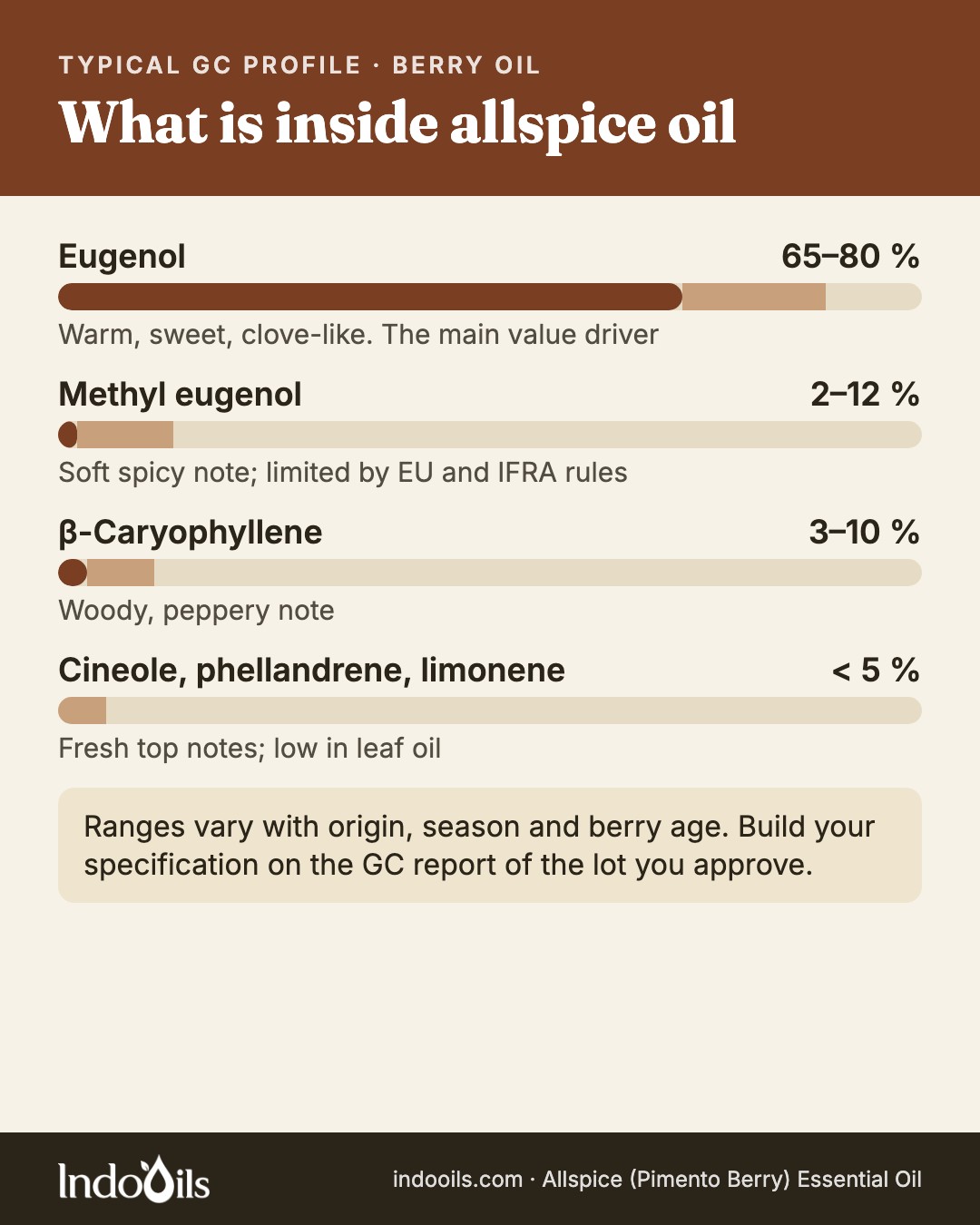
Allspice berry oil is dominated by one compound:
- Eugenol is the main constituent, usually 65 to 80 per cent. It gives the warm, sweet, clove-like note, and it is the main reason for the oil's value.
- Methyl eugenol is the second phenolic compound, typically a few per cent and sometimes over 10 per cent depending on origin and season. It adds a softer, spicy-floral note. It also matters for regulation, as explained below.
- β-Caryophyllene gives a woody, peppery note.
Smaller amounts of 1,8-cineole, α-phellandrene, limonene, myrcene and α-humulene give the fresh, peppery top notes that make berry oil smell brighter than leaf oil.
The balance varies with the origin, the season, the age of the berries and the distillation. That is normal for a natural oil. It is also why your specification should be built on the GC report of the lot you approve, with a minimum eugenol figure and a maximum methyl eugenol figure, not on a textbook range.
What to Check on the Certificate of Analysis
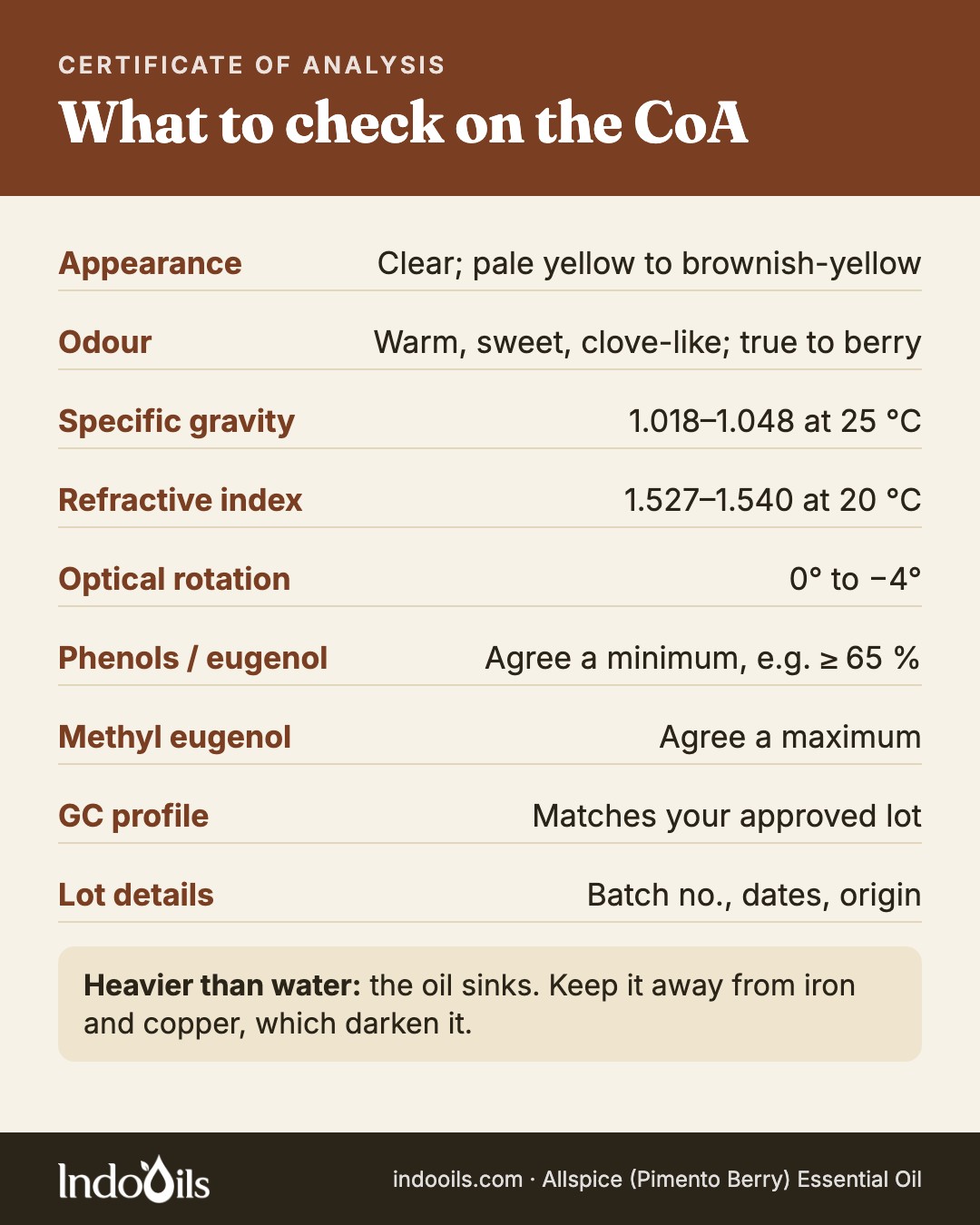
The Food Chemicals Codex monograph for pimenta (allspice berry) oil is the usual base for a specification. Its ranges are a sensible starting point for a contract:
- Appearance: clear liquid; pale yellow to brownish-yellow. Very dark oil is usually old, has been stored badly or has touched iron.
- Odour: warm, sweet, spicy and clove-like, with a fresh, peppery top note, true to crushed allspice berries.
- Specific gravity: 1.018–1.048 at 25 °C. The oil is heavier than water.
- Refractive index: 1.527–1.540 at 20 °C.
- Optical rotation: 0° to −4°.
- Phenol content: by GC, or total phenols by the classic alkali test, in which the phenols dissolve in a potassium hydroxide solution and the loss in oil volume is measured. Agree a minimum, for example 65 per cent.
- Methyl eugenol: by GC. Agree a maximum if you make cosmetics or sell food into the EU.
- GC profile: eugenol as the main peak, with methyl eugenol, β-caryophyllene and the minor constituents matching your approved reference.
- Flash point: the SDS gives the figure for each lot.
Every IndoOils lot comes with a CoA that reports these results, and every later lot should be checked against the sample you approved.
Spotting leaf oil, synthetic eugenol and cut oils
Allspice oil is valued for its eugenol and its rounded berry character, so most adulteration either swaps the source or fakes the eugenol:
- Leaf oil sold as berry oil, or blended in. Eugenol is higher than usual, while the fresh top-note compounds (cineole, phellandrene, limonene) are lower. The oil smells flatter.
- Clove leaf oil or synthetic eugenol added. The eugenol figure looks right, but the minor peaks no longer match an allspice reference. Clove oils carry eugenyl acetate and a different sesquiterpene pattern. Where a natural claim matters, isotope analysis can tell natural from synthetic eugenol.
- Solvents or carrier oils. These show up in specific gravity, refractive index and the GC.
Our cosmetics importer checklist covers adulteration risks across the wider essential-oil range.
Where Allspice Oil Is Used
Allspice oil gives the aroma of a large weight of berries in a few drops, with no husk, specks or colour, and the same strength in every batch. Its main uses are:
- Meat and savoury flavours: sausages, cured and processed meats, jerk and barbecue seasonings, marinades and brines.
- Sauces and pickles: ketchup, brown sauces, chutneys, pickled vegetables and pickled fish such as herring.
- Bakery and confectionery: spice cakes, gingerbread, biscuits and pumpkin-spice and mixed-spice premixes.
- Beverages: bitters, liqueurs, colas and spiced drinks, as part of a flavour system.
- Fragrance: spicy, oriental and woody accords in fine fragrance and aftershaves, and in bay-rum-type products.
- Soaps, candles and home fragrance: warm spice notes at low levels.
Allspice oil works naturally with the other warm spice oils. For a sharper, more medicinal clove note, see Clove Bud Essential Oil and Clove Leaf Essential Oil. For sweetness and warmth, flavourists often add Cinnamon Leaf Essential Oil or Cinnamon Bark Essential Oil, and for the nutmeg side of the profile, Nutmeg Essential Oil India or Mace Oil. Black Pepper Essential Oil and Ginger Essential Oil complete a savoury spice profile. For body and colour in sauces and meat products, oils are often combined with oleoresins such as Clove Oleoresin and Nutmeg Oleoresins; our spice oleoresins guide explains how they work together. The full range is in spice oils.
Safety, Food and Cosmetic Rules
Handling
Neat allspice oil is a concentrated, phenol-rich material. EU-format Safety Data Sheets for allspice berry oil typically classify it as:
- May cause an allergic skin reaction and causes serious eye irritation, because of its eugenol. Handle with gloves and eye protection, and never apply the oil undiluted.
- Harmful if swallowed.
- May cause cancer and suspected of causing genetic defects, because methyl eugenol is classified as a carcinogen in the EU and any mixture with 0.1 per cent or more carries the same label. This is a hazard classification for the neat oil, and it is why the methyl eugenol figure matters.
- Harmful to aquatic life.
The SDS supplied with each lot gives the full GHS classification, the flash point and transport details. Share it with your EHS team before the first drum arrives.
Food and flavour
- US: allspice oil has its own FEMA number (2018) and is on the GRAS list of essential oils (21 CFR 182.20). Pimento leaf oil has a separate FEMA number (2901).
- EU and UK: allspice oil is used as a flavouring preparation under the flavourings regulation (EC) No 1334/2008. Methyl eugenol may not be added to food as such, and the regulation sets maximum levels for it in some finished foods, such as meat products, sauces and soups. Flavour houses selling into the EU calculate methyl eugenol in the finished food, so they will ask for the GC figure.
- India: allspice is a permitted spice, and its oil is used by flavour houses. Ask for food-grade documentation with the lot, not only a CoA.
Cosmetics and fragrance
- Methyl eugenol limits: EU and UK cosmetic rules limit methyl eugenol in finished products: about 0.01 per cent in fine fragrance and much less in creams, other leave-on products and oral care. IFRA sets similar limits. With a few per cent methyl eugenol in the oil, these limits, not the eugenol, usually decide how much allspice oil a formula can carry.
- Allergens: eugenol is a listed EU and UK fragrance allergen, and the oil may also contain others, such as limonene. The allergen declaration for each lot gives the figures, and our post on fragrance allergen labelling explains the labelling thresholds.
- IFRA statement: fragrance and personal-care buyers will ask for one with each supply.
Documents to Ask For
Every IndoOils order ships with a batch-specific CoA. For allspice oil, ask for this set before approving a supplier:
- Certificate of Analysis (CoA) with appearance, specific gravity, refractive index, optical rotation, phenol or eugenol content, methyl eugenol and the main GC constituents.
- GC-MS report from the independent laboratory.
- Safety Data Sheet (SDS) with GHS classification and transport details.
- IFRA statement and allergen declaration for personal-care and home-care use.
- Food-grade statement for flavour use.
- Certificate of origin, which also confirms that you are buying Jamaican berry oil.
Standard templates are on the downloads page. IndoOils works under an ISO 9001:2015 quality system and follows GMP; see certifications.
Packing, Storage and Shelf Life
- Supplied in 20 kg and 50 kg aluminium containers, sealed and labelled with the batch number, net weight and dates.
- Store at 15–25 °C in a cool, dry, well-ventilated place, out of direct sunlight and away from heat.
- Keep containers tightly closed and the headspace small. Air slowly darkens the oil and flattens its fresh notes.
- Handle with stainless steel, glass or aluminium. Eugenol reacts with iron and copper and turns the oil dark.
- Shelf life is 36 months unopened. Once opened, use within about 12 months.
How to Order Allspice Oil in Bulk
Allspice Essential Oil is supplied in 20 kg and 50 kg aluminium packs, with a minimum order of one pack. Prices are quoted on request and depend on the crop, volume, destination and contract length.
- Request a quotation: send a bulk inquiry with your application (meat flavour, sauces, bakery, beverages, fragrance), the annual volume you expect, your minimum eugenol and maximum methyl eugenol, and any specification you already buy against.
- Approve a sample first: request a sample with its CoA for lab and sensory approval, and keep it as your reference.
- Need your own pack or blend? See our private label and custom formulation services.
Allspice has one main harvest a year, so buyers with steady demand often agree volumes for the season ahead. Export shipments include a commercial invoice, packing list and certificate of origin, and the oil is packed and labelled according to the classification on its SDS.
Frequently Asked Questions
Is allspice oil a blend of spices?
No. Allspice oil comes from one plant, Pimenta dioica. It is called allspice because its aroma reminds people of clove, cinnamon, nutmeg and pepper together.
What is the difference between pimento berry oil and pimento leaf oil?
Berry oil is distilled from the dried berries and has the full, rounded allspice aroma. Leaf oil is distilled from the leaves, contains more eugenol, smells flatter and is cheaper. They have different CAS numbers: 8006-77-7 for berry oil and 8016-45-3 for leaf oil.
Is allspice oil the same as clove oil?
No, though they are related. Both trees belong to the myrtle family and both oils are rich in eugenol. Allspice oil has a softer, rounder profile with peppery top notes, and it contains methyl eugenol, which clove oil has in only very small amounts.
Why does the methyl eugenol figure matter?
Methyl eugenol is a natural constituent of allspice oil, but EU, UK and IFRA rules limit how much of it can be in cosmetics and some foods. The figure on the CoA tells you how much oil your formula can carry within those limits.
Can allspice oil be used in food?
Yes. It is widely used in meat products, sauces, pickles, bakery and beverages. In the US it has a FEMA number (2018) and GRAS status. Ask for food-grade documentation with your order, and check the methyl eugenol rules for your market.
What is the HSN code for allspice oil?
India's tariff has no separate line for allspice oil, so it is usually classified under 33012950 (spice oils not elsewhere specified), with GST at 18 %. Confirm the code with your customs agent for your own shipments.
What is the minimum order?
One 20 kg pack. 50 kg packs are also available, and a sample can be sent before you order in bulk.
For more buyer's guides, see our posts on black pepper oil, cardamom oil, ajwain oil and spice oleoresins, or browse the full essential oils range.
Buying in bulk?
20 kg and 50 kg packs, with a certificate of analysis for every lot.
Tell us the product, quantity and destination, and we will come back with a quotation.