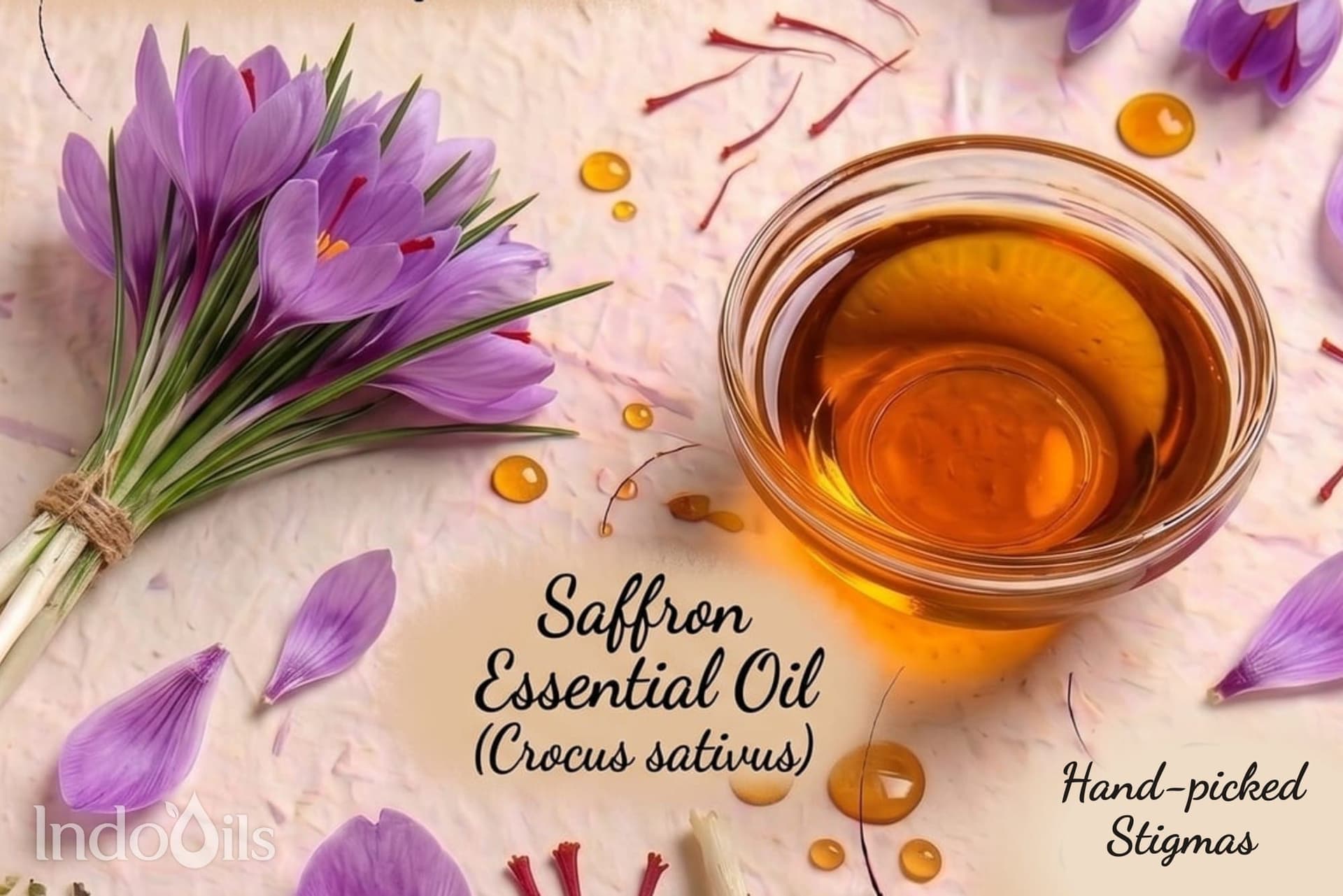
Saffron is the dried red stigma of the saffron crocus (Crocus sativus). Each flower carries only three stigmas, which are picked by hand on the morning the flower opens. It takes roughly 150,000 flowers to make one kilogram of dried saffron, which is why it is the most expensive spice in the world.
Iran grows most of the world's saffron, around 90 % by most estimates. Spain, Afghanistan, Greece and Morocco follow. In India, saffron is grown on the karewa plateaus of Kashmir, around Pampore in Pulwama district, with smaller areas in Budgam, Srinagar and Kishtwar. Kashmir saffron received a Geographical Indication (GI) tag in 2020 and is prized for its deep colour and strong aroma.
Because the raw material is so costly, "saffron oil" is one of the most loosely used names in the essential oil trade. This guide explains the forms you will be offered, what to check on the paperwork and how to buy the saffron range from IndoOils in bulk.
Four Products Sold as "Saffron Oil"
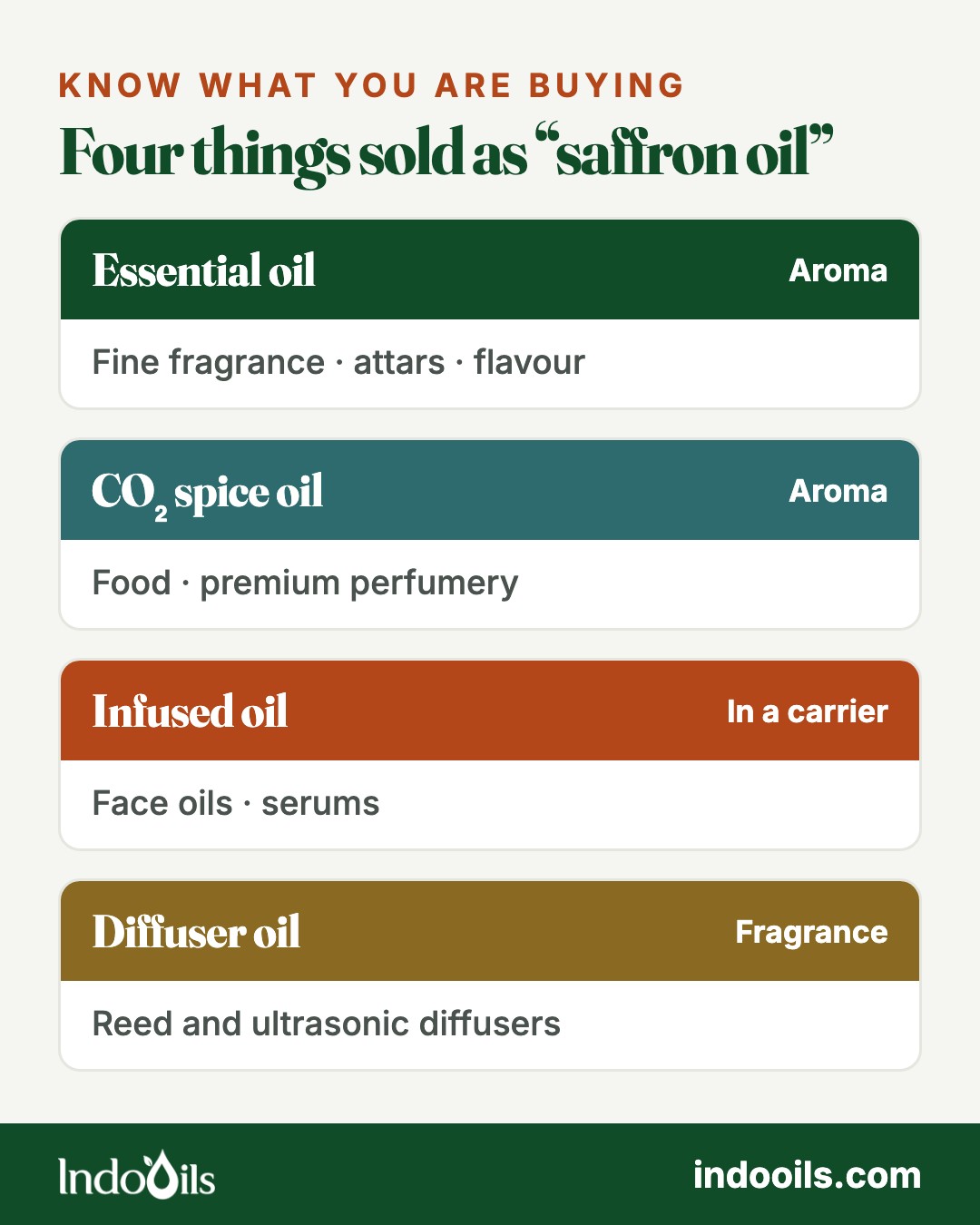
Before you compare quotes, make sure every supplier is offering the same thing. Saffron oil is sold in four quite different forms, and the price, strength and best use change a lot from one to the next.
Saffron Essential Oil
Saffron Essential Oil is the concentrated aroma of the stigmas. Its job is scent and flavour, not colour. It is used in very small amounts in fine fragrance, attars, luxury cosmetics and flavours.
- Botanical name: Crocus sativus
- INCI name: Crocus Sativus Stigma Oil
- CAS number: 8022-19-3
- HSN code: 33012990
- SKU: IND0098
- Plant part: Stigmas
- Raw material origin: India, Spain or Iran (ask for the origin of your lot)
- Shelf life: 36 months, unopened
Saffron holds only a small amount of volatile oil, usually well under 1 % of the dried stigmas. True steam-distilled saffron oil is therefore rare and very expensive. Much of what the trade calls "saffron essential oil" is in fact an absolute or extract, which is why CAS 8022-19-3 is also used for saffron absolute, resinoid and oleoresin. Ask your supplier to state the extraction method on the CoA. That one line decides how you should judge the price.
Saffron CO₂ Spice Oil
Saffron Spice Oil is extracted with supercritical CO₂ at low temperature. Without heat or water, the extract keeps more of the fresh, honeyed, hay-like character of good saffron threads. It is deep golden-red to amber, soluble in oils and alcohol, and insoluble in water. Flavour houses and fine fragrance perfumers favour it for its rounded, natural profile.
- CAS number: 84604-17-1
- HSN code: 33012990
- SKU: INDO-564
- Extraction method: Supercritical CO₂
- Category: Spice oils
Saffron Oil (Infused, Organic)
Saffron Oil is made by extracting saffron stigmas into a carrier. The result is a golden reddish-orange oil that dissolves easily in other fixed oils. This is the form used in face oils, serums and Ayurvedic-style cosmetic formulations, where saffron is one part of a larger oil blend. Ask for the name and percentage of the carrier oil, because it determines the INCI list on your finished product.
- CAS number: 84604-17-1
- SKU: INDO-508
- Category: Organic essential oils
Saffron Diffuser Oil
Saffron Diffuser Oil is a ready-to-use fragrance oil for reed diffusers and ultrasonic diffusers. It gives a warm, spicy-sweet, leathery saffron note at a price that suits home fragrance. It is a fragrance product, not a pure botanical oil, so do not use it in food or skincare. See the full aroma diffuser oils range.
- HSN code: 33029012
- SKU: INDO-595
The Chemistry: Colour, Bitterness and Aroma
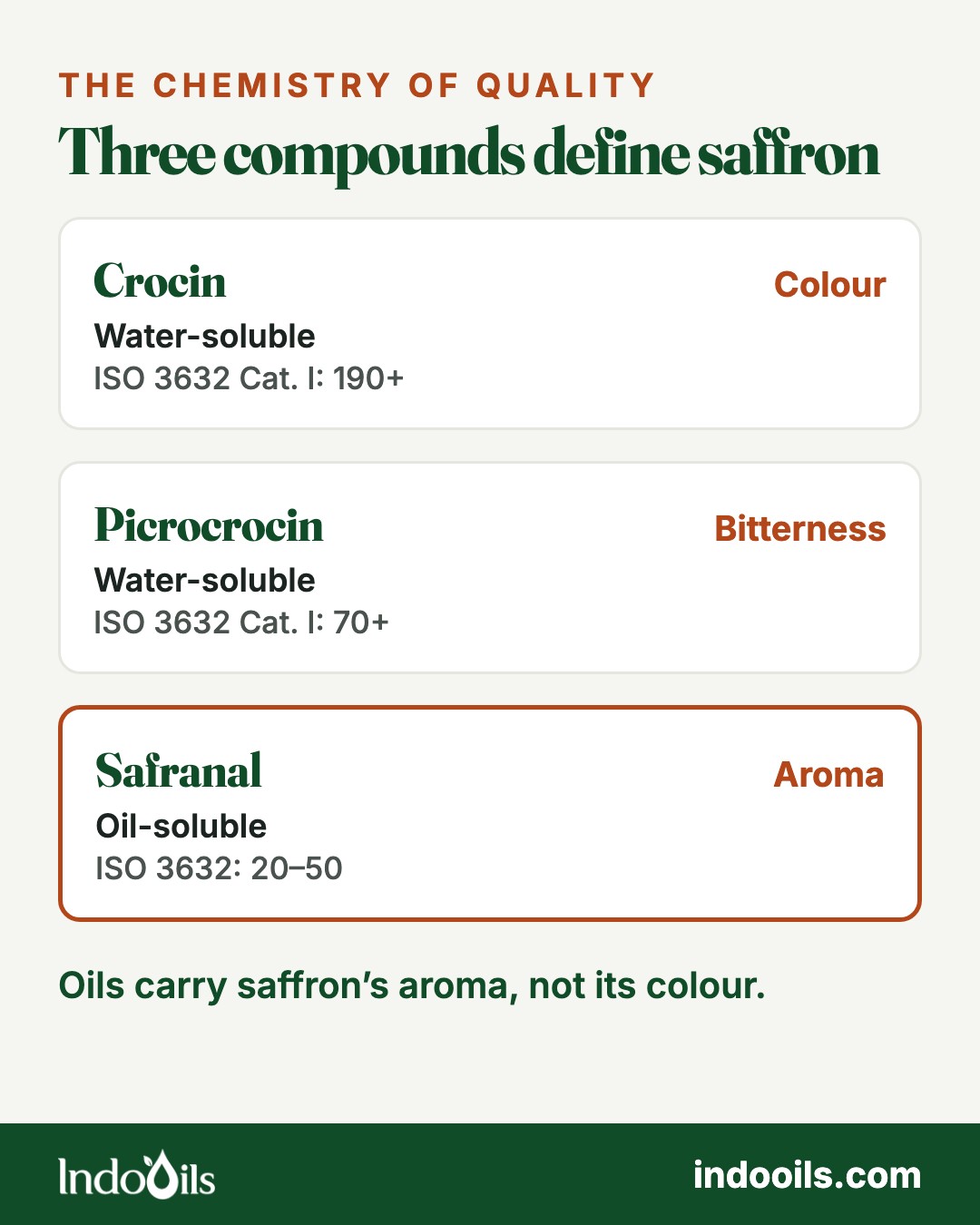
Saffron quality is defined by three compounds, and the international grading standard for threads, ISO 3632, measures all three:
- Crocin: the golden-red colour. Category I saffron must reach a colouring strength of at least 190 (absorbance at 440 nm).
- Picrocrocin: the bitter taste, and the parent of safranal. Category I needs at least 70.
- Safranal: the honeyed, hay-like, slightly metallic aroma. It forms from picrocrocin as the stigmas dry, and it is usually the main constituent of saffron's volatile oil.
This matters for oil buyers in one important way. Crocin and picrocrocin are water-soluble, while safranal is volatile and oil-soluble. A steam-distilled or CO₂ oil therefore carries the aroma of saffron, but not much of its colour. A deep red-orange oil does not prove high saffron content. The colour may come from the carrier, from other carotenoids or from added colour.
On a GC-MS report, look for:
- Safranal as a leading peak, with smaller amounts of isophorone-type compounds (such as 4-ketoisophorone) and other saffron volatiles.
- A natural profile, not a single molecule. A report showing almost pure safranal with very little else suggests synthetic safranal. It is cheap and widely used to "boost" saffron oils.
- No undeclared solvent or carrier peaks that the specification sheet does not mention.
Saffron is one of the most adulterated spices in the world, so oils made from it need the same care. Ask for the ISO 3632 category of the threads used, and a written statement that no nature-identical or synthetic saffron aroma chemicals were added.
Where Bulk Buyers Use Saffron Oil
Fine fragrance and attars
Saffron is one of the defining notes of modern Middle Eastern and niche perfumery. It sits at the heart of oud, leather, rose and amber accords. In India it has a long history in the attar tradition of Kannauj, where floral and spice materials are distilled into a sandalwood base. A little natural saffron goes a long way: perfumers use it to add warmth and a luminous, leathery edge.
Cosmetics and personal care
- Face oils and serums: infused saffron oil in premium facial oil blends, often with sandalwood, almond or jojoba.
- Creams and lotions: essential oil or CO₂ extract at trace levels for a luxury saffron fragrance.
- Soaps and bath products: premium bars and bath oils with a warm, golden note.
Cosmetic brands can find more on our cosmetics and personal care page. Make product claims only on the basis of your own safety assessment and the rules of your market.
Food and beverage
Saffron appears in the US list of natural extractives generally recognised as safe (21 CFR 182.20). A few drops of saffron extract can standardise the aroma of:
- Rice dishes and ready meals: biryani, pulao, paella and risotto.
- Indian sweets and dairy: kesar milk, kulfi, shrikhand, rasmalai and halwa.
- Bakery and confectionery: saffron buns, cakes and chocolate.
- Beverages: Gulf-style coffee, teas and premium soft drinks.
Use only food-grade CO₂ extract or essential oil with matching paperwork, never the infused cosmetic oil or the diffuser oil. In India, ask for documents that meet your FSSAI requirements. More on our food and beverage page.
Home fragrance
Candles, reed diffusers and room sprays use saffron for a warm, luxurious note, often paired with oud, amber or rose. See home care and fragrance.
Blending Partners
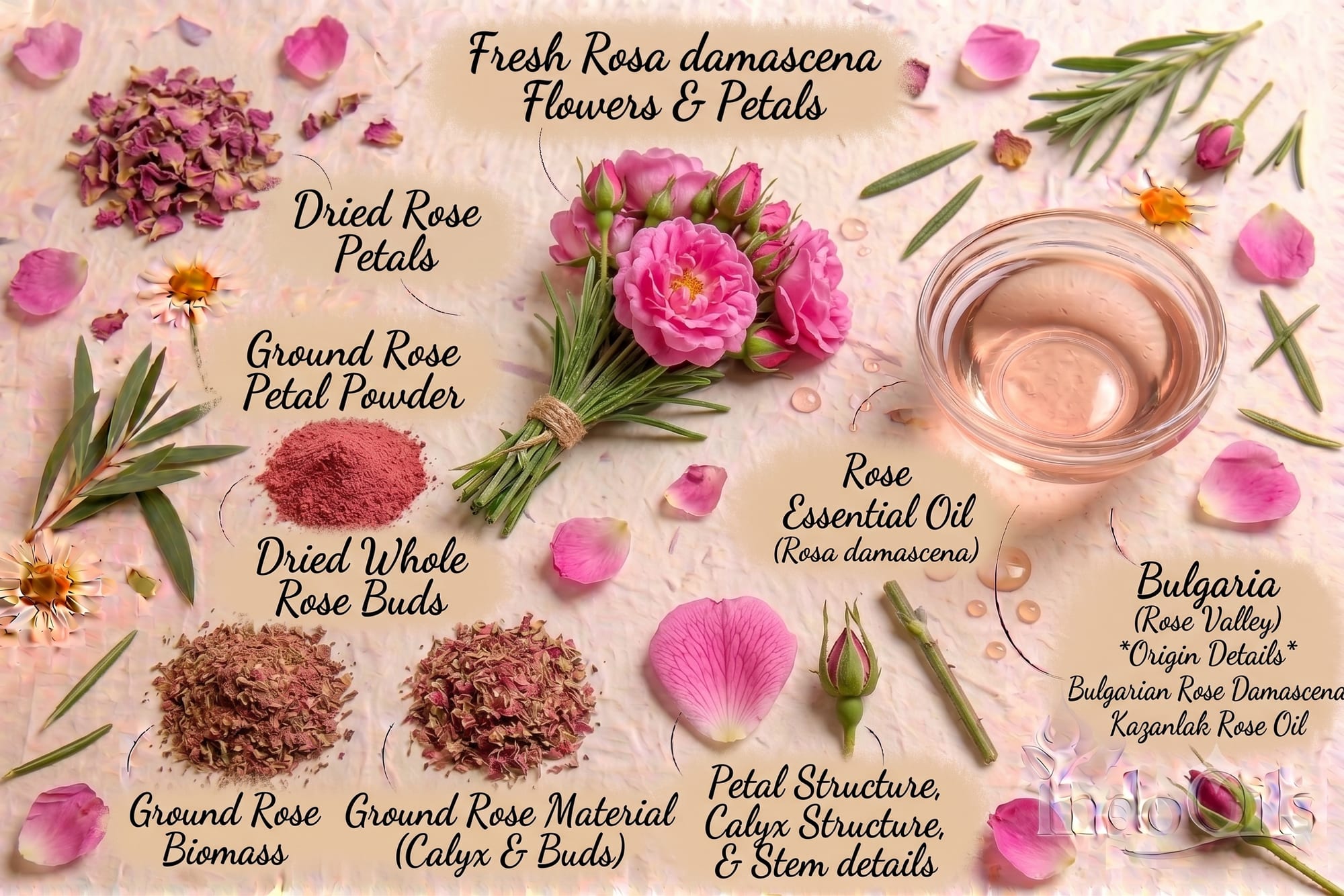
Saffron rarely works alone. These pairings are used in most saffron accords, and all of them are available from the same supplier:
- Rose and floral: Bulgarian rose, rose CO₂ absolute, jasmine sambac and orris
- Woods and oud: sandalwood, vetiver and the oudh diffuser oil for home fragrance
- Amber, resin and musk: benzoin, amber absolute and ambrette
- Spice and gourmand: cardamom, cinnamon bark, nutmeg and vanilla fragrance oil
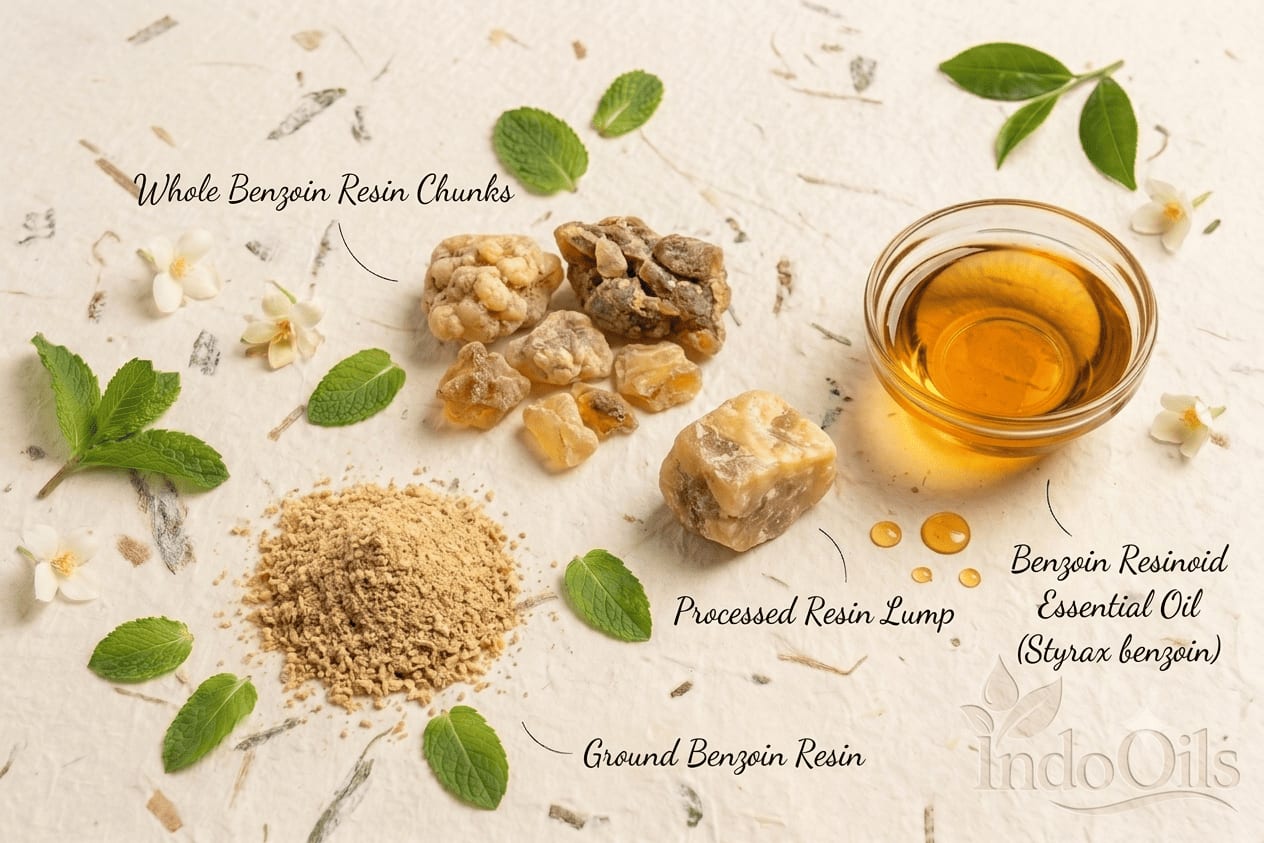
Building a saffron-rose or saffron-oud accord for a launch? Our custom formulation team can match a target profile, so you buy one standardised blend instead of several separate oils. For more on the wood side of these accords, see our sandalwood oil buyer's guide and vetiver oil buyer's guide.
Quality Checks and Documents to Request
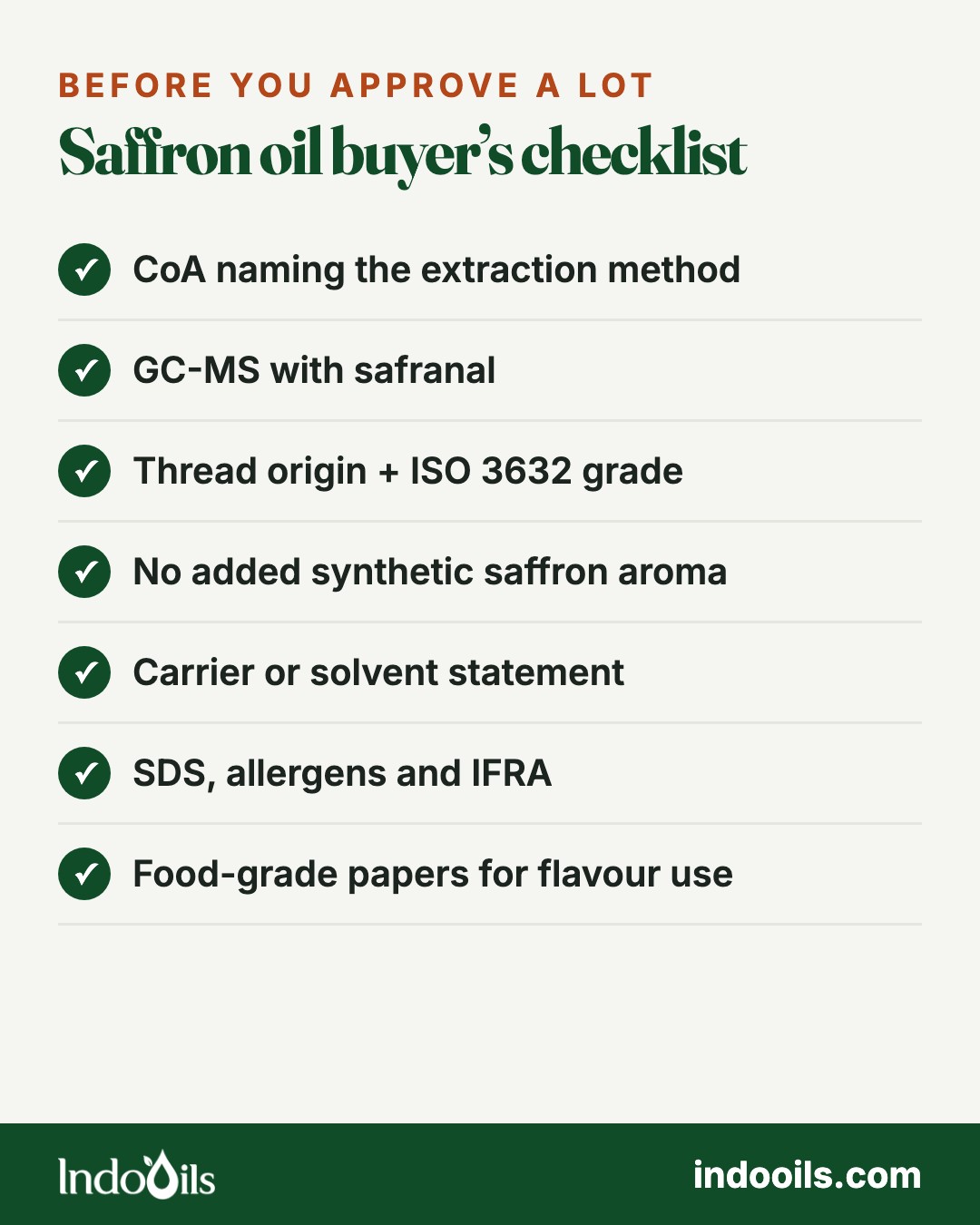
Before approving a bulk lot, ask for:
- Certificate of Analysis (CoA) that names the extraction method (steam distillation, CO₂, solvent or infusion), with GC-MS showing safranal and the other main constituents, and the specific gravity and refractive index. Agree acceptance ranges in writing before the first order.
- Source declaration: the origin of the threads (Iran, Spain, Kashmir or another), their ISO 3632 category where available, and a statement that no synthetic saffron aroma chemicals were added.
- Carrier and solvent statement for infused oils and extracts: the carrier name and percentage, or the residual-solvent result.
- Safety Data Sheet (SDS), needed for transport and for import into the EU, UK, US and most other markets.
- Fragrance allergen declaration and IFRA certificate for cosmetic and fragrance use. Blends and fragrance oils may contain listed allergens even when saffron itself does not. See fragrance allergen labelling: the documentation buyers need.
- Food-grade statement when the oil goes into food or drinks.
- Certificate of origin for customs and for any origin claim on your label.
Our traceability and quality assurance pages explain how lots are tracked. Standard templates are on the downloads page, and current company certifications are listed under certifications. For the wider picture, see clean-label traceability: what 2026 sourcing teams expect and our importer checklist for cosmetic essential oils.
Supply and Seasonality
Saffron flowers for only two to three weeks a year, in October and November across the northern hemisphere. Each crop is picked by hand, so supply depends on both weather and labour. Drought has cut Iranian output in recent seasons, and rainfall shortfalls have hit the Kashmir harvest too. When thread prices rise, saffron oil and extract prices follow.
For steady supply:
- Book annual volumes after the new crop is in, rather than buying spot in the lean months before harvest.
- Approve a reference sample and keep it, so every later lot is judged against the same standard.
- Agree the form and strength first. A cheaper quote often means a weaker extract, a higher carrier share or a fragrance oil, not a better deal.
Our climate volatility and wholesale pricing 2026 article explains how weather is reshaping botanical supply.
Storage and Handling
- Store at 15–25 °C in a dry, dark place. Light breaks down saffron's aroma and colour compounds quickly.
- Keep containers tightly closed and keep headspace small. Top up part-used packs with nitrogen if possible.
- Use the aluminium containers as supplied; do not repack into clear plastic.
- Shelf life is 36 months unopened. Use opened packs within about 12 months for the best aroma.
- Keep away from heat and open flame.
How to Order Saffron Oil in Bulk
All saffron products ship from India in 20 kg and 50 kg aluminium packs, with a minimum order of one pack. Pricing is quoted on request and depends on the form, strength, volume, destination and contract length.
- Request a quotation: send a bulk inquiry naming the form you need (essential oil, CO₂ spice oil, infused oil or diffuser oil), your application and your expected annual volume.
- Try before you commit: request a sample with its CoA for lab and sensory approval.
- Launching your own brand? Our private label service covers filling, labelling and export documents. See the private-label guide for brand owners.
Export shipments include a commercial invoice, packing list and certificate of origin as standard.
Frequently Asked Questions
Is saffron essential oil the same as saffron extract?
Not always. A true steam-distilled saffron oil contains only the volatile aroma. Absolutes, CO₂ extracts and oleoresins also carry heavier compounds, and infused oils are saffron extracted into a carrier oil. Ask your supplier to state the extraction method on the CoA.
Why is real saffron oil so expensive?
It takes around 150,000 hand-picked flowers to make one kilogram of dried saffron, and the stigmas contain well under 1 % volatile oil. Very cheap "saffron oil" is usually a diluted, infused or fragrance product.
Will saffron oil colour my product?
Only slightly. Saffron's colour comes from crocin, which dissolves in water, not in oil. For colour in food, use saffron threads or a water-soluble saffron extract alongside the oil.
Which form should I use for perfume, skincare or food?
For fine fragrance and attars, use the essential oil or CO₂ extract. For face oils, use the infused saffron oil. For food, use a food-grade CO₂ extract or essential oil. For candles and diffusers, use the diffuser oil.
What is the minimum order?
One 20 kg pack. 50 kg packs are also available, and samples can be sent before a bulk order.
For more Indian-origin buyer's guides, see our posts on cardamom oil, davana oil, camphor oil and turmeric oleoresin, or browse the full essential oils range and absolute oils.
Buying in bulk?
20 kg and 50 kg packs, with a certificate of analysis for every lot.
Tell us the product, quantity and destination, and we will come back with a quotation.