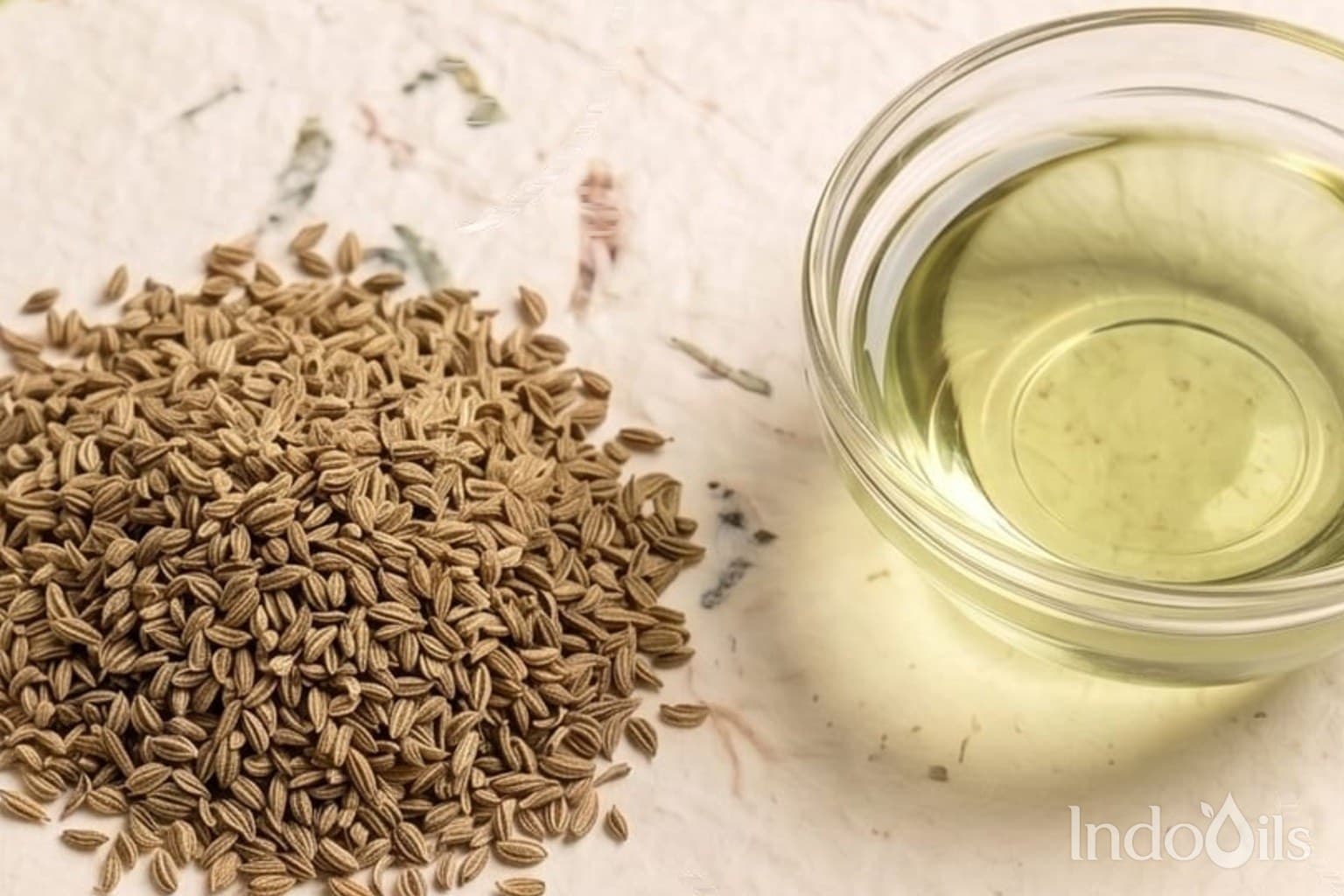
Almost every Indian kitchen has a jar of ajwain. The small, ridged seeds go into parathas, pakoras, namkeen and pickles, and their sharp, thyme-like smell is instantly familiar. India grows most of the world's ajwain, mainly in Gujarat, Rajasthan and Madhya Pradesh, and trades it through spice markets such as Unjha in north Gujarat.
Some of that crop is distilled. The result, ajwain essential oil, is one of the richest natural sources of thymol, which makes it useful well beyond the kitchen: in food flavours, oral-care products, soaps, household products and animal-feed flavourings.
This guide covers Ajwain Essential Oil from IndoOils: what it is, what is in it, which tests matter, how to handle it safely, where it is used and how to order it in bulk.
One Seed, Many Names
Ajwain is sold under more names than almost any other spice, and buyers in different countries use different ones:
- Ajwain or ajowan: the Hindi name and its older English spelling. "Ajowan oil" is the usual name in European and US trade.
- Carom seed: the common English name in recipes and on retail packs.
- Omum (Tamil) and vamu (Telugu) in South India.
- Trachyspermum ammi: the botanical name. Older documents use Carum copticum or Ammi copticum for the same plant.
Two warnings. First, ajwain is sometimes called bishop's weed, but that name also belongs to Ammi majus and Ammi visnaga, which are different plants. Second, ajwain smells like thyme, and its oil contains the same main compound, but it is not thyme. A purchase order should name Trachyspermum ammi and the CAS number.
Ajwain belongs to the Apiaceae family, with cumin, coriander, fennel, dill and caraway. Like theirs, its "seeds" are botanically small dried fruits, which is why their INCI names end in "Fruit Oil".
Product identifiers
- Product: Ajwain (Ajowan) Essential Oil
- Botanical name: Trachyspermum ammi (L.) Sprague; synonym Carum copticum
- INCI name: Trachyspermum Ammi Fruit Oil
- CAS number: 8001-99-8
- HSN code: 33012950 (spice oils not elsewhere specified)
- SKU: INDO-0001
- Plant part: Dried seed (fruit)
- Extraction method: Steam distillation
- Origin: India
- Shelf life: 36 months, unopened
Whole Oil, Dethymolised Oil and Thymol
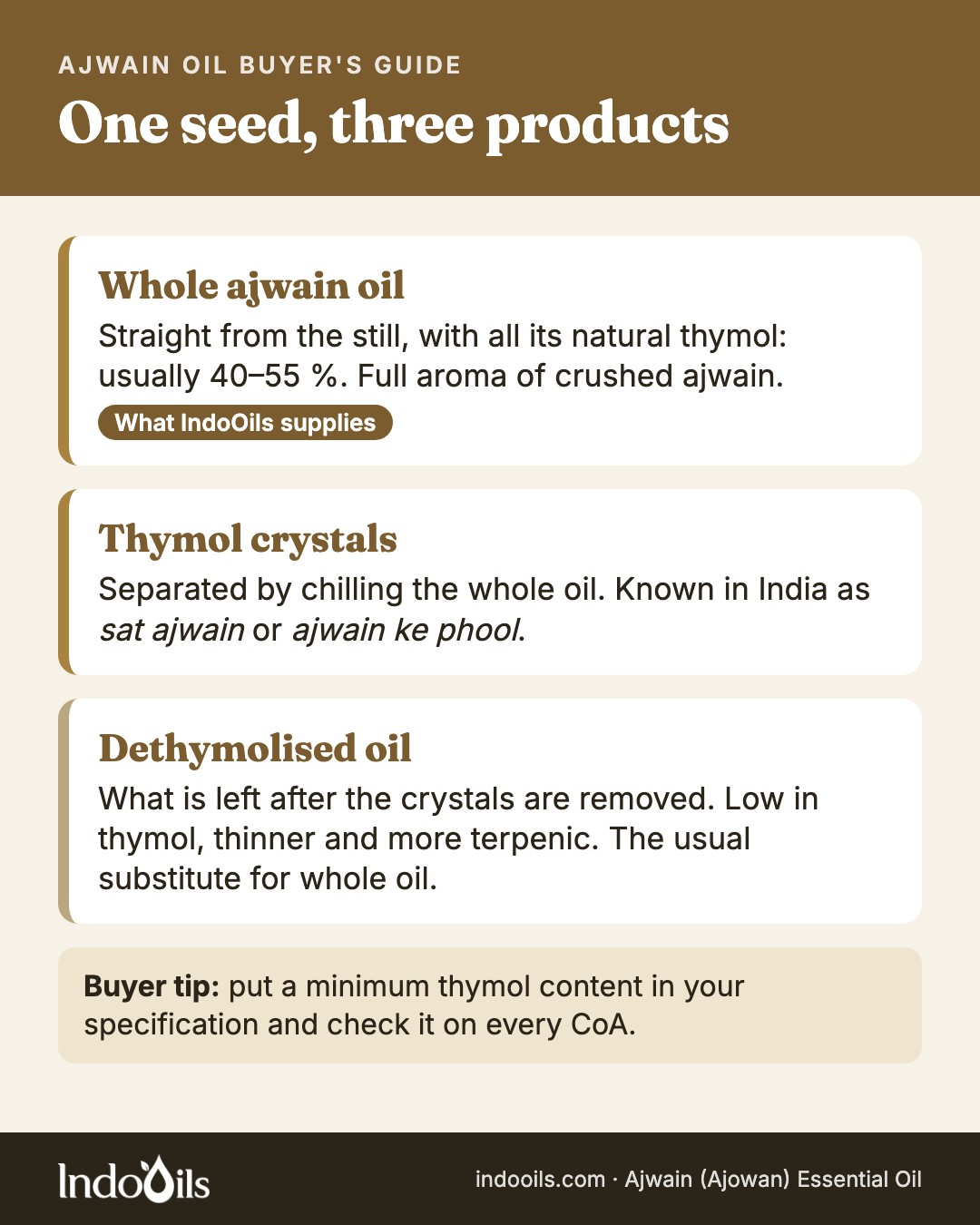
Ajwain seed yields three different products, and an enquiry for "ajwain oil" can be answered with any of them, so it pays to be precise:
- Whole ajwain oil is the oil as it comes out of the still, with all its natural thymol: usually 40 to 55 per cent. It has the full aroma of crushed ajwain. This is what IndoOils supplies.
- Thymol crystals are separated from the whole oil by chilling it. Thymol crystallises out and is collected and dried. In India these crystals are traditionally called ajwain ke phool ("ajwain flowers") or sat ajwain.
- Dethymolised oil is what remains after the crystals are removed. It is mostly γ-terpinene and p-cymene, contains much less thymol, and smells thinner and more terpenic. It is sometimes sold as "thymene".
Dethymolised oil is cheaper, and it looks the same in a drum, so it is the most common substitution in the ajwain trade. The cure is simple: put a minimum thymol or phenol content in your specification and check it on every CoA.
Most thymol sold worldwide today is synthetic, made from petrochemicals. Natural thymol from ajwain is a smaller, separate market. If you need natural thymol crystals, ask us; we can check availability with our partner distillers.
How Ajwain Oil Is Made
IndoOils' ajwain oil is distilled in India by selected partner distillers and released only after IndoOils' own checks. The process follows the same path as our other steam-distilled oils, described on our manufacturing page.
- Growing and harvest. Ajwain is a winter (rabi) crop. It is sown in October and November and harvested from about February to April, when the umbels turn brown.
- Cleaning. The dried seed is cleaned of stalks, dust and stones. Clean seed gives a cleaner oil.
- Crushing. The seeds are crushed just before distillation, so the oil is released fresh.
- Steam distillation. Steam passes through the crushed seed and carries the volatile oil to a condenser, where the oil separates from the water. Ajwain seed holds only about 2 to 4 per cent of oil, so a large weight of seed goes into every kilogram.
- Testing. Each batch is checked in-house and analysed by GC-MS at an independent laboratory before release.
- Packing. The oil is filled into clean 20 kg or 50 kg aluminium containers, sealed and labelled with its batch number.
Because the oil yield is low and there is one harvest a year, ajwain oil prices follow the seed crop and the Unjha market closely. Our post on climate volatility and wholesale pricing explains how one weak harvest shows up in spice oil prices until the next one.
What Is Inside Ajwain Oil
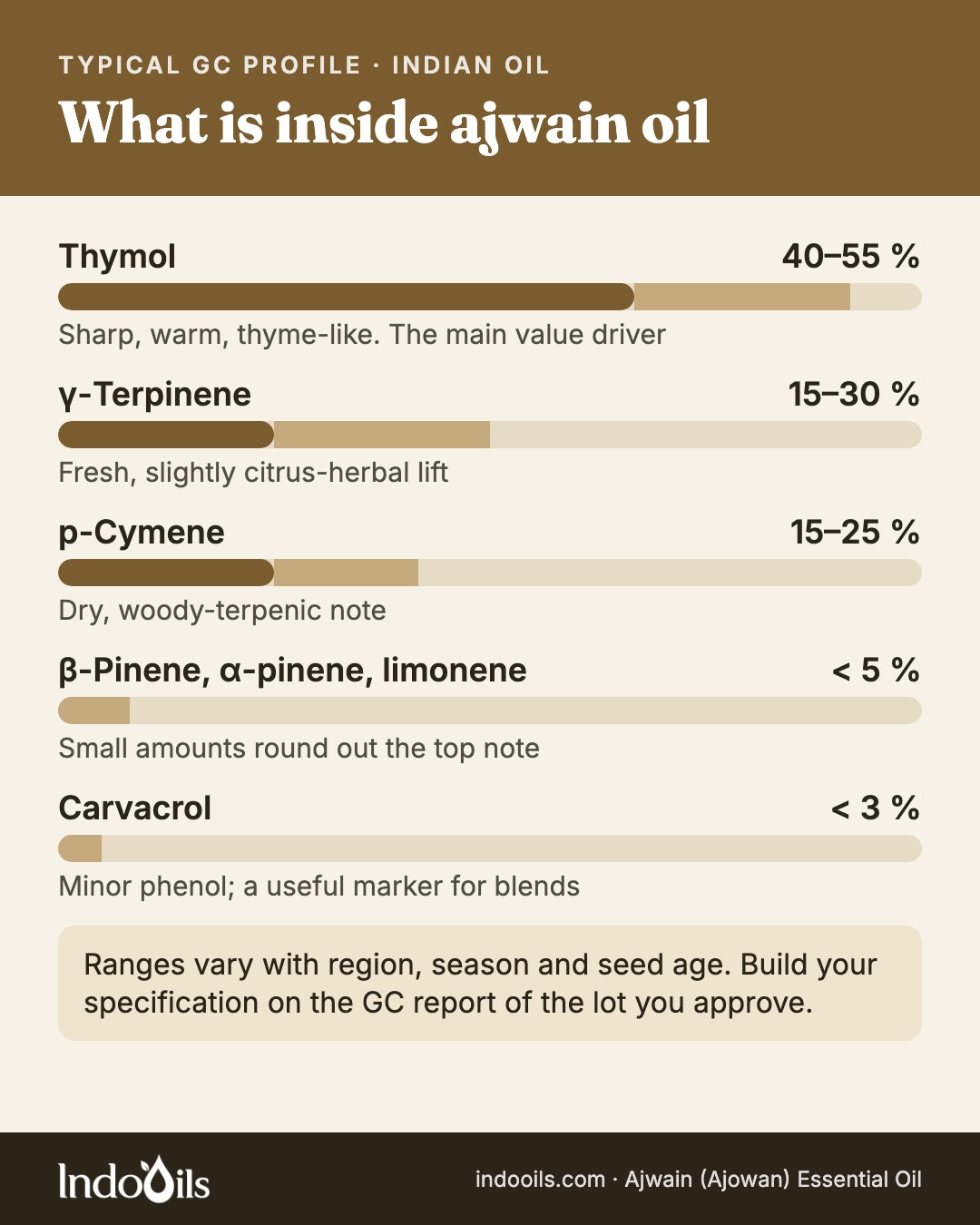
Ajwain oil is dominated by one compound, and three groups make up almost all of it:
- Thymol is the main constituent, usually 40 to 55 per cent in Indian oils and sometimes more. It gives the sharp, warm, herbal-phenolic note that people recognise as ajwain or thyme, and it is the main reason for the oil's commercial value.
- γ-Terpinene adds a fresh, slightly citrus-herbal lift.
- p-Cymene gives a dry, woody-terpenic note.
Small amounts of β-pinene, α-pinene, limonene and carvacrol complete the profile. The balance depends on the region, the season, the age of the seed and the distillation. Published analyses of Iranian oils, for example, report thymol well above 60 per cent, and a few Indian regional types are low in thymol altogether and led by other compounds.
That variation is normal for a natural oil. It is also why your specification should be built on the GC report of the lot you approve, with a minimum thymol figure, not on a textbook range.
What to Check on the Certificate of Analysis
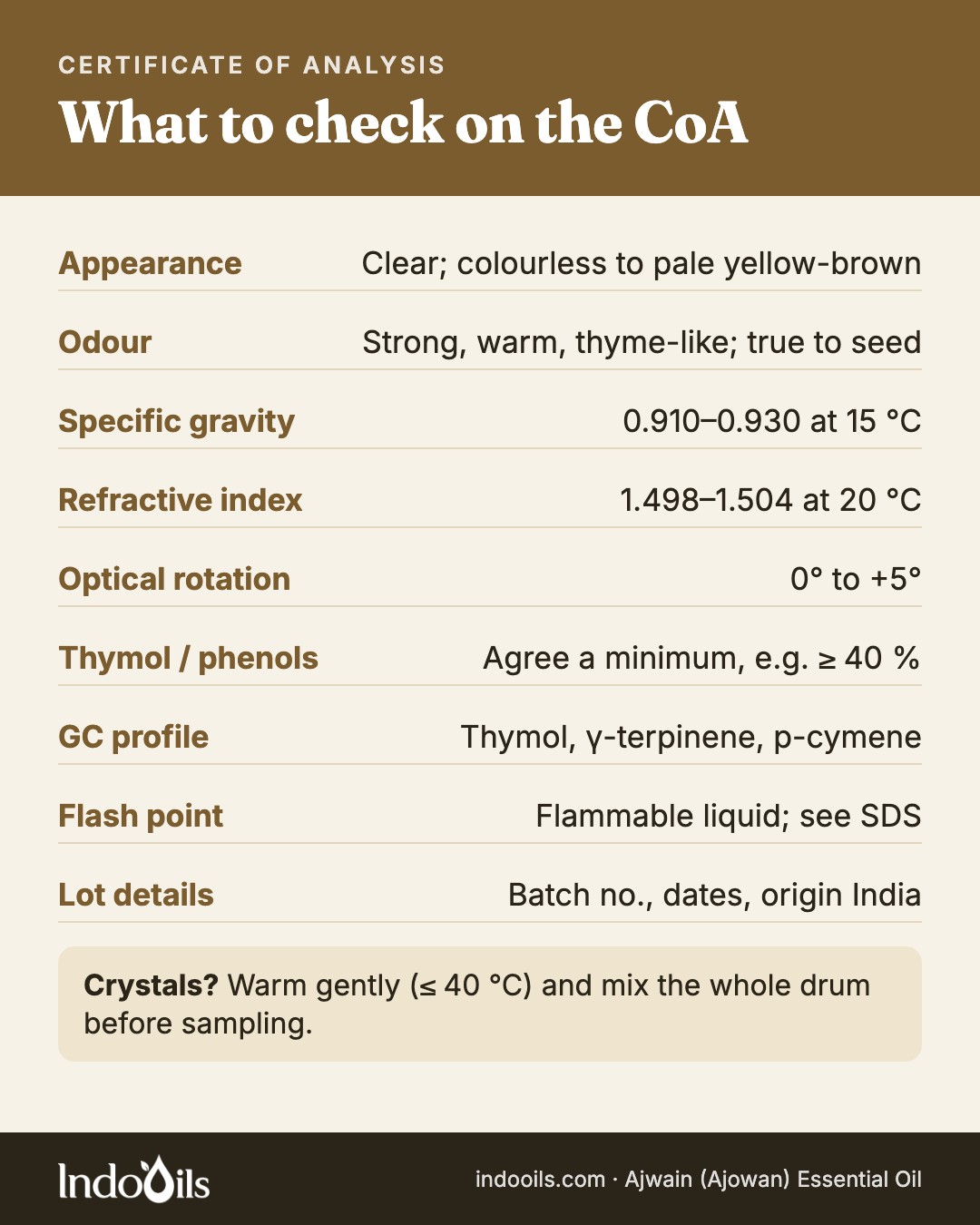
There is no current ISO or Food Chemicals Codex monograph for ajowan oil, so specifications are based on long-standing trade ranges. These are a sensible base for a contract:
- Appearance: clear, mobile liquid; colourless to pale yellow-brown. A dark reddish-brown oil is usually old or has been stored badly.
- Odour: strong, warm, herbaceous-spicy and thyme-like, true to freshly crushed ajwain.
- Specific gravity: 0.910–0.930 at 15 °C.
- Refractive index: 1.498–1.504 at 20 °C.
- Optical rotation: 0° to +5°. Ajwain oil is close to optically inactive.
- Thymol content: by GC, or total phenols by the classic alkali test, in which the phenols dissolve in sodium hydroxide solution and the loss in oil volume is measured. Agree a minimum, for example 40 per cent.
- GC profile: thymol, γ-terpinene and p-cymene as the main peaks, matching your approved reference.
- Flash point: the oil is a flammable liquid for transport. The SDS gives the figure for each lot.
Every IndoOils lot comes with a CoA that reports these results, and every later lot should be checked against the sample you approved.
Spotting stripped, topped-up and cut oils
Ajwain oil is valued for its thymol, so most adulteration either removes thymol or fakes it:
- Dethymolised oil sold as whole oil. Thymol and total phenols are low, while γ-terpinene and p-cymene are high. Specific gravity and refractive index both drop.
- Dethymolised oil topped up with synthetic thymol. The thymol figure looks right, but the GC can show by-products typical of synthetic thymol as unexpected small peaks, and the balance of the other constituents is wrong. Where a natural claim matters, isotope analysis can tell natural from synthetic thymol.
- Cheap terpene fractions such as p-cymene or other terpene by-products, added to stretch the oil. They lower the thymol figure and change the GC ratios.
- Blends with other phenolic oils such as thyme or other thymol-rich oils. The minor peaks, especially carvacrol, no longer match an ajwain reference.
- Solvents or carrier oils. These show up in specific gravity, refractive index and the GC.
Our quality assurance page explains how in-house checks and independent GC-MS work together, and the cosmetics importer checklist covers adulteration risks across the wider essential-oil range.
Crystals in the drum are not a defect
An oil this rich in thymol can deposit thymol crystals when it gets cold, in winter shipments or cold stores. The crystals are part of the oil. If you sample only the liquid above them, the thymol result will be low. Warm the closed container gently, to no more than about 40 °C, until the crystals dissolve, and mix the whole contents before sampling or use.
Where Ajwain Oil Is Used
Ajwain oil delivers the aroma of a large weight of seed in a few drops, with no husk, specks or colour. Its main uses are:
- Savoury flavours: namkeen, bhujia, mathri, crackers, biscuits, paratha and bakery premixes, pickles, papad and snack seasonings. One drum of oil replaces many bags of seed and gives the same strength in every batch.
- Oral care: thymol is a classic flavour note in toothpastes and mouthwashes, usually alongside mint. Ajwain oil is a natural source of it.
- Personal care: soaps, herbal hair oils and other personal-care products, as a fragrance ingredient at low levels.
- Household products: cleaners and herbal home-care products with a warm, thyme-like note.
- Animal-feed flavourings: thymol-type flavour premixes for feed manufacturers.
- Traditional formulations: Ayurvedic and herbal manufacturers buy it as a raw material. They decide, and are responsible for, what their own labels claim.
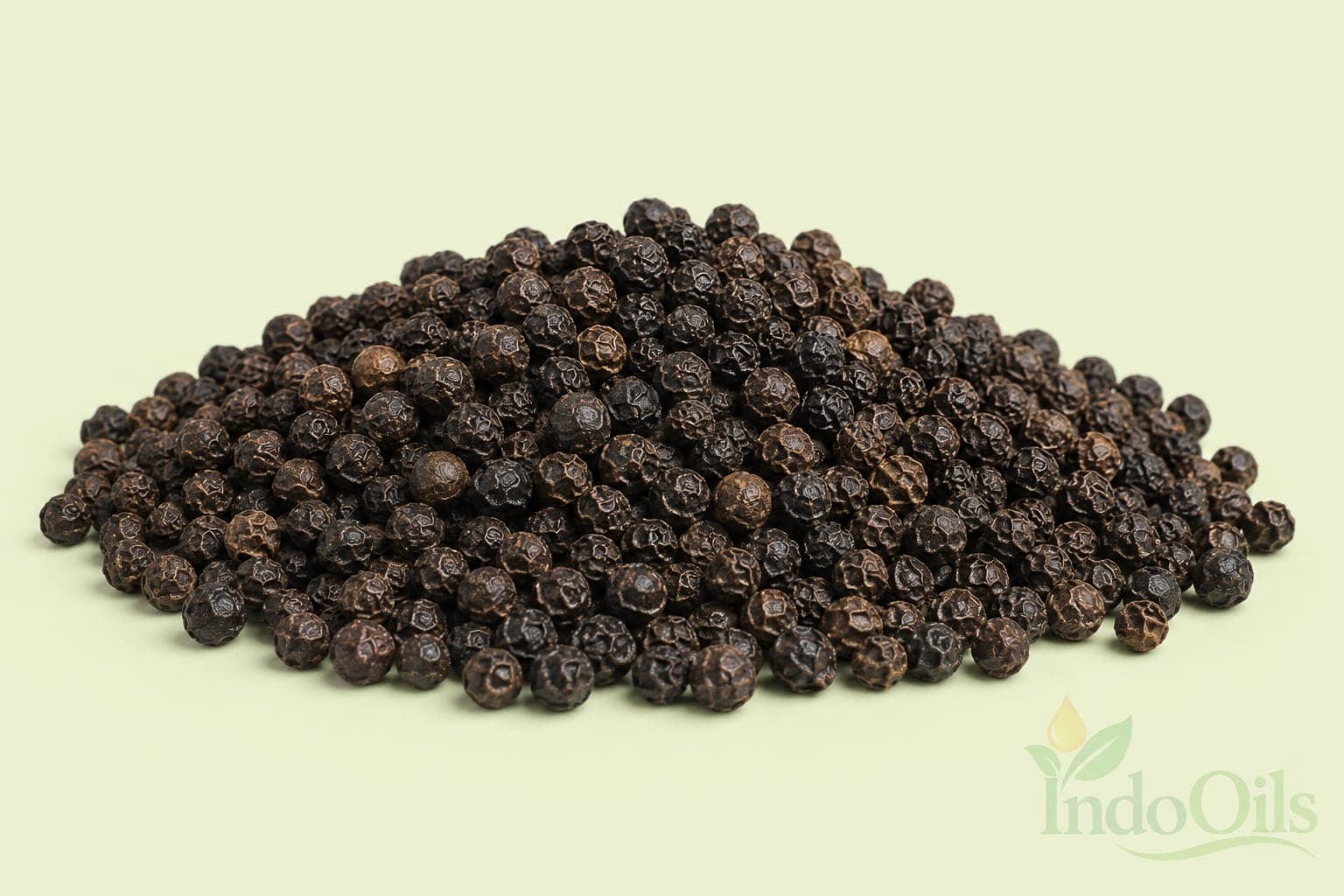
Ajwain oil sits naturally with the other Indian seed-spice oils, such as Cumin Seed Essential Oil, Coriander Seed Essential Oil, Celery Seed Essential Oil, Dill Seed Essential Oil, Caraway Spice Oil and Fennel Seed Oil. For a herbal-phenolic note with carvacrol instead of thymol, see Oregano Essential Oil. Flavourists building a full Indian spice profile often combine ajwain oil with Black Pepper Essential Oil and with oleoresins such as Cumin Oleoresin for body and colour; our spice oleoresins guide explains how oils and oleoresins work together. The full range is in spice oils.
Safety, Food and Cosmetic Rules
Handling: treat it as a corrosive
Thymol is corrosive to skin and eyes, and at 40 to 55 per cent thymol, neat ajwain oil is too. Supplier Safety Data Sheets for Indian ajowan oil typically classify it as:
- Causes severe skin burns and eye damage (skin corrosion). Handle with gloves and eye protection, and never apply the oil undiluted.
- Harmful if swallowed, and an aspiration hazard: it may be fatal if swallowed and it enters the airways.
- Flammable liquid. Keep it away from heat, sparks and open flame.
- Toxic to aquatic life with long-lasting effects.
The SDS supplied with each lot gives the full GHS classification. Share it with your EHS team before the first drum arrives; the corrosive classification affects storage, personal protective equipment and transport labelling.
Food and flavour
- India: ajwain is one of the most common spices, and ajwain oil is widely used by Indian flavour houses and snack makers. Ask for food-grade documentation with the lot, not only a CoA.
- US: ajowan oil does not have its own FEMA number and is not on the GRAS list for essential oils. Thymol itself is FEMA 3066. US buyers should confirm the oil's status for their use with their regulatory team.
- EU and UK: thymol is on the Union list of flavouring substances (FL 04.006). Ajwain oil is used as a flavouring preparation under the flavourings regulation (EC) No 1334/2008, and a "natural" claim needs the flavour to come from the named source, which is one reason to ask for GC data.
Cosmetics and fragrance
- Dose: thymol-rich oils are used at low levels in finished products. Your safety assessor sets the limit for each product type.
- Allergens: ajwain oil may contain small amounts of listed EU and UK fragrance allergens, such as limonene. The allergen declaration for each lot gives the figures, and our post on fragrance allergen labelling explains the labelling thresholds.
- IFRA statement: fragrance and personal-care buyers will ask for one with each supply.
Documents to Ask For
Every IndoOils order ships with a batch-specific CoA. For ajwain oil, ask for this set before approving a supplier:
- Certificate of Analysis (CoA) with appearance, specific gravity, refractive index, optical rotation, thymol or total phenol content and the main GC constituents.
- GC-MS report from the independent laboratory.
- Safety Data Sheet (SDS) with GHS classification and transport details.
- IFRA statement and allergen declaration for personal-care and home-care use.
- Food-grade statement for flavour use.
- Certificate of origin for export shipments and for any "Indian origin" claim.
Standard templates are on the downloads page. IndoOils works under an ISO 9001:2015 quality system and follows GMP; see certifications.
Packing, Storage and Shelf Life
- Supplied in 20 kg and 50 kg aluminium containers, sealed and labelled with the batch number, net weight and dates.
- Store at 15–25 °C in a cool, dry, well-ventilated place, out of direct sunlight and away from ignition sources.
- Keep containers tightly closed and the headspace small. Air slowly darkens the oil and flattens its fresh notes.
- If crystals form in the cold, warm gently and mix before use, as described above.
- Handle with stainless steel, glass or aluminium; thymol can soften some plastics and rubbers.
- Shelf life is 36 months unopened. Once opened, use within about 12 months.
How to Order Ajwain Oil in Bulk
Ajwain Essential Oil ships from India in 20 kg and 50 kg aluminium packs, with a minimum order of one pack. Prices are quoted on request and depend on the crop, volume, destination and contract length.
- Request a quotation: send a bulk inquiry with your application (food flavour, oral care, personal care, household, feed), the annual volume you expect, your minimum thymol content and any specification you already buy against.
- Approve a sample first: request a sample with its CoA for lab and sensory approval, and keep it as your reference.
- Need your own pack or blend? See our private label and custom formulation services.
Ajwain is harvested once a year, from about February to April, so buyers with steady demand often agree volumes for the season ahead. Export shipments include a commercial invoice, packing list and certificate of origin, and ajwain oil is packed and labelled according to the classification on its SDS.
Frequently Asked Questions
Is ajwain oil the same as thyme oil?
No. They come from different plants: ajwain from Trachyspermum ammi, thyme from Thymus species. Both are rich in thymol, so they smell alike, but their other constituents differ and they have different CAS numbers and specifications.
How much thymol does ajwain oil contain?
Indian whole ajwain oil usually contains 40 to 55 per cent thymol. The exact figure is reported on the CoA for each lot. Dethymolised oil contains much less.
Why are there crystals in my ajwain oil?
Ajwain oil is so rich in thymol that some can crystallise out in cold weather. It is not a defect. Warm the closed container gently, to no more than about 40 °C, and mix the whole contents before use.
Where does your ajwain oil come from?
It is steam distilled in India from ajwain seed grown mainly in Gujarat and Rajasthan, and analysed by GC-MS at an independent laboratory before release.
Can ajwain oil be used in food?
Yes. It is widely used in Indian snack, bakery and seasoning flavours. Ask for food-grade documentation with your order, and outside India check its status for your market: in the US, for example, ajowan oil has no FEMA number of its own.
What is the HSN code for ajwain oil?
India's tariff has no separate line for ajwain oil, so it is usually classified under 33012950 (spice oils not elsewhere specified), with GST at 18 %. Confirm the code with your customs agent for your own shipments.
What is the minimum order?
One 20 kg pack. 50 kg packs are also available, and a sample can be sent before you order in bulk.
For more buyer's guides, see our posts on black pepper oil, cardamom oil, spice oleoresins and peppermint oil, or browse the full essential oils range.
Buying in bulk?
20 kg and 50 kg packs, with a certificate of analysis for every lot.
Tell us the product, quantity and destination, and we will come back with a quotation.