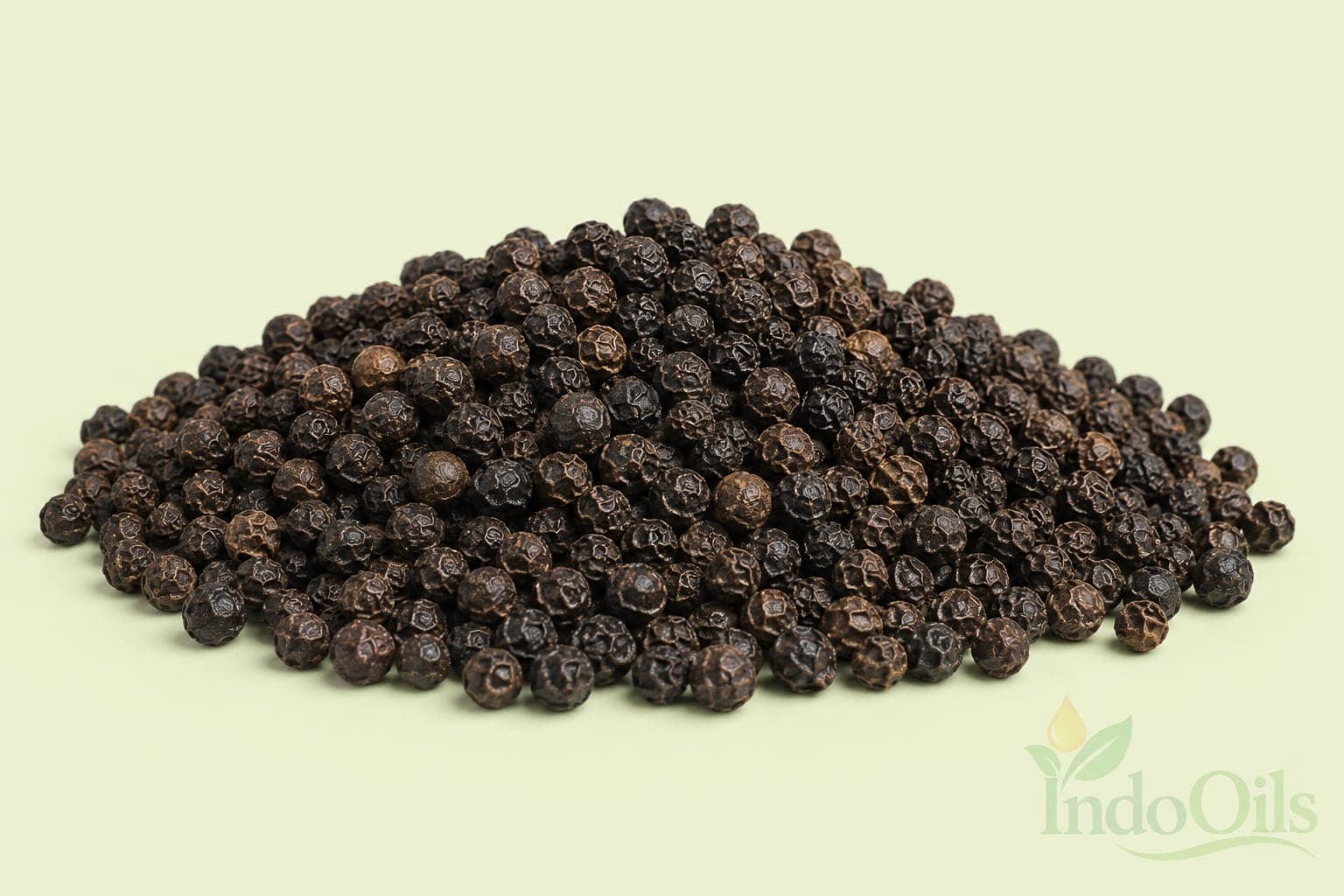
Pepper is India's oldest export. Traders sailed to the Malabar Coast for it more than two thousand years ago, and "Malabar" and "Tellicherry" are still names that pepper buyers around the world know. Today the vines grow in the hills of Kerala and Karnataka, and the berries are picked from about December to February.
Most of that crop is sold as whole or ground spice. A smaller share is turned into extracts for manufacturers, and the most versatile of them is black pepper essential oil: a clear oil that carries the fresh, sharp smell of freshly cracked pepper into flavours, fragrances and personal-care products.
This guide covers Black Pepper Essential Oil from IndoOils: how it differs from the other pepper extracts, what is in it, which tests matter, where it is used and how to order it in bulk.
Four Black Pepper Extracts, Four Different Jobs
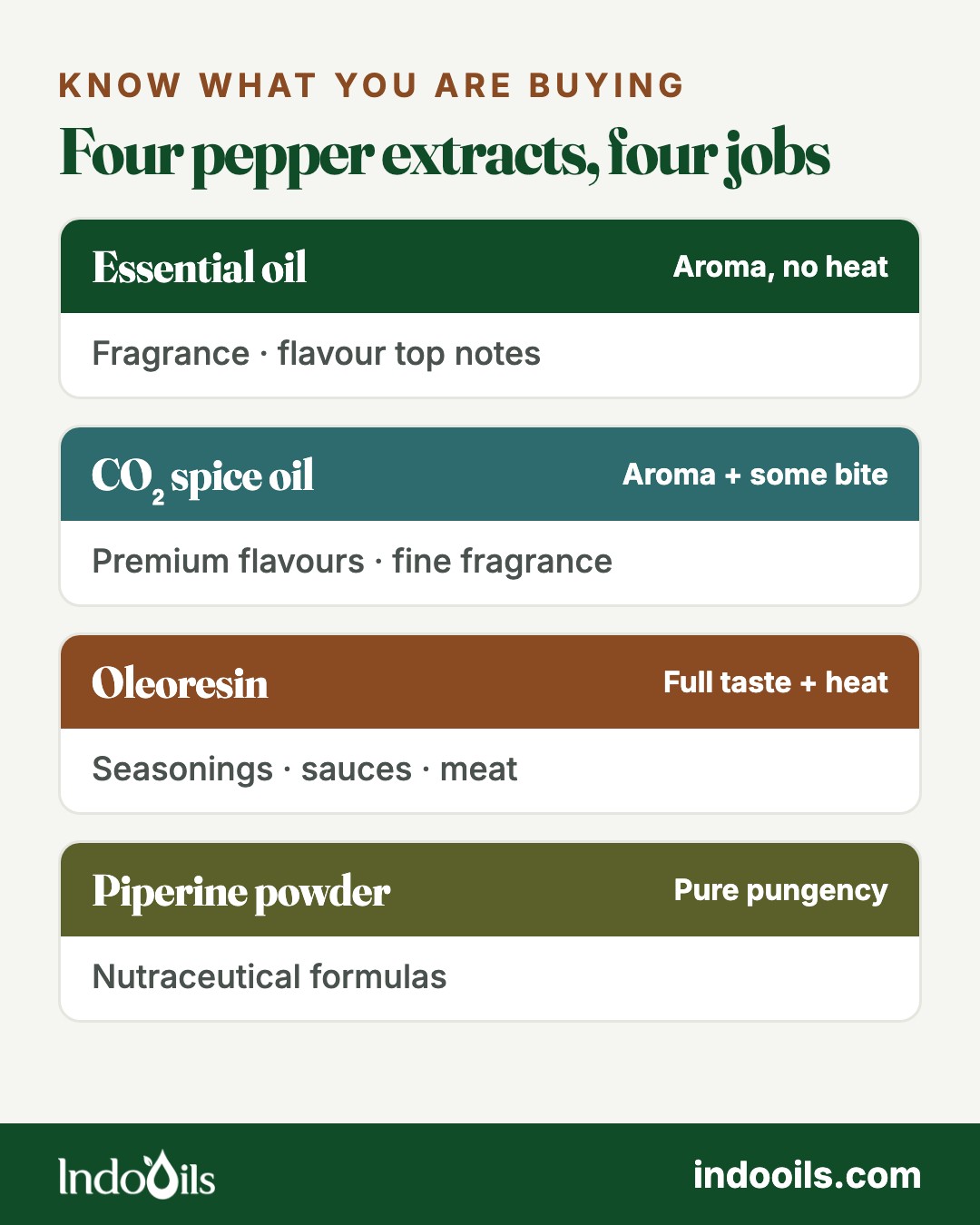
"Pepper extract" can mean four different products. They come from the same berry, but they are made differently, they do different jobs and they are specified differently, so the first line of any enquiry should say which one you need.
- Essential oil is steam distilled. It carries pepper's aroma and none of its heat, because piperine, the pungent compound, does not distil. It is clear, it adds no colour or specks, and it is used for flavour top notes, fine fragrance and personal care.
- CO₂ spice oil is extracted with supercritical carbon dioxide. It keeps more of the heavier aroma compounds, so it smells rounder and closer to the whole spice, and it can carry some pungency. Our Black Pepper Spice Oil is this type.
- Oleoresin is solvent extracted and gives the full taste of pepper: aroma, heat and body. It is standardised on piperine and volatile oil, and it is the workhorse of seasonings, sauces and processed meat. Our spice oleoresins guide covers pepper oleoresins in detail, including White Pepper Oleoresin and Long Pepper Oleoresin.
- Piperine is the purified pungent compound, sold as a powder. Piperine Powder is used in nutraceutical formulas, not for flavour.
If you want a product to taste hot, you need oleoresin or piperine. If you want it to smell of pepper, you need the essential oil or the CO₂ extract.
Pink pepper and Sichuan pepper are not pepper
Two other "peppers" are sold as oils, and neither comes from Piper nigrum:
- Pink pepper comes from Schinus trees in South America.
- Sichuan pepper comes from Zanthoxylum shrubs and has a citrusy, numbing character.
Both have their own botanical names, CAS numbers and specifications. A purchase order for black pepper oil should name Piper nigrum.
Product identifiers
- Product: Black Pepper Essential Oil
- Botanical name: Piper nigrum L.
- INCI name: Piper Nigrum Fruit Oil
- CAS number: 8006-82-4
- FEMA number: 2845
- HSN code: 33012935 (pepper oil)
- SKU: INDO004
- Plant part: Dried black peppercorns (fruit)
- Extraction method: Steam distillation
- Origin: India
- Shelf life: 36 months, unopened
How Black Pepper Oil Is Made
IndoOils' black pepper oil is distilled in India by selected partner distillers and released only after IndoOils' own checks. The process follows the same path as our other steam-distilled oils, described on our manufacturing page.
- Harvest. Pepper spikes are picked when the first berries on them start to turn red, from about December to February.
- Drying. The berries are sun-dried for several days. The green skin turns black and wrinkled, and that is what makes black pepper black.
- Crushing. Dried peppercorns hold their oil inside the berry, so they are coarsely cracked just before distillation. Cracking them earlier would let the lightest notes escape.
- Steam distillation. Steam passes through the cracked pepper and carries the volatile oil to a condenser, where the oil separates from the water.
- Testing. Each batch is checked in-house and analysed by GC-MS at an independent laboratory before release.
- Packing. The oil is filled into clean 20 kg or 50 kg aluminium containers, sealed and labelled with its batch number.
Peppercorns contain only a few per cent of volatile oil, so a large weight of pepper goes into every kilogram of oil. That is why black pepper oil prices follow the pepper crop closely. Our post on climate volatility and wholesale pricing explains how one weak harvest shows up in spice oil prices until the next one.
What Is Inside Black Pepper Oil
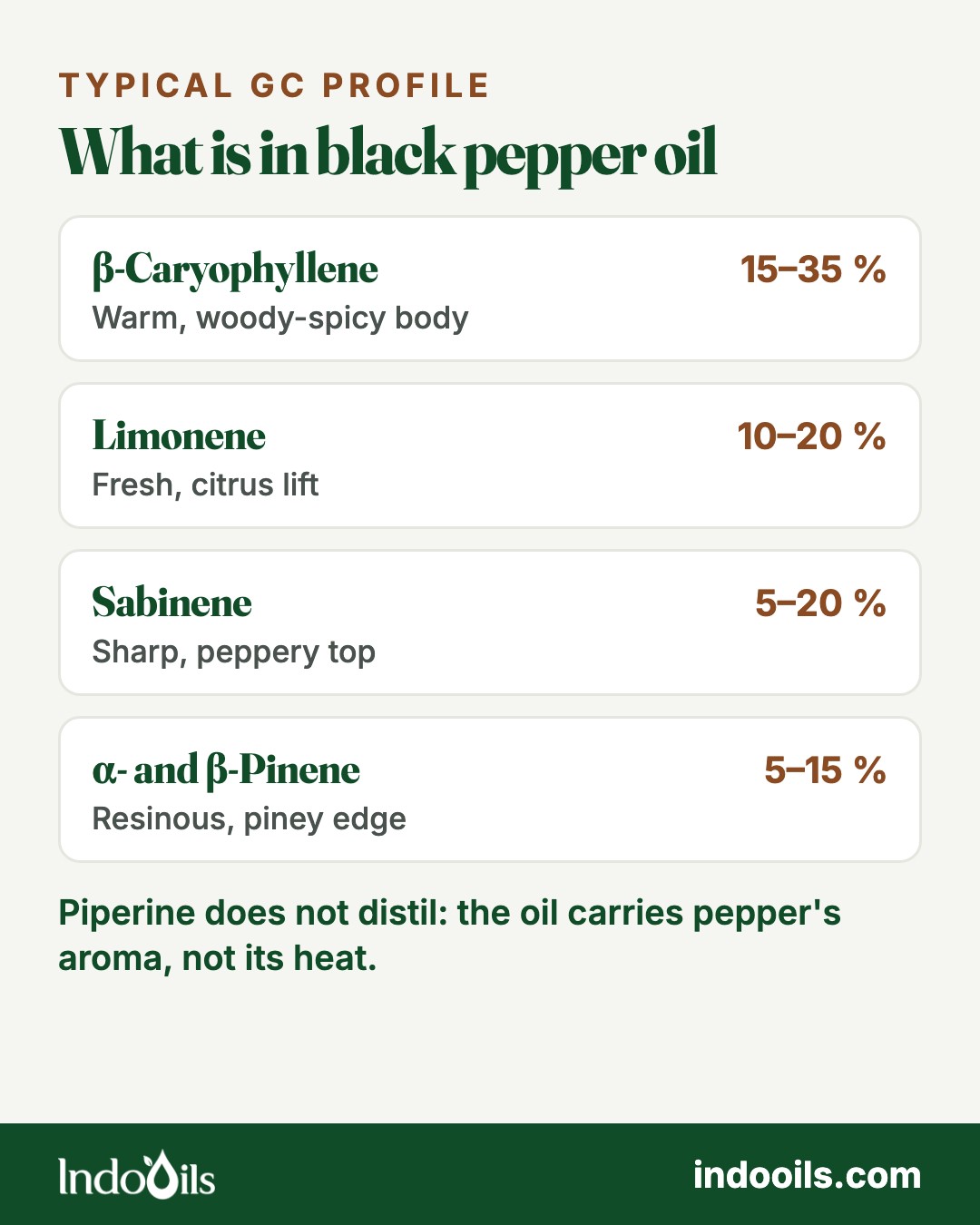
Black pepper oil is a blend of terpenes, and four groups do most of the work:
- β-Caryophyllene is usually the largest single constituent. It gives the warm, dry, woody-spicy body.
- Limonene adds a fresh, slightly citrus lift.
- Sabinene gives the sharp, peppery top note that people recognise as "freshly ground".
- α- and β-pinene add a resinous, piney edge.
Smaller amounts of δ-3-carene, myrcene, α-phellandrene and linalool complete the profile. The exact balance depends on the pepper variety, the region, the age of the dried pepper and how it was distilled. Published analyses of Indian cultivars, for example, range from oils led by β-caryophyllene at about 25 % to oils in which limonene and sabinene lead.
That variation is normal for a natural oil. It is also why your specification should be built on the GC report of the lot you approve, not on a textbook figure.
What to Check on the Certificate of Analysis
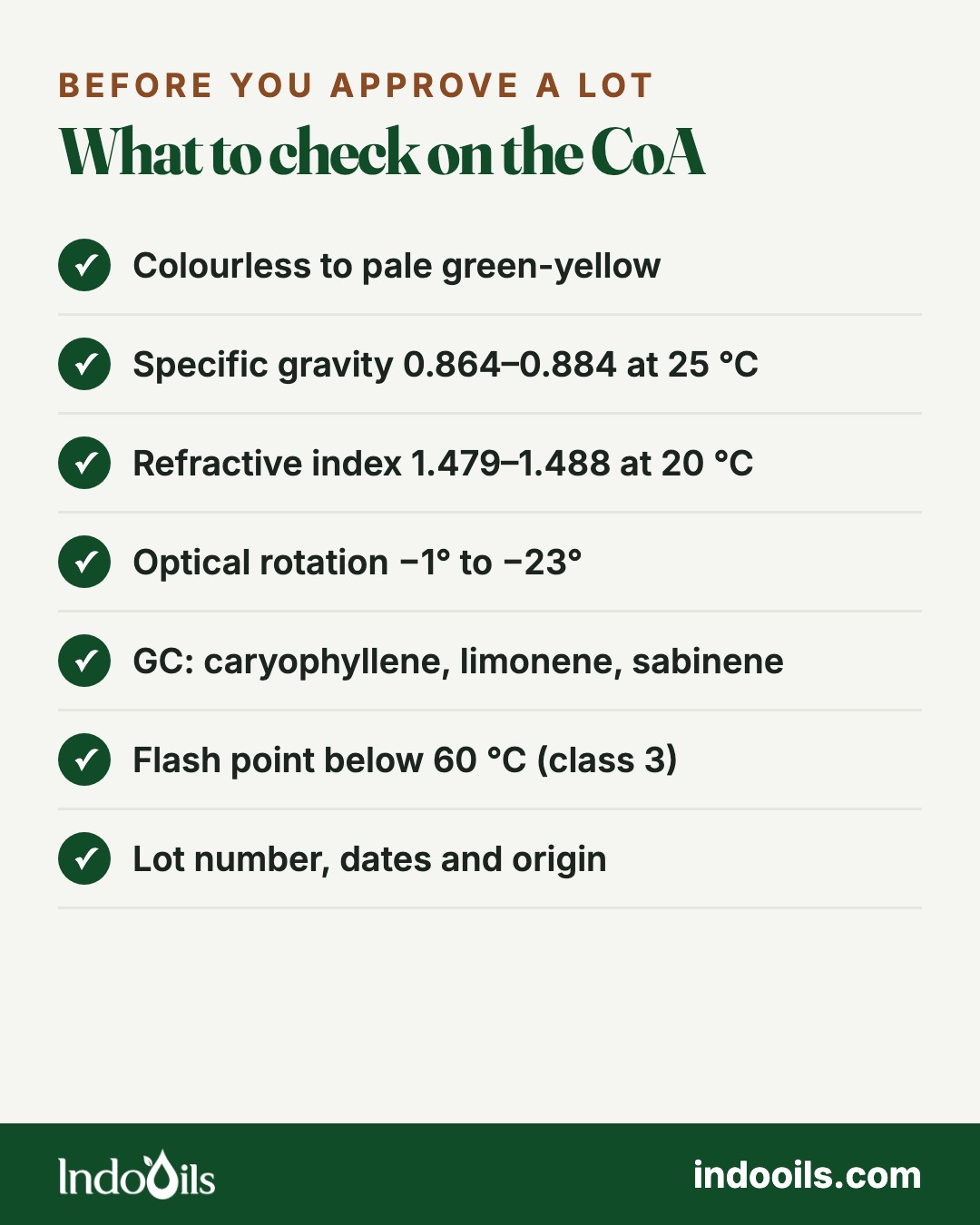
Black pepper oil has a monograph in the Food Chemicals Codex (FCC), which most suppliers publish their specifications against. The FCC ranges are a sensible base for a contract:
- Appearance: clear, mobile liquid; colourless to pale greenish-yellow.
- Odour: fresh, sharp, peppery and warm-spicy, true to freshly ground pepper.
- Specific gravity: 0.864–0.884 at 25 °C.
- Refractive index: 1.479–1.488 at 20 °C.
- Optical rotation: −1° to −23°. Black pepper oil is laevorotatory (negative).
- GC profile: β-caryophyllene, limonene, sabinene and the pinenes as the main peaks, matching your approved reference.
- Flash point: below 60 °C, which makes it a flammable liquid for transport. The SDS gives the figure for each lot.
Every IndoOils lot comes with a CoA that reports these results, and every later lot should be checked against the sample you approved.
Spotting cut and reconstituted oils
Black pepper oil costs much more than the terpenes it is made of, so it is a target for adulteration. The common tricks are:
- Adding cheap terpenes such as pinene from turpentine or limonene from orange peel. Orange limonene is strongly positive in rotation, so it pulls the optical rotation towards zero or above, and it changes the GC ratios.
- Adding caryophyllene from cheaper sources, such as clove oil by-products. The GC shows a caryophyllene peak that is out of line with the rest of the profile.
- Distilling spent or very old pepper and topping it up. The oil smells flat, and the fresh top notes (sabinene, the pinenes) are low.
- Thinning with solvents or carrier oils. These show up in specific gravity, refractive index and the GC.
Chiral GC can confirm natural origin where it matters, for example for natural-flavour claims. Our quality assurance page explains how in-house checks and independent GC-MS work together, and the cosmetics importer checklist covers adulteration risks across the wider essential-oil range.
Where Black Pepper Oil Is Used
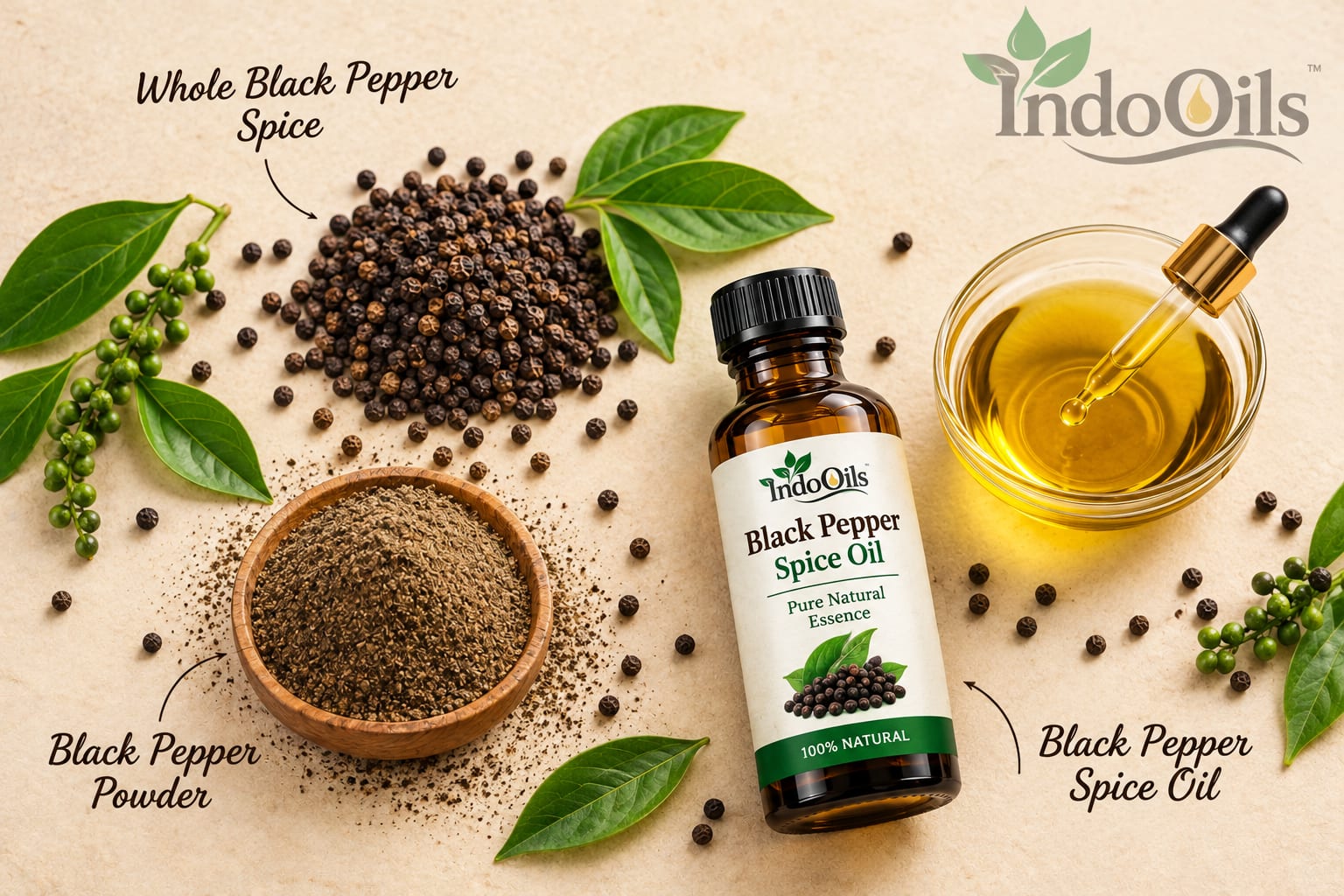
Black pepper oil is used wherever a product should smell of pepper without tasting hot, looking speckled or turning cloudy:
- Savoury flavours: seasonings, snacks, soups, sauces, marinades, meat and ready-meal flavours, often together with an oleoresin that supplies the heat.
- Beverages: spirits and gin botanicals, bitters, ginger-style drinks and cola-type flavours, where a clear oil is essential.
- Fine fragrance: a classic fresh-spicy top note in woody, amber and masculine perfumes.
- Personal care: shower gels, soaps, deodorants, beard oils and men's grooming ranges.
- Massage and aromatherapy blends: as a fragrance ingredient. Manufacturers decide, and are responsible for, what their own labels claim.
- Home fragrance: candles, reed diffusers and room sprays with warm spice accords.
Black pepper oil sits naturally with the other Indian spice oils, such as Cardamom Essential Oil, Ginger Essential Oil Fresh, Clove Bud Essential Oil, Nutmeg Essential Oil India and Cinnamon Bark Essential Oil. Our cardamom oil guide covers the closest relative in a chai or warm-spice flavour, and the full range is in spice oils.
Food, Cosmetic and Safety Rules
Food and flavour
- US: black pepper oil is listed as generally recognised as safe (GRAS) for use in food (21 CFR 182.20), and it has FEMA number 2845.
- EU and UK: it is used as a natural flavouring preparation under the flavourings regulation (EC) No 1334/2008. "Natural black pepper flavouring" claims need the flavour to come from pepper, which is one reason to ask for GC data and, if needed, chiral GC.
- Food-grade paperwork: for flavour use, ask for food-grade documentation with the lot, not only a CoA.
Cosmetics and fragrance
- Allergens: the oil naturally contains limonene and linalool, which are listed fragrance allergens in the EU and UK. They must be declared on the label above 0.001 % in leave-on and 0.01 % in rinse-off products. Our post on fragrance allergen labelling explains how this works.
- Oxidation: like other terpene-rich oils, black pepper oil forms skin-sensitising oxidation products as it ages in air. IFRA's standards for limonene-rich materials expect low peroxide levels, so keep stock fresh and containers full.
- IFRA statement: fragrance and personal-care buyers will ask for one with each supply.
Handling
The Safety Data Sheet for each lot gives the full GHS classification. Typical points for black pepper oil:
- Flammable liquid (category 3). Keep it away from heat, sparks and open flame.
- Aspiration hazard: may be fatal if swallowed and it enters the airways.
- Skin irritant and skin sensitiser. It should never be applied undiluted.
- Toxic to aquatic life with long-lasting effects.
Documents to Ask For
Every IndoOils order ships with a batch-specific CoA. For black pepper oil, ask for this set before approving a supplier:
- Certificate of Analysis (CoA) with appearance, specific gravity, refractive index, optical rotation and the main GC constituents.
- GC-MS report from the independent laboratory, and chiral GC if you need proof of natural origin.
- Safety Data Sheet (SDS) with GHS classification and transport details.
- IFRA statement and allergen declaration for fragrance, personal-care and home-care use.
- Food-grade statement for flavour use.
- Certificate of origin for export shipments and for any "Indian origin" claim.
Standard templates are on the downloads page. IndoOils works under an ISO 9001:2015 quality system and follows GMP; see certifications.
Packing, Storage and Shelf Life
- Supplied in 20 kg and 50 kg aluminium containers, sealed and labelled with the batch number, net weight and dates.
- Store at 15–25 °C in a cool, dry, well-ventilated place, out of direct sunlight and away from ignition sources.
- Keep containers tightly closed and the headspace small. Air flattens the fresh top notes and oxidises the terpenes.
- After opening, flush the headspace with nitrogen if you can, or decant into smaller containers that you fill to the top.
- Shelf life is 36 months unopened. Once opened, use within about 12 months.
How to Order Black Pepper Oil in Bulk
Black Pepper Essential Oil ships from India in 20 kg and 50 kg aluminium packs, with a minimum order of one pack. Prices are quoted on request and depend on the crop, volume, destination and contract length.
- Request a quotation: send a bulk inquiry with your application (flavour, fragrance, personal care, home fragrance), the annual volume you expect and any specification you already buy against.
- Approve a sample first: request a sample with its CoA for lab and sensory approval, and keep it as your reference.
- Need your own pack or blend? See our private label and custom formulation services.
Pepper is harvested once a year, so buyers with steady demand often agree volumes for the season ahead. Export shipments include a commercial invoice, packing list and certificate of origin, and black pepper oil is packed and labelled as a flammable liquid.
Frequently Asked Questions
Is black pepper oil hot like pepper?
No. Piperine, the compound that makes pepper hot, does not distil, so the essential oil carries pepper's aroma without its heat. For heat, use a pepper oleoresin or piperine.
What is the difference between black pepper essential oil and black pepper CO₂ oil?
The essential oil is steam distilled and has a fresh, sharp top note. The CO₂ extract keeps more of the heavier compounds, so it smells rounder and closer to the whole spice, and it can carry some pungency.
Where does your black pepper oil come from?
It is steam distilled in India from dried black peppercorns grown in Kerala and Karnataka, and analysed by GC-MS at an independent laboratory before release.
Can black pepper oil be used in food?
Yes. It is a recognised flavouring (FEMA 2845, GRAS in the US) and is used in seasonings, sauces, meat products and drinks. Ask for food-grade documentation with your order.
What is the HSN code for black pepper oil?
India's tariff lists pepper oil under 33012935, with GST at 18 %. Confirm the code with your customs agent for your own shipments.
How should black pepper oil be stored?
In full, tightly closed aluminium containers at 15–25 °C, away from light and heat. Air is the main enemy: it flattens the aroma and oxidises the terpenes.
What is the minimum order?
One 20 kg pack. 50 kg packs are also available, and a sample can be sent before you order in bulk.
For more buyer's guides, see our posts on cardamom oil, spice oleoresins, camphor oil and saffron oil, or browse the full essential oils range.
Buying in bulk?
20 kg and 50 kg packs, with a certificate of analysis for every lot.
Tell us the product, quantity and destination, and we will come back with a quotation.