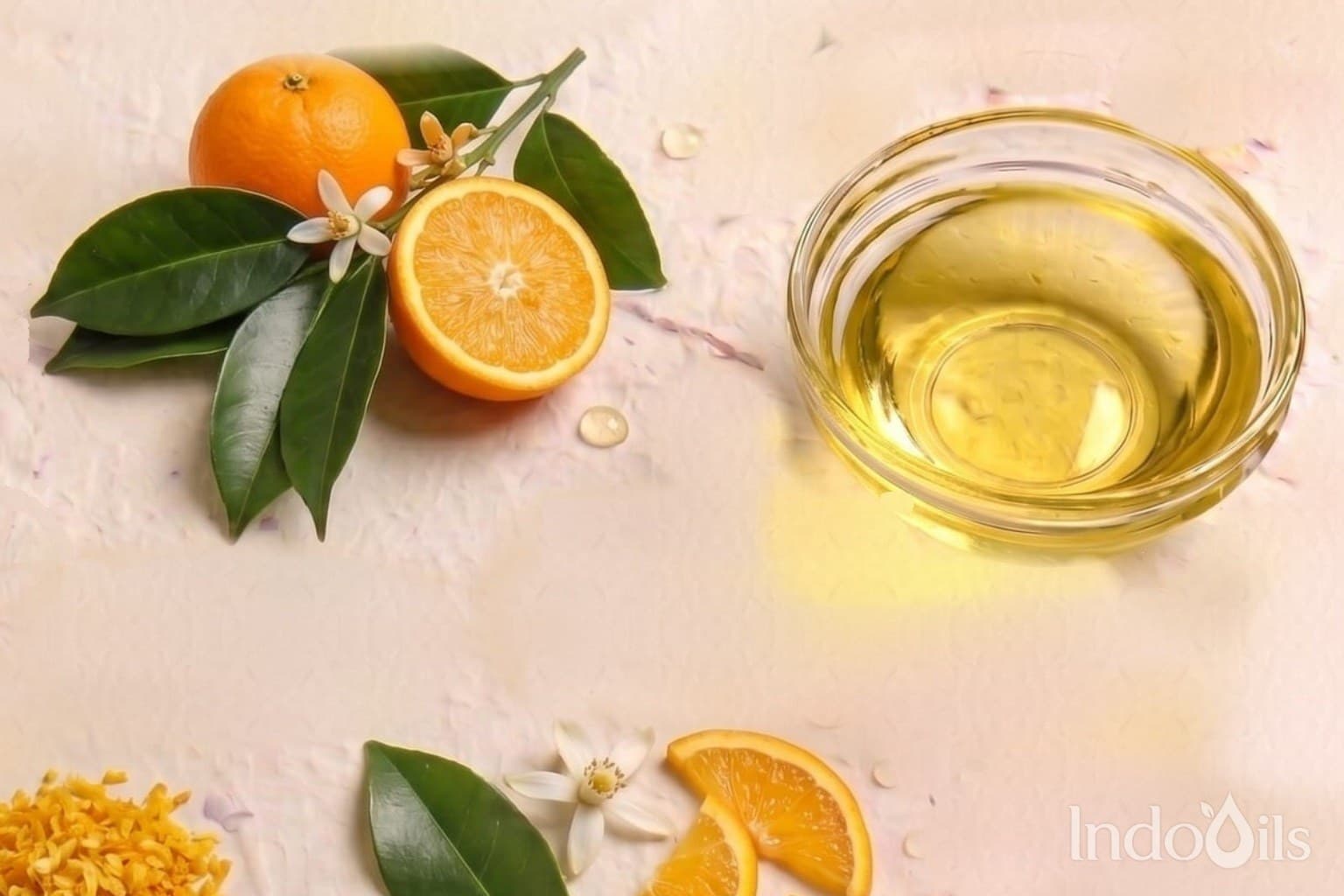
Sweet orange oil is the citrus oil most people have smelled without knowing it. The bright, juicy orange note in soft drinks, sweets, ice cream, shower gels and citrus kitchen cleaners usually comes from it. It is the most widely traded citrus oil in the world, and one of the most widely traded essential oils of any kind.
Almost all of it is a by-product of orange juice. The oil sits in the coloured outer layer of the peel, and juice factories recover it before the peel goes to cattle feed. That link to the juice industry shapes everything about the oil: where it comes from, how it is made, what it costs and how its quality varies.
This guide covers Sweet Orange Essential Oil from IndoOils: what it is, how it is made, what is in it, which tests matter, which rules apply, where it is used and how to order it in bulk.
Sweet Orange, Bitter Orange, Mandarin: Getting the Name Right
"Orange oil" can mean several different things, so the first job is to make sure supplier and buyer mean the same oil:
- Sweet orange oil comes from the peel of the sweet orange, Citrus sinensis: the common eating and juice orange (Valencia, Pera, Hamlin, navel and others). When a flavour or fragrance specification says "orange oil" without a qualifier, this is the oil it means.
- Bitter orange oil comes from the peel of Citrus aurantium, the Seville orange. It smells drier and more bitter, and it is restricted in cosmetics because it can make skin sensitive to sunlight. IndoOils lists it separately as Bitter Orange Essential Oil.
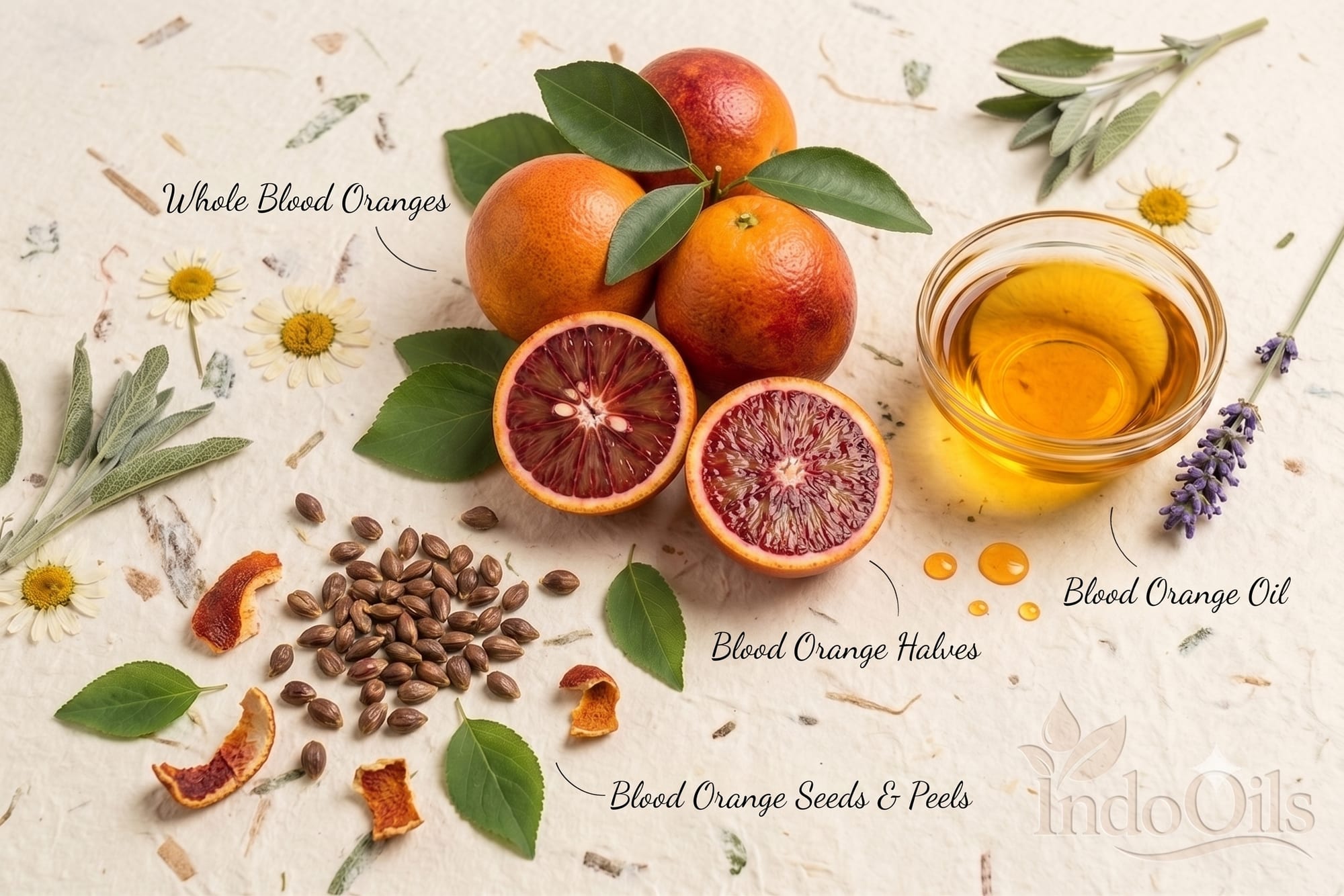
- Blood orange oil comes from red-fleshed varieties of sweet orange (Moro, Tarocco, Sanguinello), mostly from Italy. See Blood Orange Essential Oil.
- Mandarin and tangerine oils come from Citrus reticulata and its hybrids. They smell softer and sweeter, with a distinct note that sweet orange oil does not have.
- Neroli is distilled from the blossom of the bitter orange, not from any peel. See Neroli (Orange Blossom) Essential Oil.
One point matters for buyers in India. Most fruit sold as "orange" in India, such as Nagpur, Coorg and Darjeeling oranges, are botanically mandarins, and Kinnow is a mandarin hybrid. Oil pressed from them is mandarin oil, not sweet orange oil, and it should not be sold against a sweet orange specification.
An old trade name, oil of Portugal, still turns up on some older European documents. It means sweet orange oil.
Product identifiers
- Product: Sweet Orange Essential Oil (Cold Pressed)
- Botanical name: Citrus sinensis (L.) Osbeck
- INCI name: Citrus Aurantium Dulcis (Orange) Peel Oil
- CAS number: 8008-57-9 (8028-48-6 also appears on some documents)
- EC number: 232-433-8
- FEMA number: 2825
- HSN code: 33011200 (essential oils of orange)
- SKU: IND0093
- Plant part: Fresh fruit peel
- Extraction method: Cold expression
- Main constituent: d-limonene, typically 93–96 %
Cold-Pressed Oil, Folded Oil and Orange Terpenes
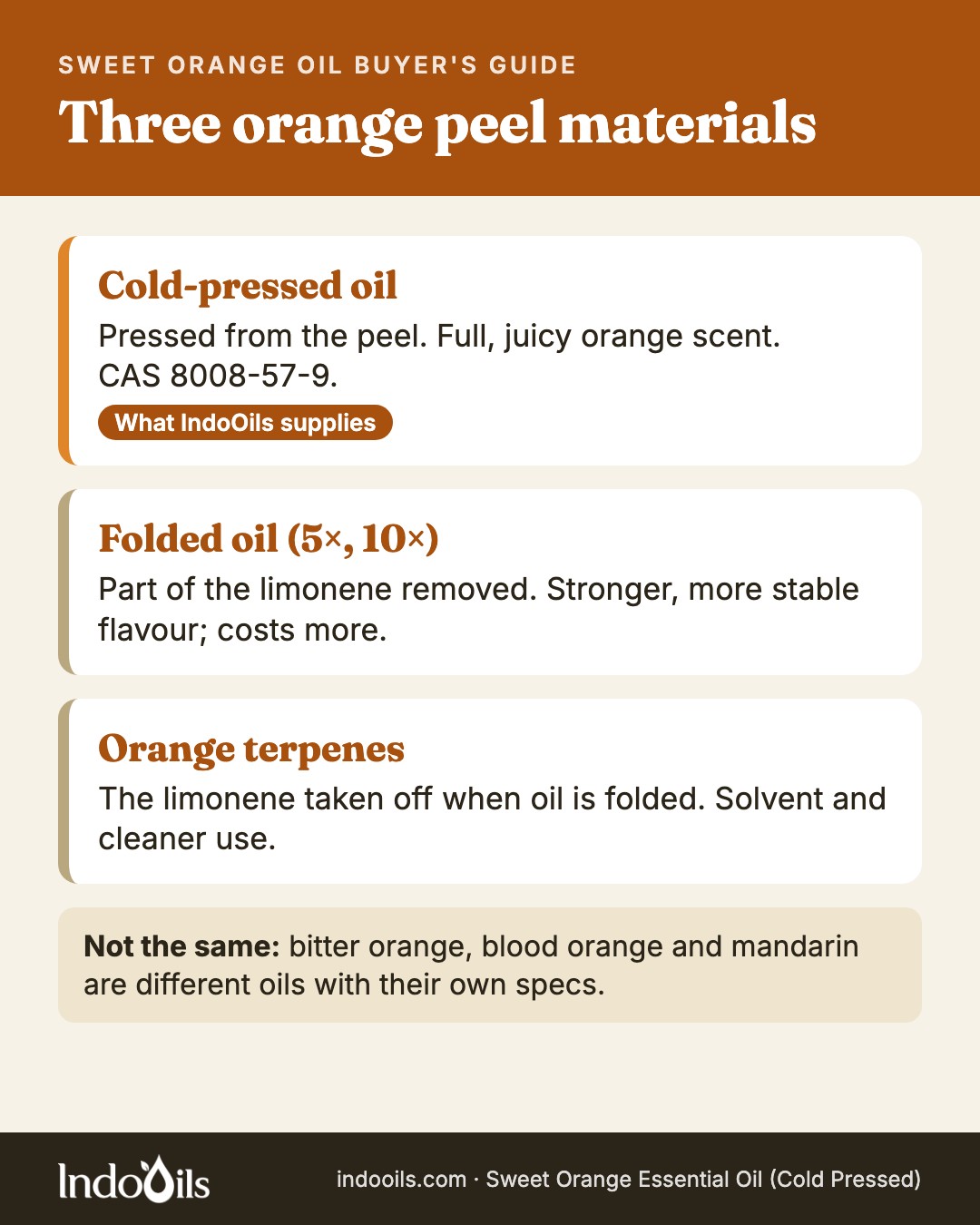
The orange juice industry sells several materials from the same peel. They look alike in a drum but behave very differently in a formula:
- Cold-pressed (single-fold) oil is the oil as it comes off the peel, after centrifuging, chilling and filtering. It has the full, juicy scent of the fruit. This is what IndoOils supplies, and it is the standard material for most flavour, fragrance and home-care uses.
- Folded oil (2-fold, 5-fold, 10-fold and higher) is cold-pressed oil that has been concentrated by removing part of the limonene under vacuum. A 5-fold oil is roughly one-fifth of the starting weight. It is stronger, more stable, and dissolves better in water-alcohol mixes, so flavour houses use it for clear drinks. It costs much more per kilogram.
- Orange terpenes are the limonene taken off during folding. They still smell of orange, but faintly. They are used as natural solvents in cleaners, degreasers and paint strippers, and as a cheap orange note.
- Distilled orange oil is made by steam-distilling peel or recovered oil. It lacks the non-volatile part of pressed oil and smells flatter. It is sometimes used where colour or residue must be avoided.
There is also orange essence oil, recovered from the evaporators when orange juice is concentrated. It has a fresh, juice-like note, rich in valencene, and is mainly sold to flavour houses.
Make sure your order and every document name the grade. A specification that says only "orange oil" invites a supplier to send whatever is cheapest that week.
How Sweet Orange Oil Is Made
Sweet orange oil is pressed, not distilled. The process runs alongside juice extraction in large juice plants:
- Juice season: oranges are washed and graded, then fed into juice extractors. Most of the world's orange oil comes from the big juice industries of Brazil (São Paulo state) and the United States (Florida and California), with smaller volumes from Mexico, South Africa, Spain and others.
- Cold pressing: as the juice is extracted, the machines puncture or scrape the outer peel and break the oil glands. A spray of water rinses the oil off as an oil-in-water emulsion.
- Centrifuging: the emulsion goes through a first centrifuge to remove water and peel solids, then a "polishing" centrifuge that gives clear oil.
- Winterising: the oil is chilled, often for several weeks, so that natural peel waxes settle out. It is then filtered. Oil that is not winterised properly turns cloudy in the cold.
- Testing and packing: each lot is tested, then packed with as little air as possible, often under nitrogen.
The yield is small: a tonne of oranges gives only a few kilograms of oil. Because the oil is a by-product of juice, its supply and price follow the orange crop, not demand for the oil. When Brazil's harvests fell in recent seasons, under drought and the citrus greening disease, orange oil became much more expensive and harder to find. Our post on climate volatility and wholesale pricing explains how to plan for swings like that.
What Is Inside Sweet Orange Oil
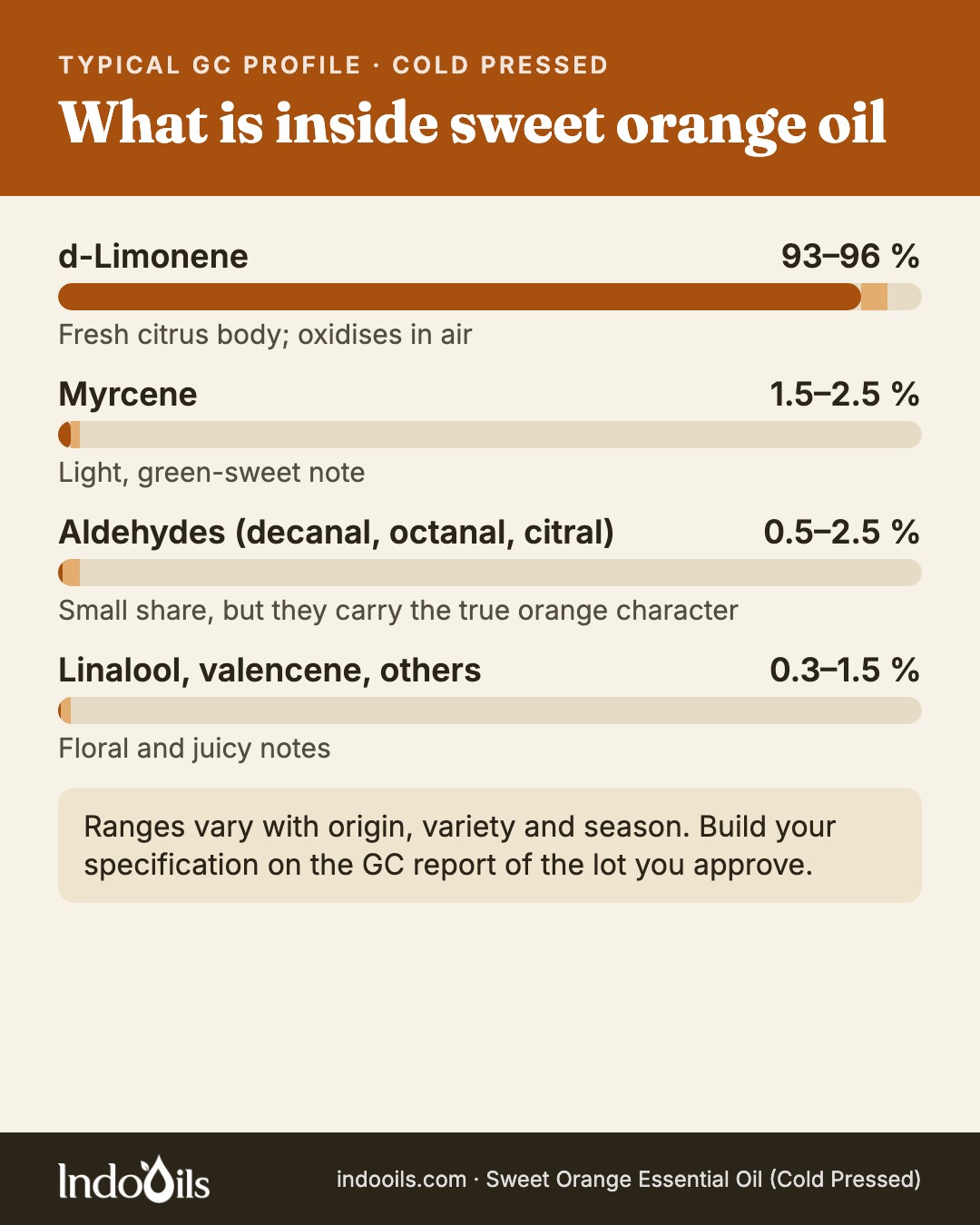
Sweet orange oil is simple on paper. A GC-MS report usually shows:
- d-Limonene, 93–96 %: the fresh, clean citrus body of the oil. Limonene is also what makes orange oil a good solvent, and what oxidises when the oil is exposed to air.
- Myrcene, 1.5–2.5 %: a light, green-sweet note.
- Aldehydes, about 0.5–2.5 % in total: decanal, octanal, citral (neral and geranial) and others. They are a small share of the oil, but they carry the true "orange" character. Two oils with the same limonene can smell quite different if their aldehydes differ.
- Linalool, valencene, sinensals and others: floral and juicy notes in small amounts.
- Non-volatile residue: pressed oil also carries a little non-volatile material from the peel (waxes, coumarins, flavonoids and colour). It does not show on a GC report, but it is part of what makes pressed oil different from distilled oil.
The figures vary with orange variety, country, season and how the oil was processed. Early-season and late-season oils differ, and oils from Valencia oranges differ from those of Pera or Hamlin. That is why a buyer's specification should be built on the GC report of an approved lot, not on a textbook range.
What to Check on the Certificate of Analysis
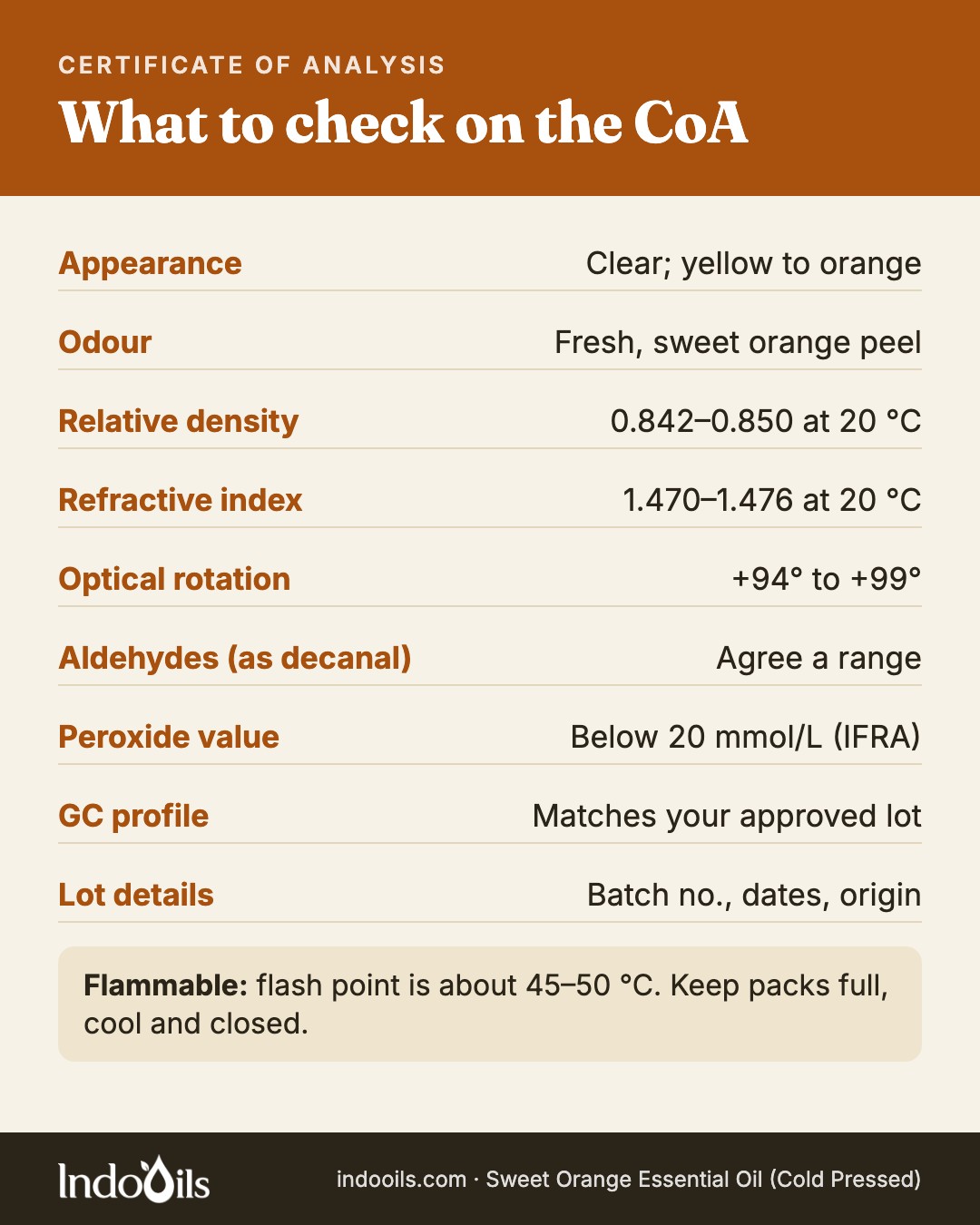
A CoA for cold-pressed sweet orange oil should report:
- Appearance: clear, mobile liquid; yellow to orange. A slight haze in the cold can be wax; a haze at room temperature is a question for the supplier.
- Odour: fresh, sweet orange peel, matching your approved sample. Oxidised oil smells flat, harsh or "turpentine-like".
- Relative density: about 0.842–0.850 at 20 °C.
- Refractive index: about 1.470–1.476 at 20 °C.
- Optical rotation: about +94° to +99°. This is a quick check that the limonene is the natural (+)-form at the expected level.
- Aldehyde content: usually reported "as decanal". Agree a range with your supplier; it is the best single figure for flavour strength.
- Peroxide value: a measure of oxidation. IFRA asks that limonene-rich materials have a peroxide value below 20 mmol/L. For fragrance and personal-care buyers, this is often the first figure they look at.
- GC profile: limonene, myrcene, the main aldehydes and linalool, compared with your approved lot.
- Lot details: batch number, production and expiry dates, and country of origin.
Food buyers should also ask for a pesticide residue report. Pesticides used on the fruit are oil-soluble, so they concentrate in peel oil, and residue limits apply to flavourings in most markets.
Spotting cut and tired oils
Orange oil is cheap compared with most essential oils, but it is still adulterated, especially when crops are short:
- Added limonene or orange terpenes: the most common trick. Limonene is cheap and makes up most of the oil anyway, so a small addition is hard to see. Low aldehydes, a flat odour and a missing non-volatile residue are the giveaways.
- Distilled oil sold as pressed oil: distilled oil has almost no non-volatile residue and different minor compounds. An evaporation residue test and a UV absorbance check show the difference.
- Other citrus oils: mandarin, grapefruit or cheaper "orange" oils of mixed origin. A GC fingerprint against an authentic reference usually catches these.
- Old, oxidised oil: not adulteration as such, but common. A high peroxide value and a harsh odour mean the oil has been badly stored or is past its best.
The protection is the same as for any oil: approve a sample, keep a retained sample, and compare every lot's GC report and peroxide value with the approved one.
Where Sweet Orange Oil Is Used
Sweet orange oil has one of the widest spreads of uses of any essential oil:
- Beverages: soft drinks, juice drinks, syrups, energy drinks and liqueurs. Orange oil does not dissolve in water, so drinks use it in emulsions (for cloudy drinks) or as folded or washed oil (for clear drinks).
- Confectionery and bakery: hard candy, jellies, chocolate, chewing gum, cakes, biscuits, icings and fillings.
- Dairy and desserts: ice cream, yoghurt, flavoured milk and puddings.
- Flavour houses: the base of orange, mixed-citrus and "tutti-frutti" flavours, often blended with lemon, lime and grapefruit oils.
- Pharmaceutical and supplement flavouring: syrups, chewable tablets and gummies, where orange is the most popular taste-masking flavour. See our pharmaceuticals page.
- Fragrance: a fresh top note in colognes, body sprays and fine fragrance, often with bergamot, neroli, lavender and ylang ylang.
- Personal care: soaps, shower gels, shampoos and lotions. See cosmetics and personal care.
- Home care: citrus cleaners, degreasers, dish liquids, hand cleaners, air fresheners and candles. Limonene dissolves grease, adhesives and inks, so orange oil does real work in these products as well as scenting them. See home care and fragrance.
In warm "orange and spice" profiles, popular in festive products, sweet orange pairs with clove bud, cinnamon bark, nutmeg, ginger and cardamom. For ready-made home-fragrance blends, IndoOils also offers Sweet Orange Diffuser Oil and Mandarine Diffuser Oil.
Safety, Food and Cosmetic Rules
Handling
Sweet orange oil is a common material, but it is not harmless in bulk:
- It is flammable. The flash point is about 45–50 °C (closed cup), so it is classed as a flammable liquid for storage and transport. Keep drums away from heat, sparks and flames, and earth them when transferring.
- It is a skin irritant and can cause skin allergy. Fresh limonene is a weak sensitiser, but the hydroperoxides formed when it oxidises are strong ones. Fresh oil with a low peroxide value is safer to work with and to formulate.
- It is an aspiration hazard. Like other limonene-rich oils, it may be fatal if swallowed and it enters the airways.
- It is very toxic to aquatic life. Keep spills out of drains.
Wear gloves and eye protection, and read the Safety Data Sheet supplied with each batch for the full GHS classification and transport details.
Food and flavour
Sweet orange oil is one of the most established flavouring materials there is. In the US it has FEMA number 2825 and is listed as generally recognised as safe (21 CFR 182.20). In the EU it is used as a natural flavouring preparation under Regulation (EC) No 1334/2008, and a product can be labelled "natural orange flavouring" only if at least 95 % of the flavouring comes from orange. Our post on clean-label traceability explains how buyers document that.
For food use, ask for a food-grade statement, a pesticide residue report and, if the oil contains one, the name and level of any added antioxidant.
Cosmetics and fragrance
- EU allergens: sweet orange oil contains limonene and linalool, and smaller amounts of citral. These must be named on EU cosmetic labels when they pass the labelling limits (0.001 % in leave-on and 0.01 % in rinse-off products). The EU allergen list was expanded by Regulation (EU) 2023/1545; see our post on fragrance allergen labelling.
- IFRA: the IFRA Standard for limonene asks that limonene and materials rich in it be kept low in peroxides, below 20 mmol/L, usually with an antioxidant. Ask for an IFRA certificate with your order.
- Sunlight: cold-pressed sweet orange oil is low in the furocoumarins that make some citrus oils phototoxic, and it does not have its own IFRA phototoxicity limit. Bitter orange, lemon, lime, grapefruit and bergamot oils do. If you blend sweet orange with those oils, the combined furocoumarin level of the product still needs to be checked.
Documents to Ask For
For a bulk order of sweet orange oil, expect:
- A Certificate of Analysis for the actual lot, with the constants above, limonene, aldehydes and peroxide value
- A GC-MS report from an independent laboratory
- A Safety Data Sheet in GHS format, with the flash point and transport classification
- An IFRA certificate and an EU allergen declaration
- A food-grade statement and a pesticide residue report, for food and flavour use
- A certificate of origin, showing the country where the oil was produced
Our quality assurance and certifications pages describe how IndoOils tests and documents every lot.
Packing, Storage and Shelf Life
IndoOils supplies sweet orange oil in 20 kg and 50 kg aluminium packs, each with its own batch number. Aluminium protects the oil from light and does not react with it.
Oxidation is the main enemy:
- Store packs closed, at 15–25 °C, away from sunlight and heat.
- Keep the headspace small. Once a pack is opened, blanket it with nitrogen or decant the oil into smaller full containers.
- If the oil turns cloudy in the cold, warm it gently to room temperature and mix. Peel waxes cause this; it is not a defect.
- Use stainless steel, glass or aluminium for handling. Limonene softens some plastics and rubbers.
Shelf life is 24 months unopened. Use opened packs within six months, and check the peroxide value of older stock before using it in fragrance or personal-care products.
How to Order Sweet Orange Oil in Bulk
- Send your specification, or ask for ours: grade (cold-pressed single-fold), limonene, aldehyde and peroxide limits, origin preference and documents needed.
- Approve a sample. Request one through our sample request page and test it in your own lab and your own product.
- Ask for a quotation through our bulk inquiry page, with your annual volume and delivery schedule. Prices follow the orange crop, so ask about forward cover if you need a fixed price for a season.
- Order: the minimum order is one pack (20 kg); 50 kg packs are also available.
If you sell sweet orange oil under your own brand, our private label service can fill and label it for you.
Frequently Asked Questions
Is sweet orange oil the same as orange oil?
Usually, yes. When a flavour or fragrance specification says "orange oil" without a qualifier, it means cold-pressed sweet orange oil from Citrus sinensis. Bitter orange, blood orange and mandarin oils are different oils and should always be named as such.
Is sweet orange oil distilled or cold pressed?
The standard grade is cold pressed: the oil is pressed out of the peel during juice extraction, with no heat or solvent. Distilled orange oil also exists, but it smells flatter and is sold as a separate grade.
What is the difference between orange oil and d-limonene?
Sweet orange oil is about 93–96 % d-limonene, plus the aldehydes and other minor compounds that give the real orange scent. d-Limonene sold on its own (or as orange terpenes) has had most of those removed. It is a good solvent, but a poor orange flavour.
Why does the peroxide value matter?
Limonene reacts with air and forms hydroperoxides, which are strong skin sensitisers and also spoil the scent. IFRA asks that limonene-rich materials stay below 20 mmol/L. A low peroxide value shows the oil is fresh and has been stored well.
Is sweet orange oil phototoxic?
Cold-pressed sweet orange oil is low in the furocoumarins that cause phototoxicity and has no IFRA phototoxicity limit of its own. Bitter orange, lemon, lime, grapefruit and bergamot oils do have limits.
What is the HSN code for sweet orange oil?
33011200, "essential oils of citrus fruit: of orange", with GST at 18 %. Confirm the code with your customs agent for your own shipments.
What is the minimum order?
One 20 kg pack. 50 kg packs are also available, and a sample can be sent before you order in bulk.
For more buyer's guides, see our posts on allspice oil, black pepper oil, cardamom oil, lavender oil and essential oils for cosmetics, or browse the full essential oils range.
Buying in bulk?
20 kg and 50 kg packs, with a certificate of analysis for every lot.
Tell us the product, quantity and destination, and we will come back with a quotation.