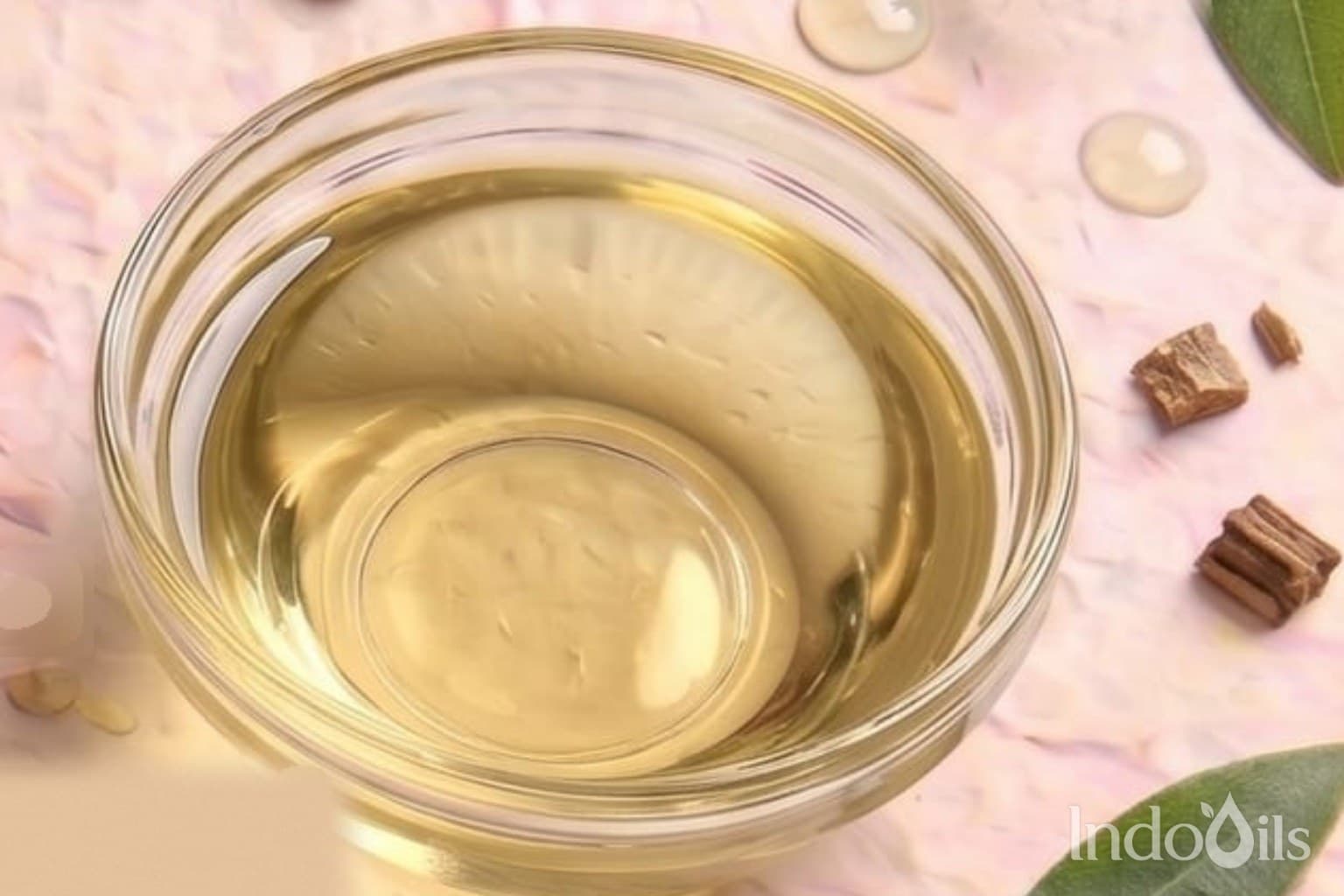
Sandalwood is one of the oldest and most valued base notes in perfumery. For most of its history that meant Indian sandalwood, Santalum album. Today a large share of the natural sandalwood oil in world trade comes from a different tree: Santalum spicatum, the sandalwood of Western Australia.
Australian sandalwood oil is a genuine, natural sandalwood oil, with its own international standard and its own character. It is not a cheaper copy of Indian oil, and it should not be sold as one. Perfumers, attar makers and personal-care manufacturers buy it in bulk because it gives a true sandalwood note at a more accessible cost and from a regulated supply.
This guide covers Australian Sandalwood Essential Oil from IndoOils: what it is, how it differs from Indian oil, what is in it, which tests matter, which rules apply and how to order it in bulk. For an overview of every sandalwood product we supply, see our sandalwood oil buyer's guide.
One Oil, Several Names
Australian sandalwood oil appears under several names on specifications and documents:
- Australian sandalwood oil: the usual trade name, and the name in the ISO standard.
- West Australian sandalwood oil or WA sandalwood oil: common in Australia, after the state where the tree grows.
- Santalum spicatum: the botanical name. Older documents use Fusanus spicatus for the same tree.
- Spicatum oil: perfumers' shorthand.
Two names cause confusion and are worth checking carefully:
- "Australian-grown Indian sandalwood" is Santalum album grown on plantations in northern Australia. It is Indian sandalwood oil in every technical sense, with the Indian standard and a different CAS number. It is not Australian sandalwood oil.
- "West Indian sandalwood" is usually amyris oil, from an unrelated Caribbean tree. It has a woody note of its own but contains no santalols and is not sandalwood.
Product identifiers
- Product: Australian Sandalwood Essential Oil
- Botanical name: Santalum spicatum (R.Br.) A.DC.; synonym Fusanus spicatus
- INCI name: Santalum Spicatum Wood Oil
- CAS number: 8024-35-9
- International standard: ISO 22769:2022
- HSN code: 33012937 (sandalwood oil)
- SKU: IND0100
- Plant part: Heartwood and roots
- Extraction method: Steam distillation
- Origin: Western Australia
- Shelf life: 36 months, unopened
Australian or Indian Sandalwood Oil?
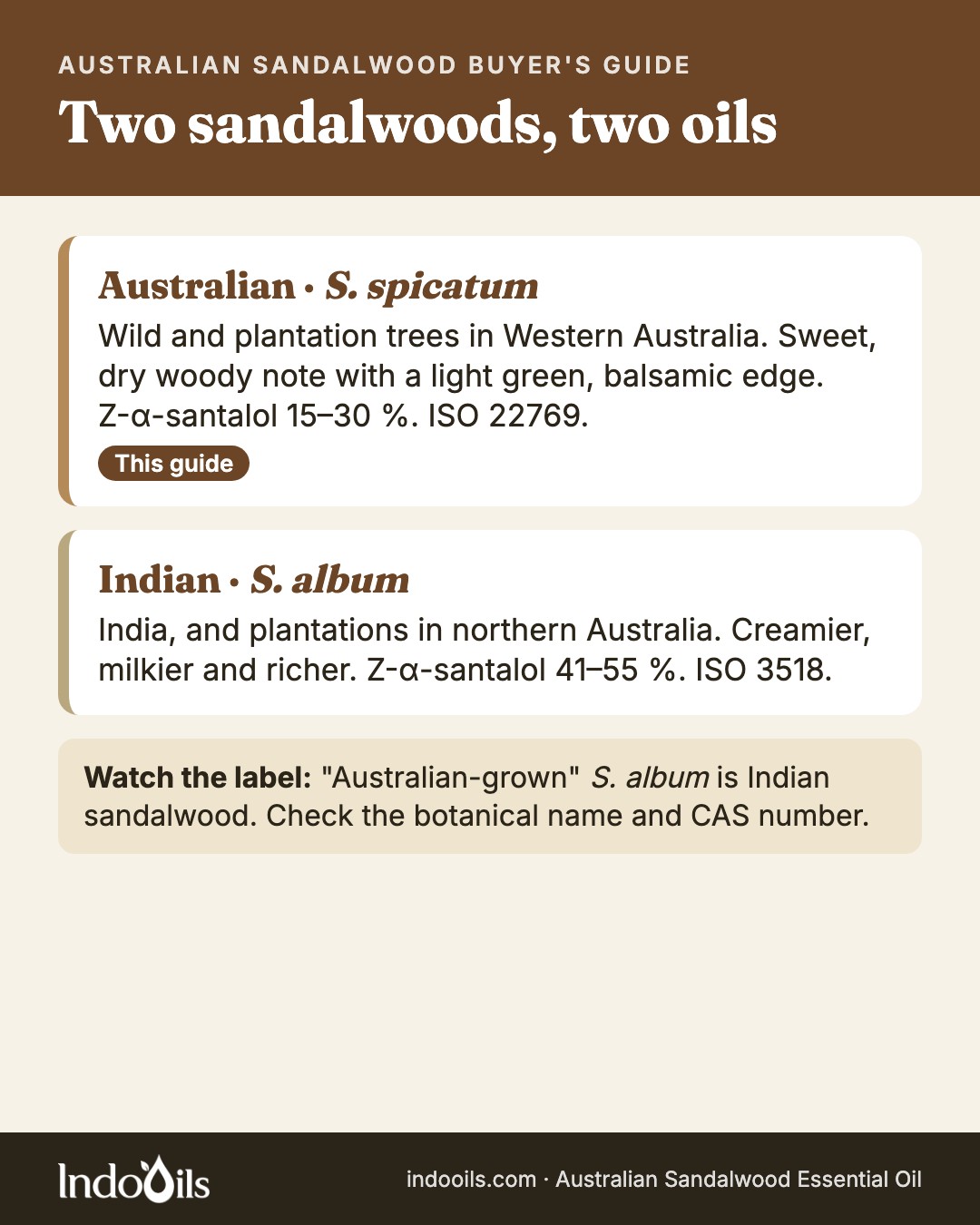
Both are true sandalwood oils, distilled from the heartwood of Santalum trees, and both are built on the same two odour molecules, α-santalol and β-santalol. They differ in how much of those molecules they contain and in what else is present.
- Australian sandalwood oil (S. spicatum) has less santalol: the ISO 22769 range for Z-α-santalol is 15 to 30 per cent. It also contains notable amounts of E,E-farnesol, Z-nuciferol and epi-α-bisabolol, which Indian oil has little of. The result is a sweet, woody and persistent oil that smells drier and lighter than Indian oil, with a faint green, balsamic top note.
- Indian sandalwood oil (S. album) is richer in santalols: the ISO 3518 range for Z-α-santalol is 41 to 55 per cent, and 16 to 24 per cent for Z-β-santalol. It smells creamier, milkier and rounder. It is also scarcer and costs considerably more.
Neither is simply "better". Indian oil is the reference for a classic creamy sandalwood heart. Australian oil is the practical choice when you want a natural sandalwood note, a long-lasting woody base or a natural fixative and the full East Indian profile is not essential. Many perfumers use the two together.
What matters for a buyer is that the oil is what the label says. Put the botanical name and the CAS number on your purchase order, and check that the CoA, the SDS and the GC report all name the same species. If you need Indian oil, see our Sandalwood Essential Oil from Santalum album.
How Australian Sandalwood Oil Is Made
Santalum spicatum is a small, slow-growing tree of the dry inland of Western Australia, from the Wheatbelt to the Goldfields and the Murchison. Like all sandalwoods it is a semi-parasite that takes part of its water and nutrients from the roots of host plants. It needs decades to build up a scented heartwood, which is why the oil is valuable.
- Harvest. Wild sandalwood on Crown land is harvested and sold by the state's Forest Products Commission under a licence and an annual tonnage limit; private harvesting is licensed too. Plantation-grown S. spicatum from the Wheatbelt is a growing share of supply. Whole trees are pulled, because the roots hold much of the oil.
- Cleaning. The bark and the pale outer sapwood carry almost no oil, so they are removed. Only the scented heartwood and roots go forward.
- Milling. The wood is chipped and ground to a coarse powder, so steam can reach the oil.
- Steam distillation. Santalols are heavy molecules with high boiling points, so the distillation is long and slow. ISO 22769 defines Australian sandalwood oil as the oil obtained by steam distillation of the heartwood.
- Testing. Each batch is checked against ISO 22769 and analysed by GC-MS at an independent laboratory before release. Our quality assurance page explains these checks.
- Packing. The oil is filled into clean 20 kg or 50 kg aluminium containers, sealed and labelled with its batch number.
IndoOils' Australian sandalwood oil is of Western Australian origin and reaches us through our partner network as finished oil. Our traceability page explains how each lot is linked to its origin and documents.
What this means for supply
Because the wild harvest is controlled by the state, supply does not jump when prices rise. The current Western Australian limit on wild sandalwood removal runs to the end of 2026 and is under review, and plantation volumes are still building. Expect firm prices and plan large contracts early. Our post on climate volatility and wholesale pricing explains how supply shocks feed through to essential-oil prices.
What Is Inside Australian Sandalwood Oil
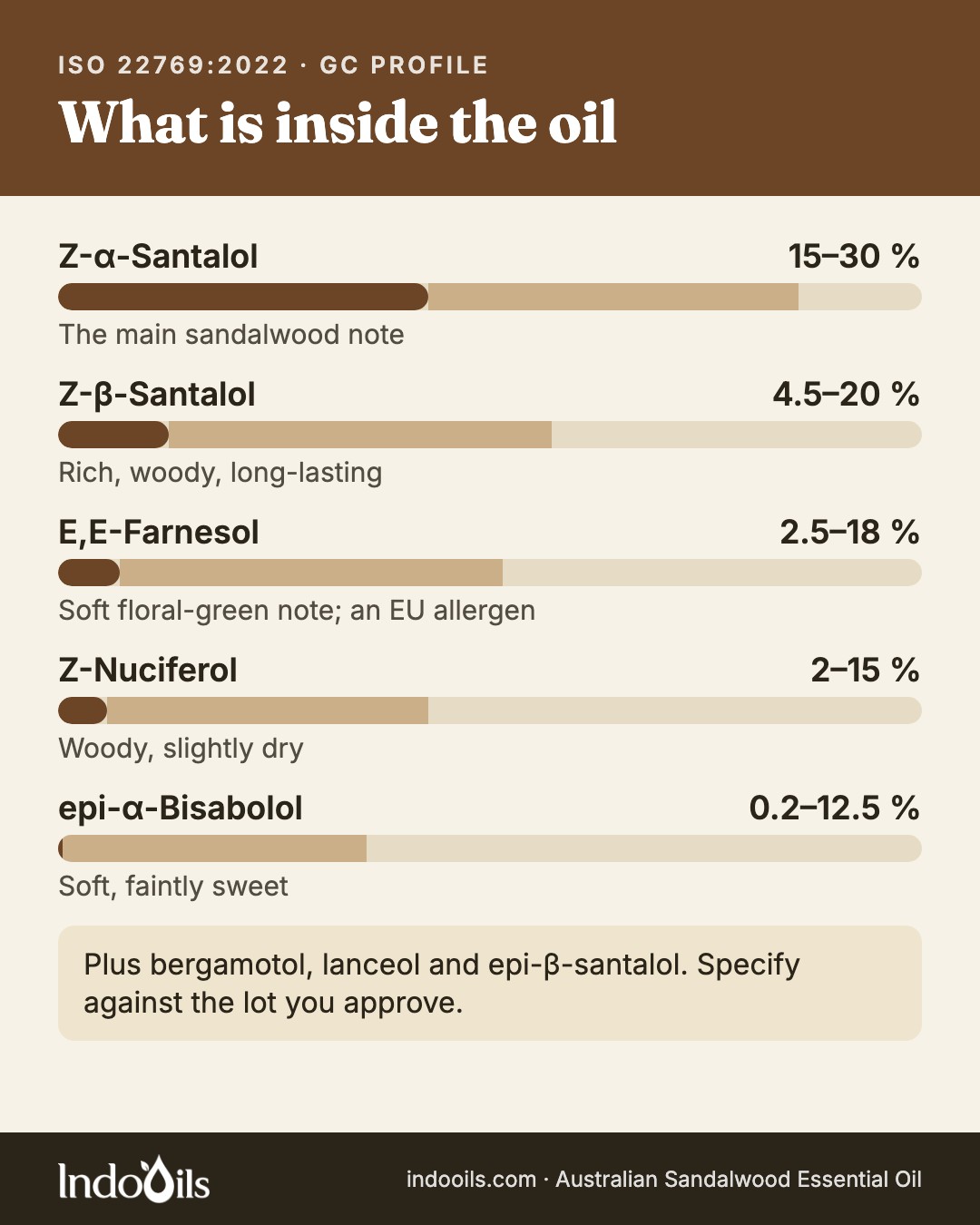
ISO 22769:2022 sets a chromatographic profile with eight components. The ranges are wide because wild trees vary with age, site and the share of root wood:
- Z-α-santalol, 15 to 30 per cent: the main sandalwood molecule and the largest single peak.
- Z-β-santalol, 4.5 to 20 per cent: richer and more tenacious than α-santalol, and an important part of the sandalwood character.
- E,E-farnesol, 2.5 to 18 per cent: a soft, slightly floral-green alcohol. It is much higher in Australian oil than in Indian oil, and it is a listed fragrance allergen in the EU.
- Z-nuciferol, 2 to 15 per cent, and epi-α-bisabolol, 0.2 to 12.5 per cent: they add the drier, slightly sweet notes typical of Australian oil.
- Z-α-trans-bergamotol (2 to 10 per cent), Z-lanceol (0.5 to 10 per cent) and epi-β-santalol (0.5 to 3.5 per cent) complete the profile.
The 2022 edition of the standard revised the limits for α-santalol, β-santalol, farnesol and lanceol, so make sure your supplier works to the current edition. The standard also notes that a polar GC column separates these alcohols better than a non-polar one; a GC report that cannot resolve them is of limited use.
Within the ISO ranges, a higher santalol content usually means a richer, more valuable oil. Build your own specification on the GC report of the lot you approve, with minimums for the santalols, rather than relying on the wide ISO bands alone.
What to Check on the Certificate of Analysis
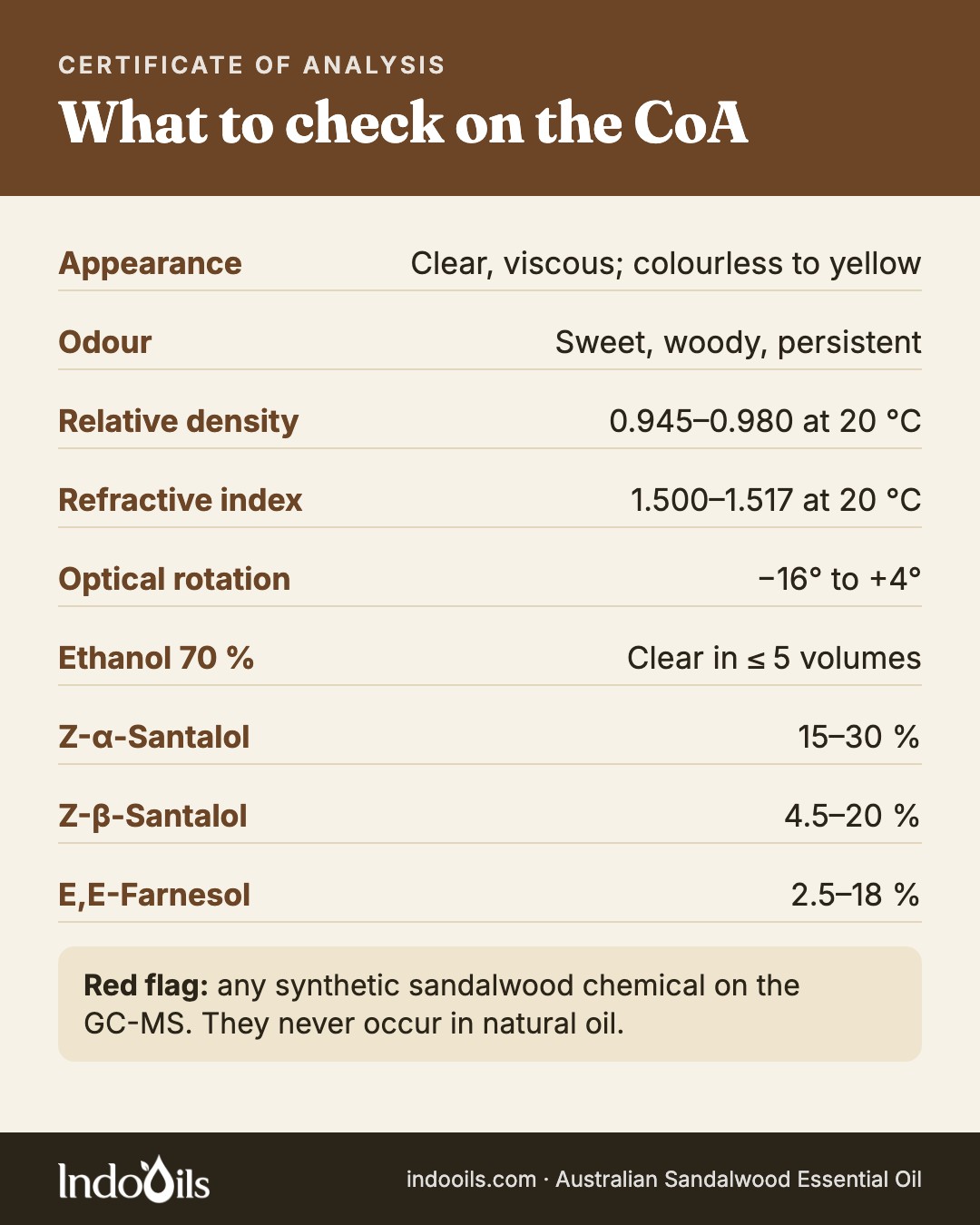
ISO 22769:2022 gives the requirements most buyers use as the base of a contract:
- Appearance: clear, viscous liquid at 20 °C.
- Colour: almost colourless to yellow. Dark or hazy oil may be old, badly stored or mixed.
- Odour: sweet, woody and persistent, true to an approved reference sample.
- Relative density: 0.945–0.980 at 20 °C.
- Refractive index: 1.500–1.517 at 20 °C.
- Optical rotation: −16° to +4° at 20 °C.
- Miscibility in ethanol: one volume of oil must give a clear solution in no more than five volumes of 70 per cent ethanol.
- GC profile: the eight components above, within the ISO ranges and close to your approved lot.
- Flash point: the standard gives a mean of about 140 °C, so the oil is combustible but far from easily flammable. The SDS gives the figure for each lot.
Every IndoOils lot comes with a CoA that reports these results, and every later lot should be checked against the sample you approved.
Spotting cut and fake sandalwood oil
Sandalwood is one of the most adulterated essential oils because of its price. The common tricks, and how a good test report catches them:
- Synthetic sandalwood chemicals. Perfumery chemicals with sandalwood odours are cheap and powerful, and a little can make a weak or diluted oil smell convincing. None of them occur in natural oil, so any peak for them on a GC-MS report is a clear red flag.
- Fixed oils and solvents. Castor oil, other vegetable oils, dipropylene glycol or benzyl benzoate can be used to stretch the oil. Castor and vegetable oils make the ethanol test cloudy; all of them shift density and refractive index and dilute every GC peak.
- Amyris or cheap woody oils. Amyris, cedarwood or other woody oils add bulk and a woody note. They bring their own marker compounds onto the GC, while the santalols drop below the ISO minimums.
- The wrong species. Australian oil sold as Indian oil fails the ISO 3518 santalol minimums and shows the farnesol and nuciferol peaks that Indian oil lacks. Blends of the two show an in-between profile that matches neither standard.
Our cosmetics importer checklist covers adulteration risks across the wider essential-oil range.
Where Australian Sandalwood Oil Is Used
Australian sandalwood oil is bought mostly for fragrance. Its main uses are:
- Fine fragrance: a base note and fixative in woody, oriental, amber and floral perfumes. It lengthens the life of top and heart notes and softens sharp edges.
- Attars: traditional attars are made by distilling flowers or herbs into a sandalwood oil base, and Australian oil is widely used for this today.
- Personal care: soaps, shower gels, lotions, deodorants, beard oils and hair oils, where a natural sandalwood note supports a premium position.
- Skin care: face oils, creams and balms, as a fragrance ingredient. Claims about the finished product are the brand's responsibility.
- Incense: premium agarbatti, dhoop and cones.
- Home fragrance: candles, reed diffusers and room sprays with a warm, woody base.
Sandalwood is one of the most versatile blending materials in perfumery. It works with florals such as Rose Essential Oil (Bulgaria), Jasmine Sambac Essential Oil, Ylang Ylang (Cananga) Essential Oil, Neroli Essential Oil and Geranium Essential Oil, and with fresh tops such as Bergamot Essential Oil (Calabrian) and Lavender Essential Oil (France & Bulgaria).
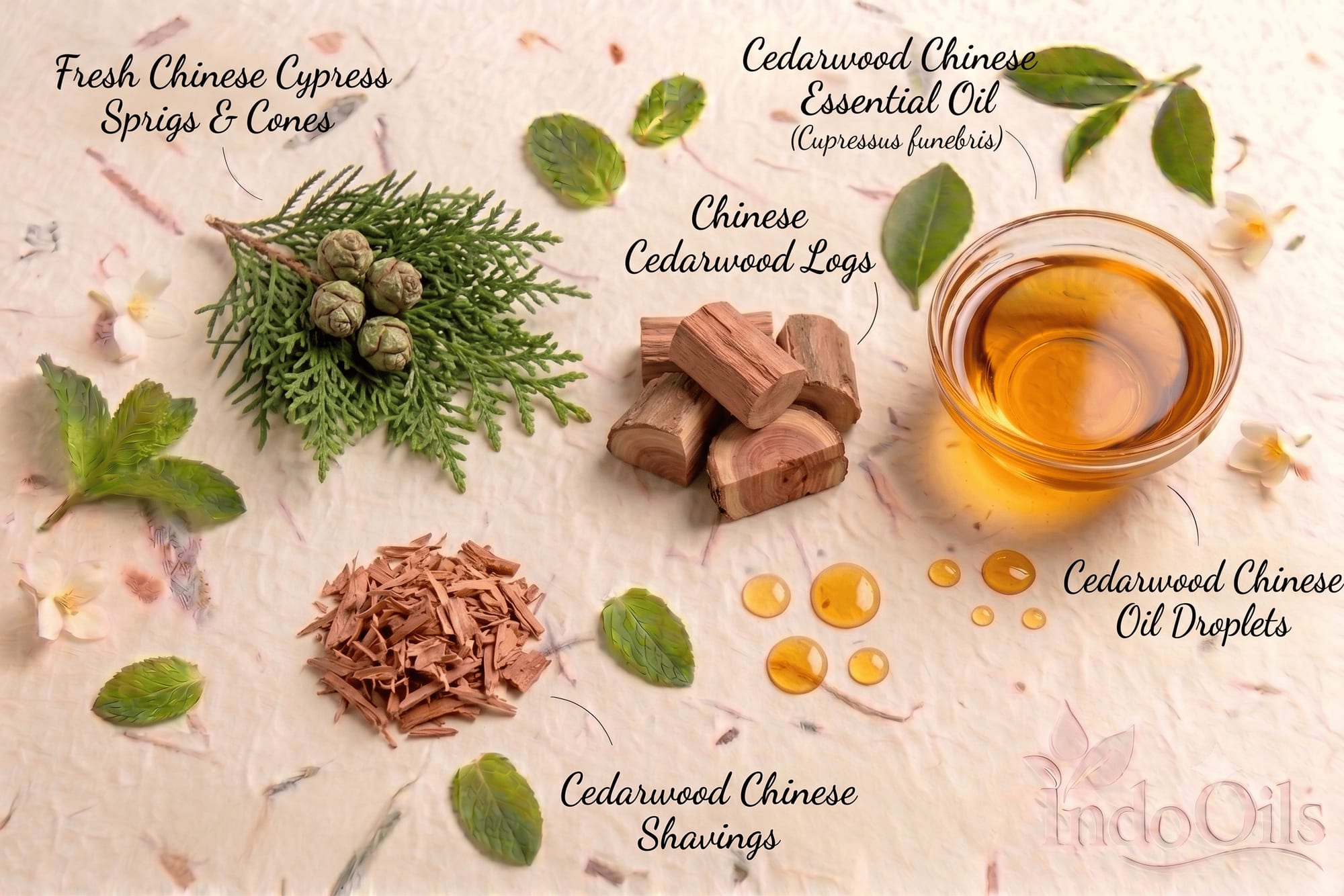
For a deeper woody base, perfumers pair it with Vetiver Oil, Cedarwood Himalayan, Cedarwood Chinese, Blue Cypress Essential Oil (Australia) and resins such as Benzoin Resinoid. Our vetiver buyer's guide covers sandalwood's closest partner in attars.
If you don't need a natural claim, a compounded Sandalwood Fragrance Oil costs far less and suits candles, incense and soaps. For ready-to-use products there is Sandalwood Diffuser Oil and Sandalwood Turmeric Massage Oil. Brands that want their own finished blends can use our private label and custom formulation services.
Safety, Allergen and Cosmetic Rules
Handling
Neat Australian sandalwood oil is a concentrated material and should be handled like any other essential oil. Published SDSs for S. spicatum oil typically classify it as:
- May cause an allergic skin reaction (H317), mainly because of its farnesol and santalols.
- Causes skin irritation (H315) and serious eye irritation (H319). Handle with gloves and eye protection, and never apply the oil undiluted.
- Harmful to aquatic life with long-lasting effects (H412). Keep it out of drains.
Its high flash point means it is usually shipped as non-dangerous goods. The SDS supplied with each lot is the document to follow; classifications differ slightly between suppliers.
EU and UK fragrance allergens
Australian sandalwood oil contains two substances on the EU list of fragrance allergens that must be named on cosmetic labels above 0.001 per cent in leave-on and 0.01 per cent in rinse-off products:
- Farnesol, one of the original 26 labelled allergens.
- Santalol, added by Regulation (EU) 2023/1545, which expanded the list to more than 80 entries. Products first placed on the market after 31 July 2026 must already comply; products already on sale have until 31 July 2028.
Because Australian oil can carry up to 18 per cent farnesol and up to about 50 per cent santalols in total, even small doses can trigger labelling. Ask for an allergen declaration with each lot, and use the figures for your own label calculation. Our guide to fragrance allergen labelling explains the rules and the documents EU and UK buyers need.
IFRA and other markets
Ask for an IFRA certificate with each lot. It states the maximum use level of the oil in each IFRA product category, based on its composition, and your fragrance supplier or safety assessor will need it.
IndoOils supplies Australian sandalwood oil for fragrance and cosmetic use only, not for food or flavour.
Documents You Should Ask For
A serious Australian sandalwood oil supplier should be able to provide, for each lot:
- Certificate of Analysis (CoA) against ISO 22769: physical constants, ethanol miscibility and the GC profile.
- GC-MS report from an independent laboratory, with the santalols, farnesol and a screen for synthetic sandalwood chemicals.
- Safety Data Sheet (SDS) in GHS format.
- IFRA certificate and EU allergen declaration.
- Technical data sheet (TDS) or specification sheet.
- Certificate of origin, naming Australia.
Our certifications page lists the quality systems behind these documents. IndoOils provides the full set with every order, and with every sample on request.
Packing, Storage and Shelf Life
IndoOils supplies Australian sandalwood oil in 20 kg and 50 kg aluminium packs. Aluminium is light, keeps out light and does not react with the oil.
- Store in the original, tightly closed container at 15–25 °C, away from direct sunlight and heat.
- Warm before use. The oil is viscous and thickens further in the cold. Warm the closed pack gently, to no more than 40 °C, and mix before you sample, weigh or fill.
- Keep the headspace small. Sandalwood oil keeps well, but air and light slowly flatten the top notes. Reseal promptly, and decant into smaller full containers if you use a pack over several months.
- Shelf life is 36 months unopened.
How to Order Australian Sandalwood Oil in Bulk
- Request a sample. Use our sample request form. We send a lab sample with its CoA so you can test it against your specification and your current oil.
- Approve and specify. Once the sample passes, the approved lot becomes your reference for santalols, farnesol, odour and physical constants.
- Send a bulk inquiry. Use our bulk inquiry form with the quantity, pack size, destination and the documents you need. We reply with a quotation, usually within one business day.
- Minimum order is one pack (20 kg). Prices depend on volume, packing and destination, so each order is quoted separately.
For wholesale terms, see our wholesale page, or browse the full essential oils range.
Frequently Asked Questions
Is Australian sandalwood oil real sandalwood?
Yes. It is distilled from the heartwood and roots of Santalum spicatum, a true sandalwood tree, and it contains the same santalols as Indian oil, in smaller amounts. It has its own international standard, ISO 22769.
How is it different from Indian sandalwood oil?
Indian oil (Santalum album) contains about twice as much α-santalol and smells creamier and richer. Australian oil is drier and lighter, contains more farnesol, nuciferol and bisabolol, and costs less. They are different products with different standards and CAS numbers.
Can I replace Indian sandalwood oil with Australian oil in my formula?
Often, but not weight for weight. Australian oil smells different and has less santalol, so the perfumer usually needs to re-balance the formula. Your allergen calculation will also change because of the farnesol.
What CAS number and INCI name should be on the documents?
CAS 8024-35-9 and INCI Santalum Spicatum Wood Oil. Some EU documents use the older names Santalum Spicata Wood Oil or Fusanus Spicatus Wood Oil for the same oil. Indian sandalwood oil has a different CAS number, 8006-87-9.
Which allergens does Australian sandalwood oil contain?
Mainly farnesol and santalol, both on the EU list of fragrance allergens. Ask for the allergen declaration of your lot and use its figures on your label.
Is the oil sustainably sourced?
Western Australian sandalwood is harvested under state licences and a limit on the quantity removed each year, and plantation supply is growing. Ask for the origin documents of the lot you buy; we share what our partners provide.
Can I use Australian sandalwood oil in food?
No. IndoOils supplies it for fragrance and cosmetic use only.
Other Buyer's Guides
- Sandalwood oil buyer's guide: Indian and Australian oils, fragrance oil and ready blends.
- Vetiver (khus) oil buyer's guide
- Davana oil buyer's guide
- Lavender oil buyer's guide
- Carrier oils for cosmetics
- Private label essential oils
Buying in bulk?
20 kg and 50 kg packs, with a certificate of analysis for every lot.
Tell us the product, quantity and destination, and we will come back with a quotation.