Few raw materials smell as distinctive as birch tar. Open a bottle and the room fills with smoke, tar, old leather and a campfire of birch logs. For centuries, Russian tanners used birch tar to cure and scent fine leather, and the result was so admired that "Russian leather" became a perfume family of its own.
Today rectified birch tar oil is a small-volume but important material for perfumers, grooming brands, soap makers and leather finishers. It is also one of the few natural materials that IFRA prohibits in its crude form. Buying it well means knowing exactly what you are buying and asking for the right test results.
This guide covers Birch Tar Oil (Rectified) from IndoOils: what it is, how it is made, how it differs from sweet birch oil, what is in it, what to check on a certificate of analysis, which rules apply and how to order it in bulk.
One Oil, Several Names
Birch tar oil is sold under many names, and some of them belong to other products. These are the ones you will meet:
- Birch tar oil, rectified: the usual trade name, and the name of its Food Chemicals Codex monograph.
- Rectified birch tar or birch tar rectified: the same product, common on perfumery price lists.
- Essence de bouleau (goudron) rectifiée: the French name, used by some European distillers.
- Oleum rusci or oleum betulae empyreumaticum: old pharmacy names. They usually mean crude birch tar, not the rectified oil.
- Birch wood pyrolysate: the name in the IFRA Standard, which covers both crude and rectified forms.
Two names cause most of the confusion:
- Sweet birch oil is a completely different product. It is steam distilled from the bark of Betula lenta and is almost pure methyl salicylate, with a wintergreen odour.
- "Birch oil" on its own can mean either. Always check the CAS number and the botanical name before you accept a quotation.
Product identifiers
- Product: Birch Tar Oil (Rectified)
- Botanical source: Betula pendula Roth (silver birch) and Betula pubescens Ehrh. (downy birch)
- CAS number: 8001-88-5
- INCI name: Betula Alba Oil (as linked to CAS 8001-88-5 in the EU CosIng inventory; follow your supplier's IFRA documents)
- HSN code: 38070020 (wood tar oils), to be confirmed by your customs agent
- SKU: IND0025
- Plant part: Bark and wood
- Process: Dry (destructive) distillation, then rectification by steam distillation
- Origin: Europe
- Shelf life: 36 months, unopened
Birch Tar Oil or Sweet Birch Oil?
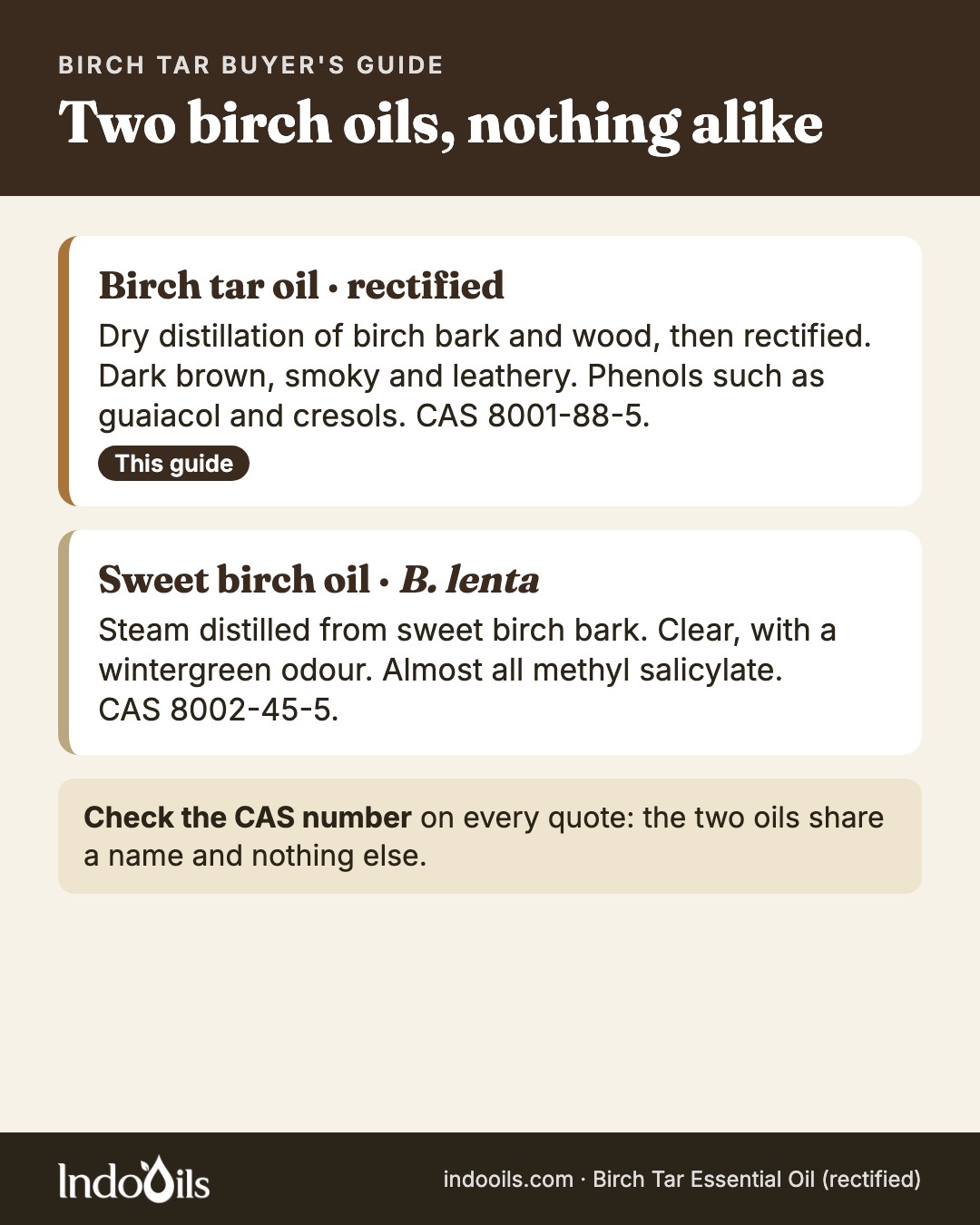
The two birch oils share a name and very little else.
- Rectified birch tar oil comes from heating birch bark and wood without air. It is dark brown, smells of smoke, tar and leather, and its odour comes from phenols such as guaiacol, cresols and creosol. Perfumers use it in drops, not kilograms.
- Sweet birch oil comes from steam distilling the bark of the American sweet birch, Betula lenta. It is almost colourless, smells of wintergreen and is more than 90 per cent methyl salicylate.
If a quotation for "birch oil" gives CAS 8002-45-5, it is sweet birch. If it gives 8001-88-5, it is birch tar. Mixing them up is an expensive mistake, because neither can replace the other in a formula.
How Rectified Birch Tar Oil Is Made
Birch tar is one of the oldest materials made by people. Stone Age hunters heated birch bark to make tar for glue, and the same basic process is still used today, in modern closed retorts.
- Raw material. The outer bark of silver and downy birch is rich in betulin and other compounds that turn into tar when heated. Bark and wood from the timber and plywood industries are the usual feed.
- Dry distillation. The bark and wood are heated in a closed retort with little or no air. They break down, and crude birch tar, a watery acid layer and a tar oil run off.
- Rectification. The crude tar oil is distilled again, usually with steam. This separates a cleaner, lighter oil from the heavy pitch, and it is the step that removes most of the polycyclic aromatic hydrocarbons (PAH). The Food Chemicals Codex defines the product as the oil from dry distillation of birch bark and wood, rectified by steam distillation.
- PAH control. The rectified oil is tested for the PAH markers named by IFRA, benzo[a]pyrene and benz[a]anthracene.
- Testing. Each lot is checked for appearance, odour, density, solubility and its phenol profile, and compared with an approved reference sample. Our quality assurance page explains these checks.
- Packing. The oil is filled into clean 20 kg or 50 kg aluminium containers, sealed and labelled with its batch number.
What this means for supply
Birch tar oil is made in small volumes, mostly in Eastern and Northern Europe where birch is a major timber tree. Quality depends heavily on the distiller: how the tar is made, how carefully it is rectified and whether PAH is tested on every lot. That is why the documents matter more for this oil than for most.
What Is Inside Birch Tar Oil
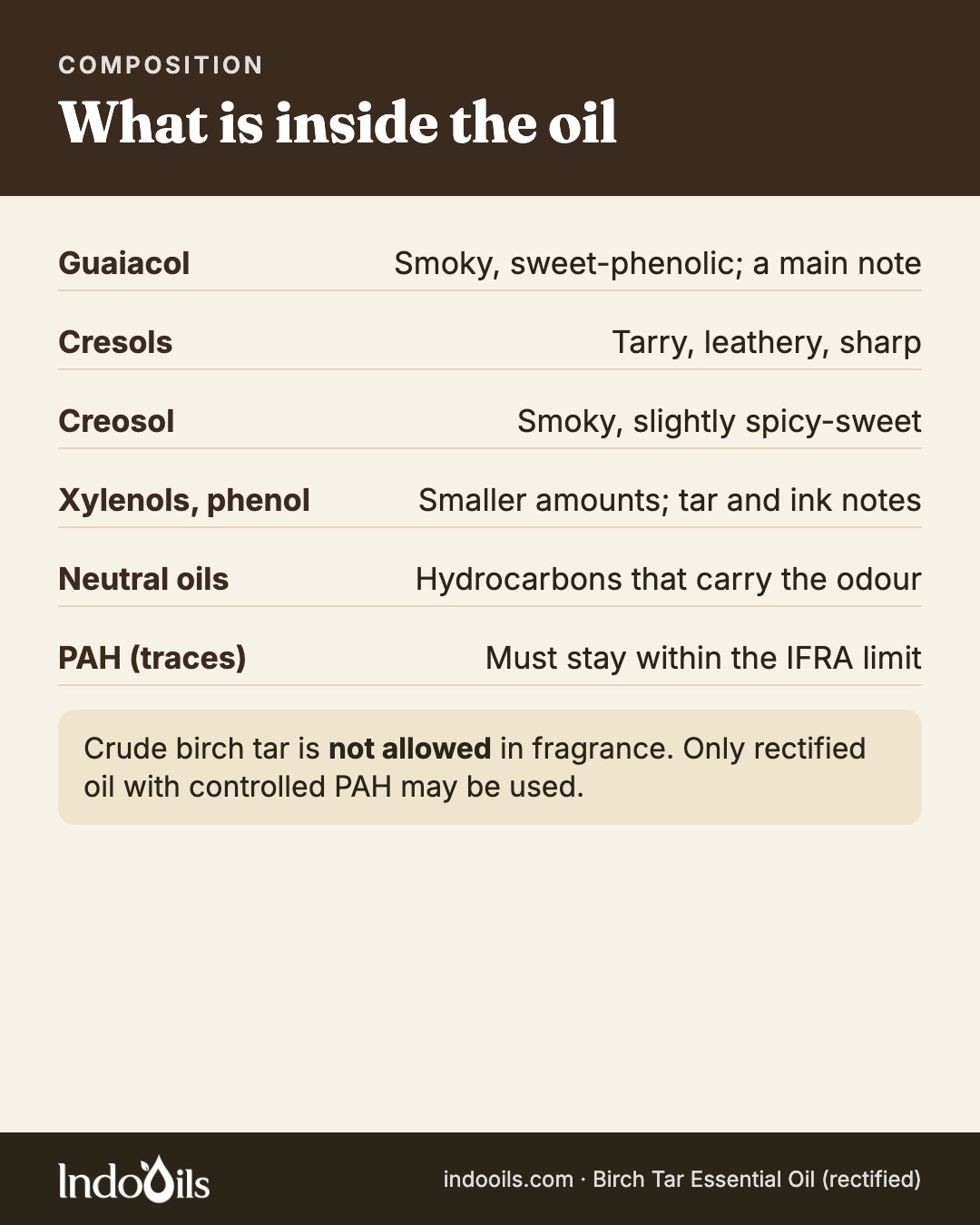
Rectified birch tar oil is a mixture of phenols and neutral oils formed when the bark is heated. Classic pharmacopoeia descriptions name its main components as:
- Guaiacol: a smoky, sweet-phenolic note, and one of the main components.
- Cresols: sharper, tarry and leathery phenols.
- Creosol (4-methylguaiacol): smoky and slightly spicy-sweet.
- Xylenols and phenol: smaller amounts, adding a dry, inky edge.
- Neutral hydrocarbon oils: odourless or faint, they carry the phenols.
- PAH: traces that survive rectification. These are the compounds IFRA limits.
The exact balance depends on the bark, the retort temperature and the rectification, so no two producers' oils are identical. Approve a reference sample and ask for a gas chromatography (GC) profile with each lot, so you can compare future lots against it.
What to Check on the Certificate of Analysis
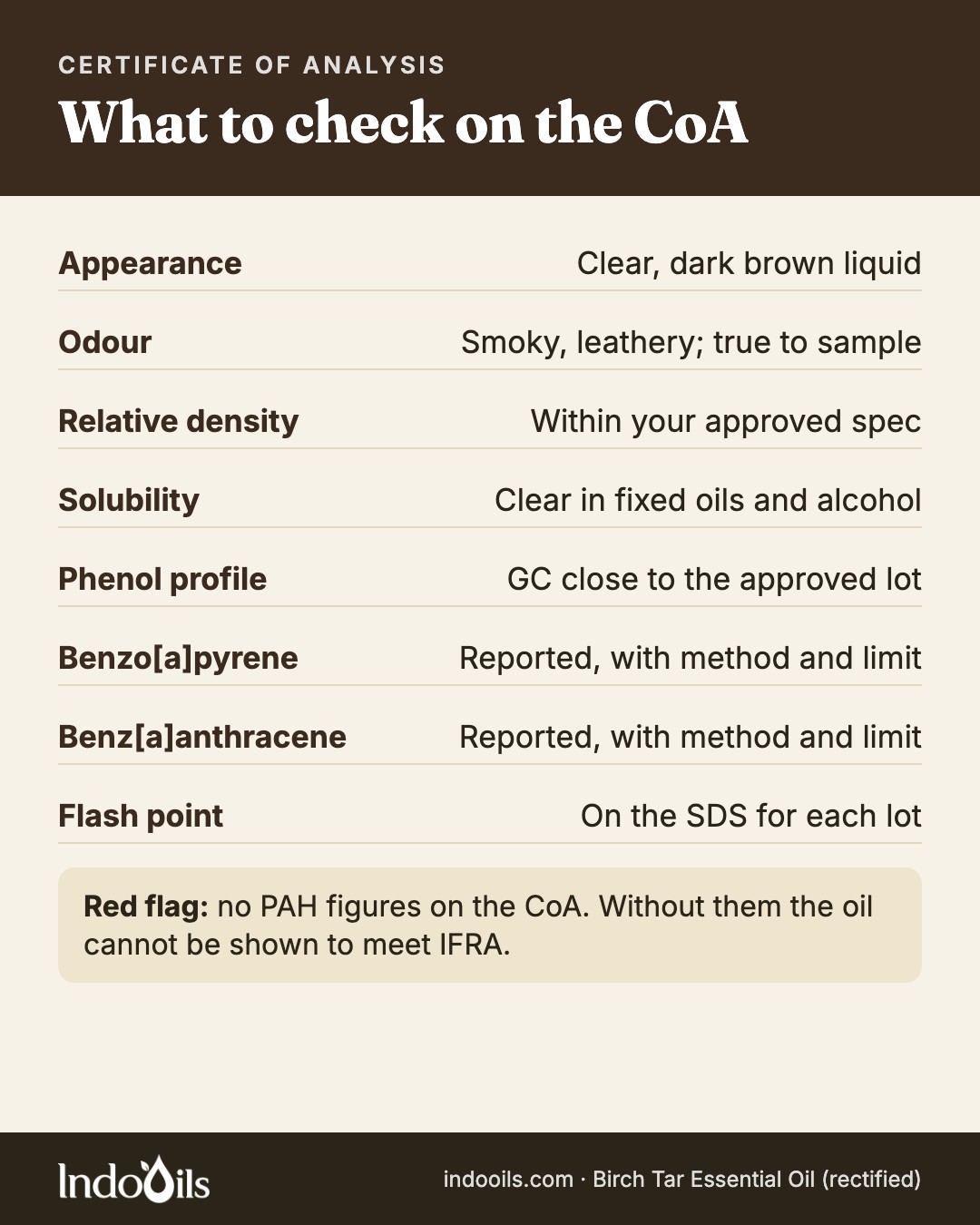
There is no ISO standard for birch tar oil, so you set the specification with your supplier from an approved sample. A good certificate of analysis (CoA) covers:
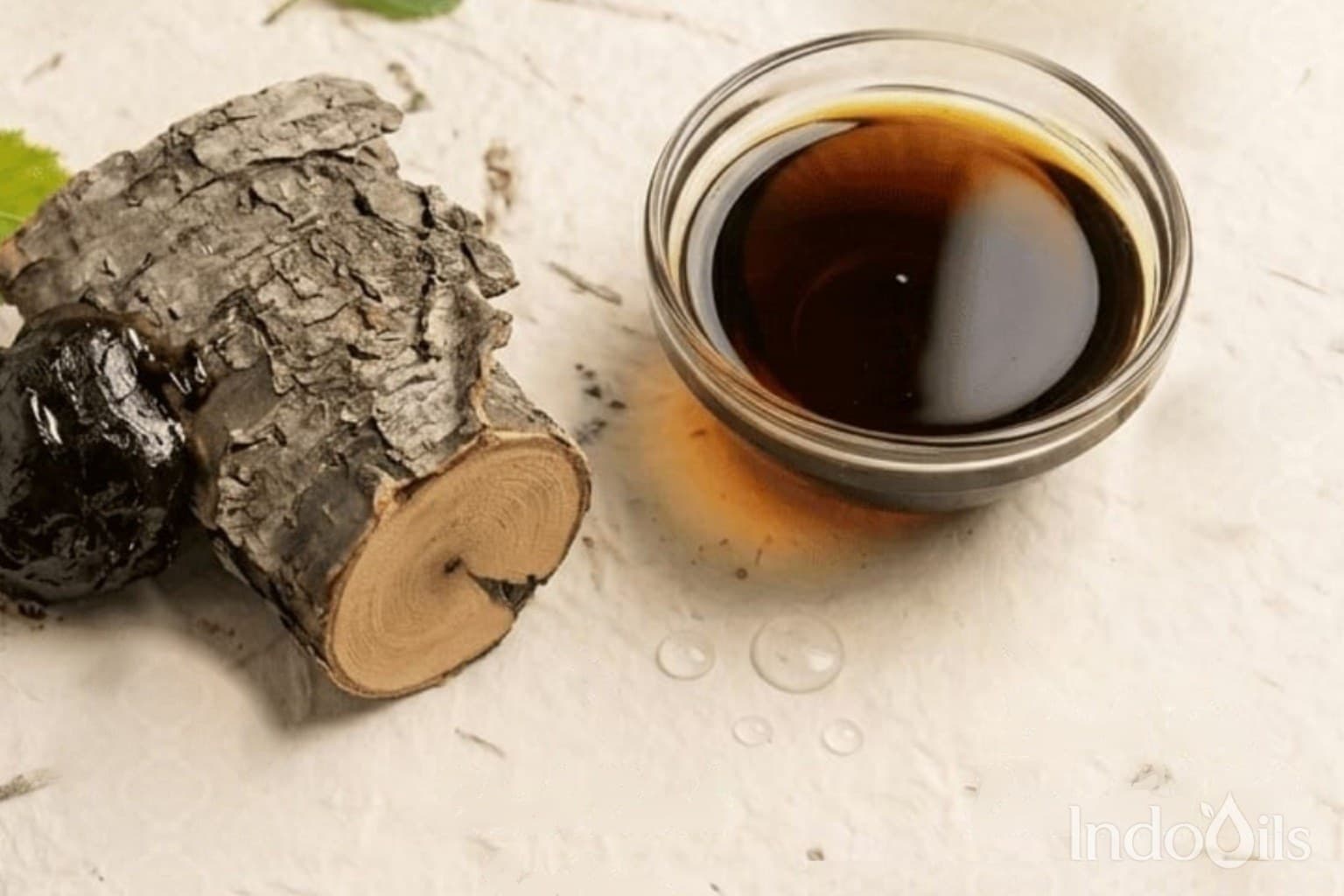
- Appearance: a clear, dark brown to reddish-brown liquid. Sediment, water or a thick, pitchy texture suggest poor rectification.
- Odour: smoky, tarry and leathery, true to the approved sample. A harsh, acrid or burnt-rubber odour points to crude or badly rectified material.
- Relative density: within the range in your specification. The old US National Formulary gave 0.886 to 0.950 at 25 °C for rectified birch tar oil; modern suppliers' figures vary, so compare against your approved lot.
- Solubility: the oil dissolves clearly in alcohol and most fixed oils, and is insoluble in water, glycerin and propylene glycol.
- GC phenol profile: guaiacol, cresols and creosol in proportions close to your approved lot.
- PAH: benzo[a]pyrene and benz[a]anthracene, with the test method and the detection limit. This is the most important line on the CoA.
- Flash point: on the SDS for each lot. Birch tar oil is combustible but not highly flammable.
Spotting crude and adulterated birch tar oil
- Crude tar sold as rectified. Crude birch tar is thick, very dark and smells harsh and acrid. It contains far more PAH than rectified oil. A CoA without PAH figures gives you no way to tell the two apart.
- Synthetic smoke chemicals. Guaiacol, cresols and other smoky aroma chemicals are cheap. A "birch tar" built from them shows a clean, simple GC with none of the minor phenols of the natural oil.
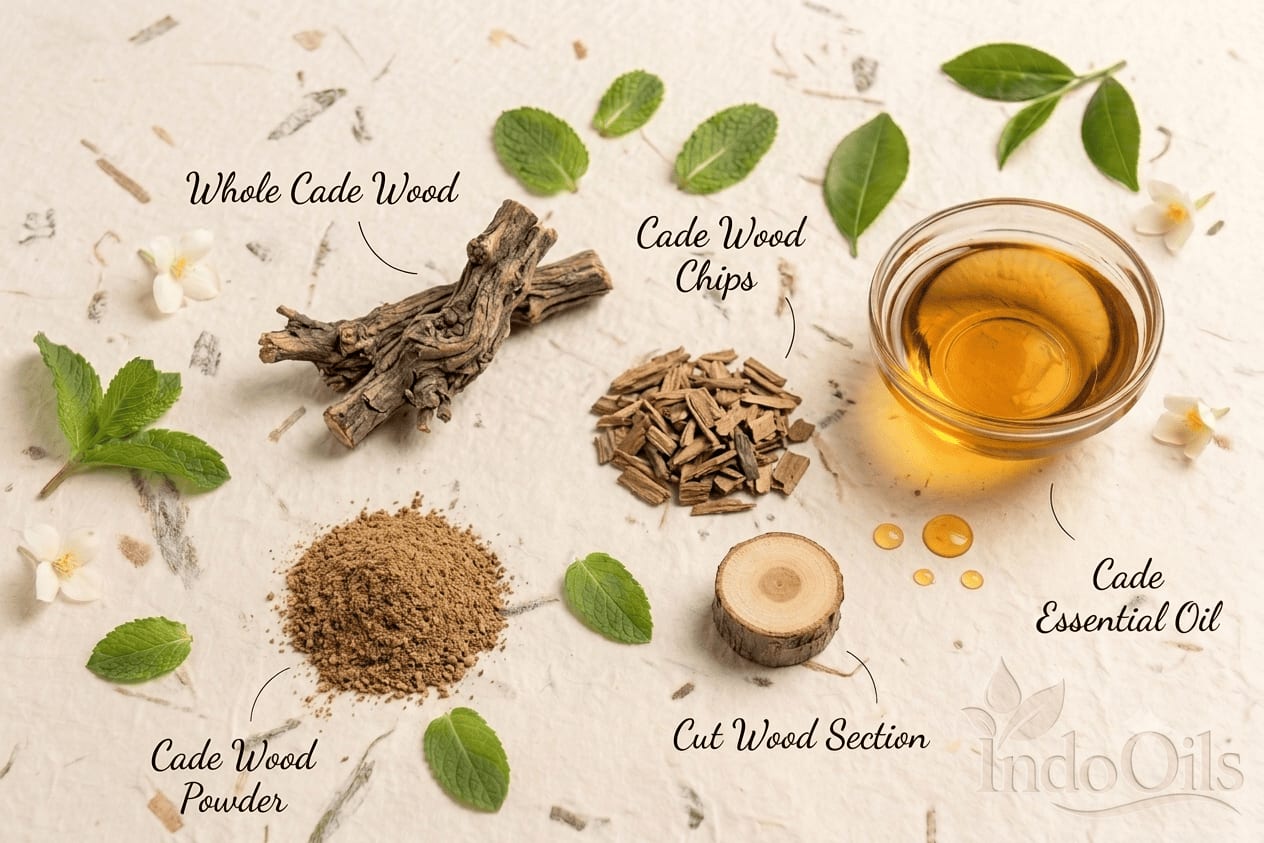
- Other tars. Pine tar, beech tar and cade oil smell similar at a distance. Each has its own phenol pattern on the GC, and pine tar adds resin acids and terpenes.
- Solvents and fixed oils. These stretch the oil, lower the density and weaken every GC peak.
Where Birch Tar Oil Is Used
Birch tar oil is used in small amounts, but it changes a formula more than almost any other natural material. The main uses are:
- Fine fragrance: the backbone of leather accords and a smoky, dry note in chypres, fougères, tobacco and dark woody perfumes. It is often paired with cade oil, vetiver, Himalayan cedarwood and tobacco absolute.
- Leather fragrance oils: ready-made leather bases such as Tuscan Leather Fragrance Oil for candles, diffusers and personal care.
- Men's grooming: beard oils, balms, aftershaves and solid colognes with a smoky, rugged note.
- Soaps: traditional tar soaps and shaving soaps, as a fragrance ingredient. Claims about the finished product are the brand's responsibility.
- Hair care: shampoos and scalp products with a tar fragrance, again with the brand responsible for its label claims.
- Leather finishing: scenting and finishing leather goods, the traditional "Russian leather" treatment.
- Home fragrance: candles, reed diffusers and room sprays with a fireside note.
- Technical uses: preserving rope and wood, and restoring traditional crafts.
Birch tar oil blends well with benzoin, bergamot, lavender, clary sage, black pepper, juniper berry and Scotch pine. Brands making their own leather or smoky range can use our private label and custom formulation services.
Safety, IFRA and Cosmetic Rules
The IFRA Standard
Birch tar oil has its own IFRA Standard, "Birch wood pyrolysate" (Amendment 47). It does two things:
- It prohibits crude birch tar. Crude oils made by pyrolysis of the wood or bark of Betula pubescens, B. pendula, B. lenta or B. alba must not be used as fragrance ingredients in any finished product.
- It sets a specification for the rectified oil. Only rectified (purified) birch tar oil may be used, and the PAH markers benzo[a]pyrene and benz[a]anthracene together must not exceed 1 ppb in the finished product. The limit also counts PAH from rectified cade, styrax and opoponax oils if they are used in the same product.
In practice, your fragrance house or safety assessor works out the maximum dose from the PAH figures on the CoA. That is why a CoA without them is not good enough.
Handling
Rectified birch tar oil is a concentrated phenolic material. The supplier's Safety Data Sheet is the reference, and typical classifications include:
- Causes skin irritation and serious eye irritation. Wear gloves and eye protection, and never apply the oil undiluted.
- May cause an allergic skin reaction, according to some suppliers' SDSs.
- May cause respiratory irritation. Handle in a well-ventilated area.
- Combustible liquid. Keep away from open flame and sparks.
The odour is also a practical hazard: it clings to equipment, gloves, packaging and other raw materials. Use dedicated tools and store it apart.
Cosmetic and food rules
- EU and UK cosmetics: a safety assessor must approve the finished product, including the PAH content. Natural phenols in the oil may include listed fragrance allergens; ask for the allergen declaration, and see our guide to fragrance allergen labelling.
- Food: rectified birch tar oil has a Food Chemicals Codex monograph and is used in tiny amounts as a smoke flavour in some markets. IndoOils supplies it for fragrance, cosmetic and technical use only, with no food-grade claim.
Documents You Should Ask For
For every lot of rectified birch tar oil, ask for:
- Certificate of Analysis (CoA): appearance, odour, density, solubility and the GC phenol profile.
- PAH report: benzo[a]pyrene and benz[a]anthracene, with the method and the limit of detection.
- Safety Data Sheet (SDS) in GHS format.
- IFRA certificate and EU allergen declaration.
- Technical data sheet (TDS) or specification sheet.
- Certificate of origin, naming the country of manufacture.
Our certifications page lists the quality systems behind our supply.
Packing, Storage and Shelf Life
- Packs: 20 kg and 50 kg aluminium containers, each sealed and labelled with its batch number. The minimum order is one pack.
- Store in the original, tightly closed container at 15–25 °C, away from direct sunlight and heat.
- Keep it apart. Store birch tar oil away from other raw materials, and never reuse its containers or tools for other oils.
- Reseal promptly and keep the headspace small; the oil darkens slowly in air and light.
- Mix before sampling or filling.
- Shelf life: 36 months unopened, when stored as above.
How to Order Birch Tar Oil in Bulk
- Request a sample. Use our sample request form. Ask for the CoA with PAH figures along with the sample, so your lab can approve both together.
- Agree a specification. Use the approved sample and its CoA as your reference: odour, density, GC profile and PAH.
- Send a bulk inquiry. Our bulk inquiry form takes the quantity, pack size and destination. We quote on request; prices are never published.
- Confirm the documents. CoA, PAH report, SDS, IFRA certificate, allergen declaration and certificate of origin travel with the shipment.
For a wider view of documents and checks, see our bulk essential oils for cosmetics importer checklist.
Frequently Asked Questions
Is birch tar oil an essential oil?
Not in the strict sense. Essential oils are made by steam distillation or pressing, while birch tar oil is made by heating bark and wood without air. It is often listed with essential oils because it is used in the same way, in fragrance and cosmetics.
What is the difference between crude and rectified birch tar oil?
Crude birch tar oil comes straight from dry distillation and is thick, very dark and high in PAH. Rectified oil has been distilled again, usually with steam, to give a cleaner oil with much less PAH. IFRA allows only the rectified oil in fragrance.
Can I use birch tar oil in a cosmetic product sold in the EU?
Yes, as a fragrance ingredient, if it is rectified, meets the IFRA PAH specification and your safety assessor approves the finished product. Ask for the PAH figures and the allergen declaration.
Is birch tar oil the same as sweet birch oil?
No. Sweet birch oil (Betula lenta, CAS 8002-45-5) is a clear, steam-distilled oil that smells of wintergreen. Birch tar oil (CAS 8001-88-5) is dark, smoky and leathery.
How much birch tar oil do perfumers use?
Very little. It is usually pre-diluted to between 1 and 10 per cent before it is weighed into a formula, and the final dose is set by the IFRA PAH limit and by the odour itself.
Where does your birch tar oil come from?
It is made in Europe, where birch is a major timber tree, from silver and downy birch bark and wood. The certificate of origin names the country for each lot.
What is the minimum order?
One 20 kg pack. Larger orders ship in 20 kg and 50 kg aluminium packs, and samples are available for approval.
More Buyer's Guides
- Bulk vetiver (khus) oil buyer's guide
- Bulk Australian sandalwood oil buyer's guide
- Bulk black pepper oil buyer's guide
- Bulk allspice (pimento) oil buyer's guide
Ready to order? Browse our essential oils and fragrance oils, or send a bulk inquiry for Birch Tar Oil (Rectified).
Buying in bulk?
20 kg and 50 kg packs, with a certificate of analysis for every lot.
Tell us the product, quantity and destination, and we will come back with a quotation.