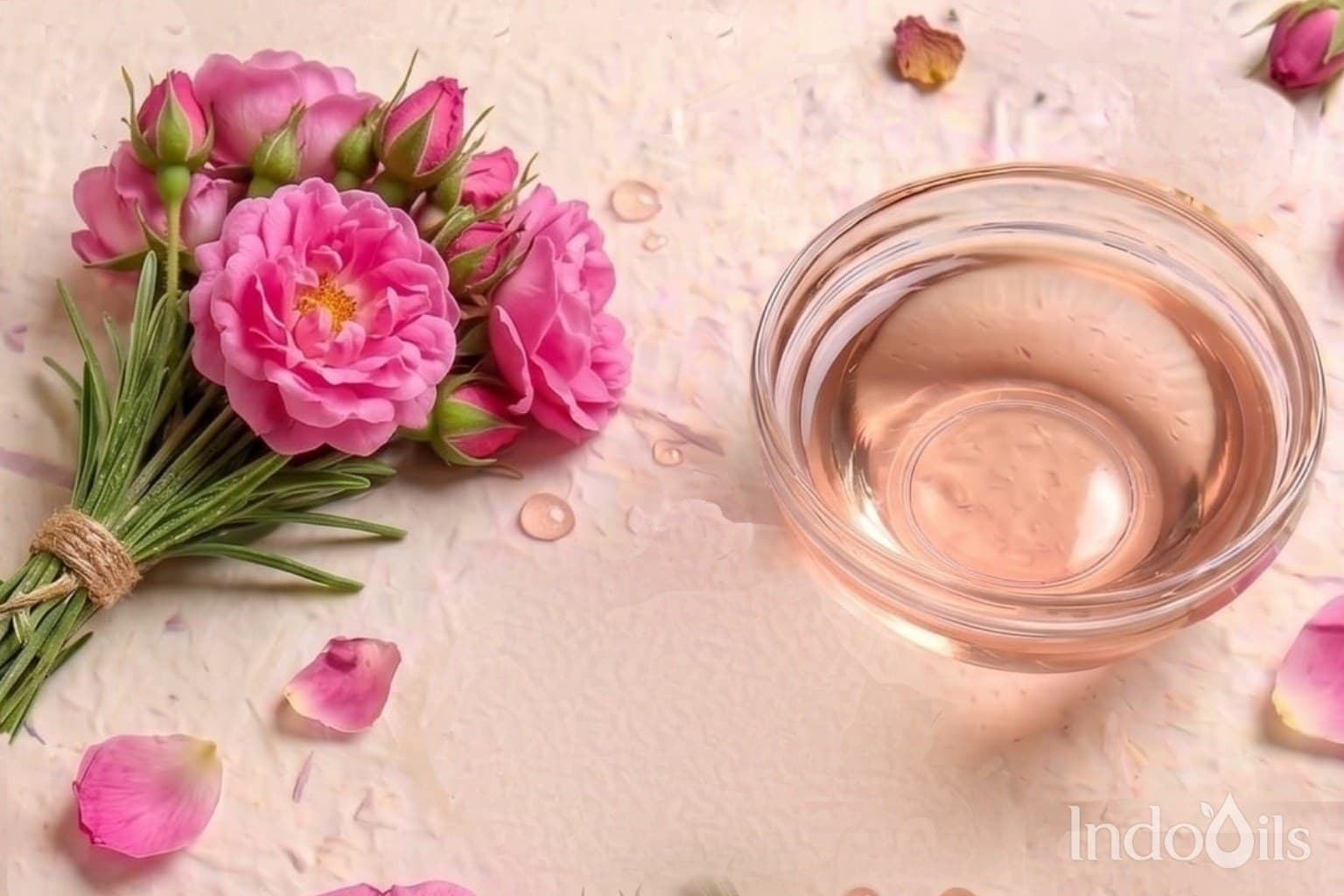
Every spring, for a few short weeks between late May and mid-June, the Rose Valley of central Bulgaria smells of roses. Pickers are in the fields before sunrise, filling sacks with pink damask roses while the dew is still on them, and the distilleries run day and night until the season ends. What comes out of those stills, a few kilograms at a time, is Bulgarian rose otto: the rose oil that perfumers have treated as the reference for more than a century.
Rose otto is also one of the most expensive materials a buyer will ever handle, and one of the most often faked. Knowing exactly what you are buying, how to test it and which papers to ask for matters more here than for almost any other oil.
This guide covers Bulgarian Rose Otto from IndoOils: what it is, how it is made, what is in it, which tests matter, which rules apply, where it is used and how to order it in bulk.
Rose Otto, Attar of Roses, Rose Oil: Getting the Name Right
Rose materials go by many names, and the same word can mean different things to different suppliers:
- Rose otto is rose oil made by distillation. "Otto" comes from the Persian and Arabic word attar, meaning fragrance. It is also called attar of roses or otto of rose, and in trade often simply rose oil.
- Bulgarian rose oil or Kazanlak rose oil is otto distilled from Rosa damascena grown in Bulgaria's Rose Valley, around Kazanlak and Karlovo. "Bulgarian Rose Oil" is registered as a protected geographical indication (PGI) in the European Union, so the name belongs to oil from that region.
- Damask rose (Rosa damascena) is the species behind almost all rose otto, in Bulgaria, Turkey, Iran and India. It is a pink, highly scented, many-petalled rose.
- May rose or rose de mai (Rosa centifolia) is a different species, grown mainly in Grasse and Morocco. It is used mostly for absolutes, such as our May Rose Absolute.
- Gulab attar in India usually means rose petals distilled into sandalwood oil, the traditional Kannauj way. It is a finished perfume, not rose otto.
Product identifiers
- Product: Bulgarian Rose Otto Essential Oil
- Botanical name: Rosa damascena Mill., family Rosaceae
- INCI name: Rosa Damascena Flower Oil
- CAS number: 8007-01-0 (some SDSs also give 90106-38-0)
- HSN code: 33012938, rose oil (confirm with your customs agent)
- Origin: Bulgaria (Rose Valley), stated per lot
- Plant part: fresh flowers
- Process: steam (water) distillation, with the distillation water re-distilled
- Packs: 20 kg and 50 kg aluminium, minimum order one pack
Otto, Absolute, Rose Water and Diluted Oils
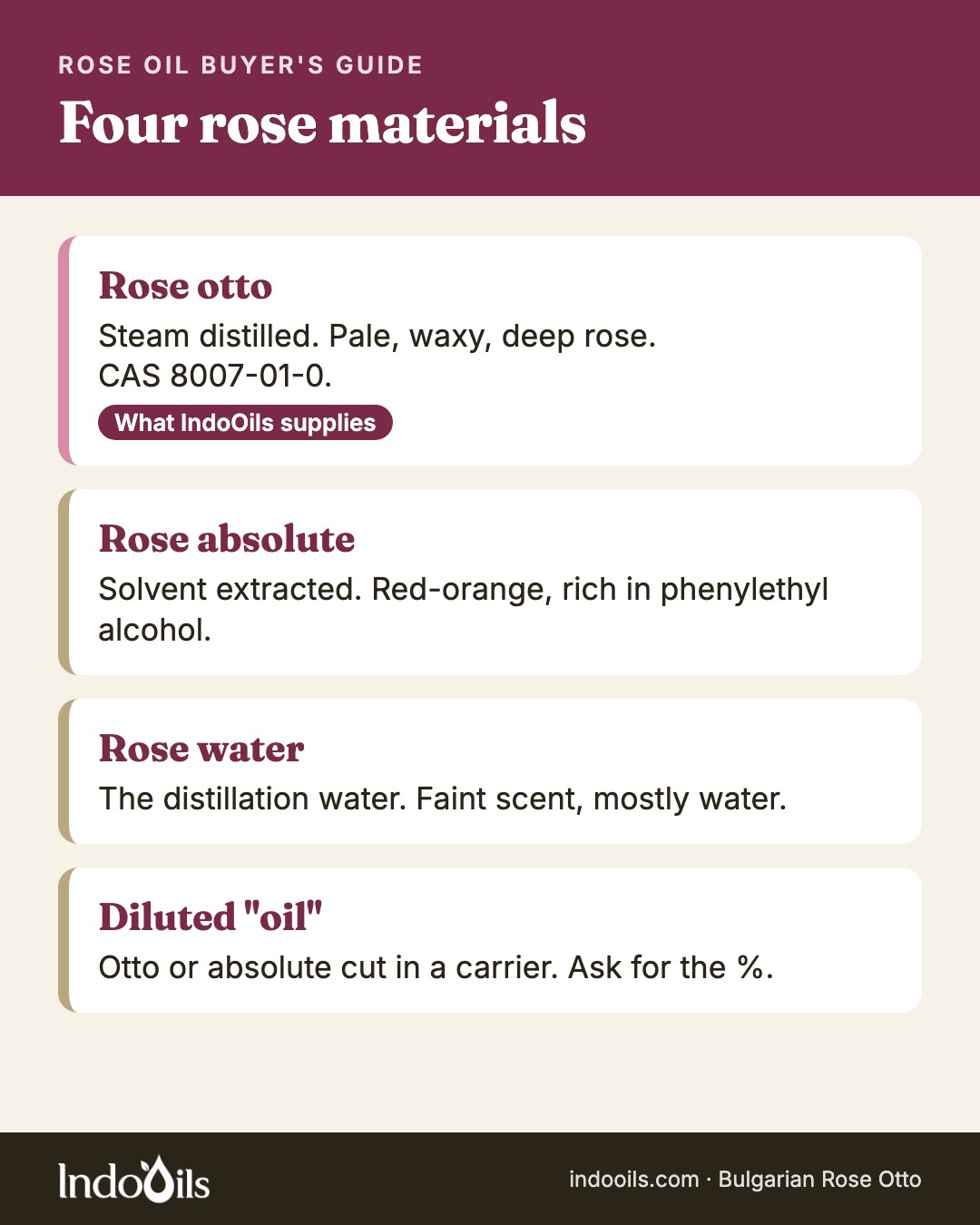
Rose reaches the market in four main forms. They are priced very differently, so it matters which one you are quoting for:
- Rose otto. Distilled oil: colourless to pale yellow, thin when warm and waxy when cool, with a deep, fresh, honeyed rose scent. This is the material fine fragrance and premium skin care buyers look for, and what IndoOils supplies.
- Rose absolute. Made by extracting the flowers with a solvent to give a waxy concrete, then washing the concrete with alcohol. It is red-orange and smells richer, sweeter and more like the fresh flower, because it keeps the phenylethyl alcohol that distillation loses to the water. It is usually cheaper than otto, and has a different specification. IndoOils also offers a Rose CO₂ Absolute and a May Rose Absolute.
- Rose water. The water left after distillation, with a small amount of rose oil dissolved in it. It is a product in its own right for toners and food, but it is mostly water.
- Diluted rose oil. Otto or absolute cut in jojoba, fractionated coconut oil, alcohol or a solvent, often at 2 to 10 per cent. It is a legitimate product for retail ranges, but it must be sold as a dilution, with the percentage stated. A low price for "pure rose oil" usually means this.
There are also rose fragrances built from aroma chemicals such as phenylethyl alcohol, citronellol and geraniol. They have a place in soaps and candles, but they are not rose otto and must never be sold as such.
How Bulgarian Rose Otto Is Made
The Rose Valley lies between the Balkan Mountains and the Sredna Gora range. Cool nights, a mild, damp spring and light soil suit the damask rose, and roses have been distilled there since at least the 17th century. Today the roses are grown on family farms and larger plantations across the valley, and distilled by cooperatives and private distilleries.
The roses flower for only three to four weeks. Each flower opens for a single day, so pickers go through the fields every morning, picking by hand from dawn until mid-morning, before the sun warms the petals and drives off the scent. The flowers go to the distillery the same day.
Bulgarian distillation has two stages:
- First oil. The fresh flowers are loaded into large stills with water and heated. The steam carries the oil out of the flowers; it is cooled, and the oil that floats on the water is separated off.
- Second oil. Rose oil dissolves in water better than most essential oils, so the distillation water still holds a large share of the scent. It is distilled again, and the oil recovered from it is added to the first oil. The two together make rose otto. The water left at the end is rose water.
Yields are tiny. It takes roughly three to four tonnes of flowers to make one kilogram of otto, depending on the year, the weather and the stills. A cold, wet or very hot May can cut the crop sharply, which is why prices move from season to season and why buyers who plan their annual volume early get the steadiest supply.
What Is Inside Bulgarian Rose Otto
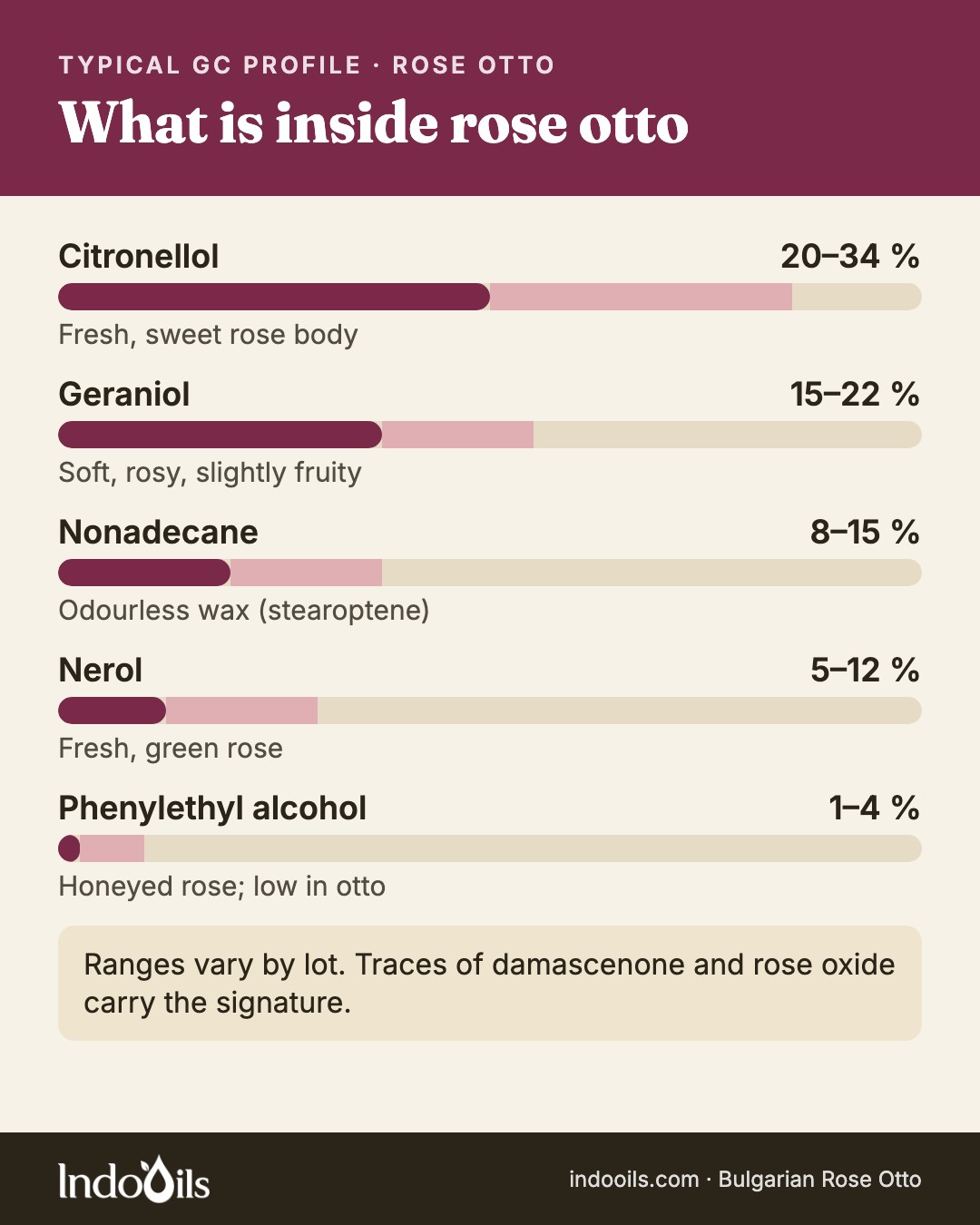
Rose otto contains several hundred compounds, but a handful carry its character:
- Citronellol: fresh, sweet and rosy; usually the largest single compound.
- Geraniol: soft, rosy and slightly fruity.
- Nerol: a fresher, greener rose note.
- Phenylethyl alcohol: honeyed, fresh-flower rose. It dominates rose absolute, but most of it stays in the water during distillation, so otto has only a few per cent.
- Stearoptenes: odourless paraffin waxes such as nonadecane and heneicosane, often 15 % or more of the oil in total. They are why otto turns solid and shows crystals when it is cool.
- Trace compounds: beta-damascenone, beta-ionone and rose oxide are present at well under one per cent, yet they carry much of the unmistakable rose scent.
- Methyl eugenol and eugenol: present in small amounts, and important for regulation (see below).
The international standard for rose oil, ISO 9842, sets composition ranges for oils from different origins. The ranges in the graphic are typical of Bulgarian otto, but each lot is a little different. The practical lesson is to build your specification on the GC report of a lot you have approved, and to compare every new lot against it.
What to Check on the Certificate of Analysis
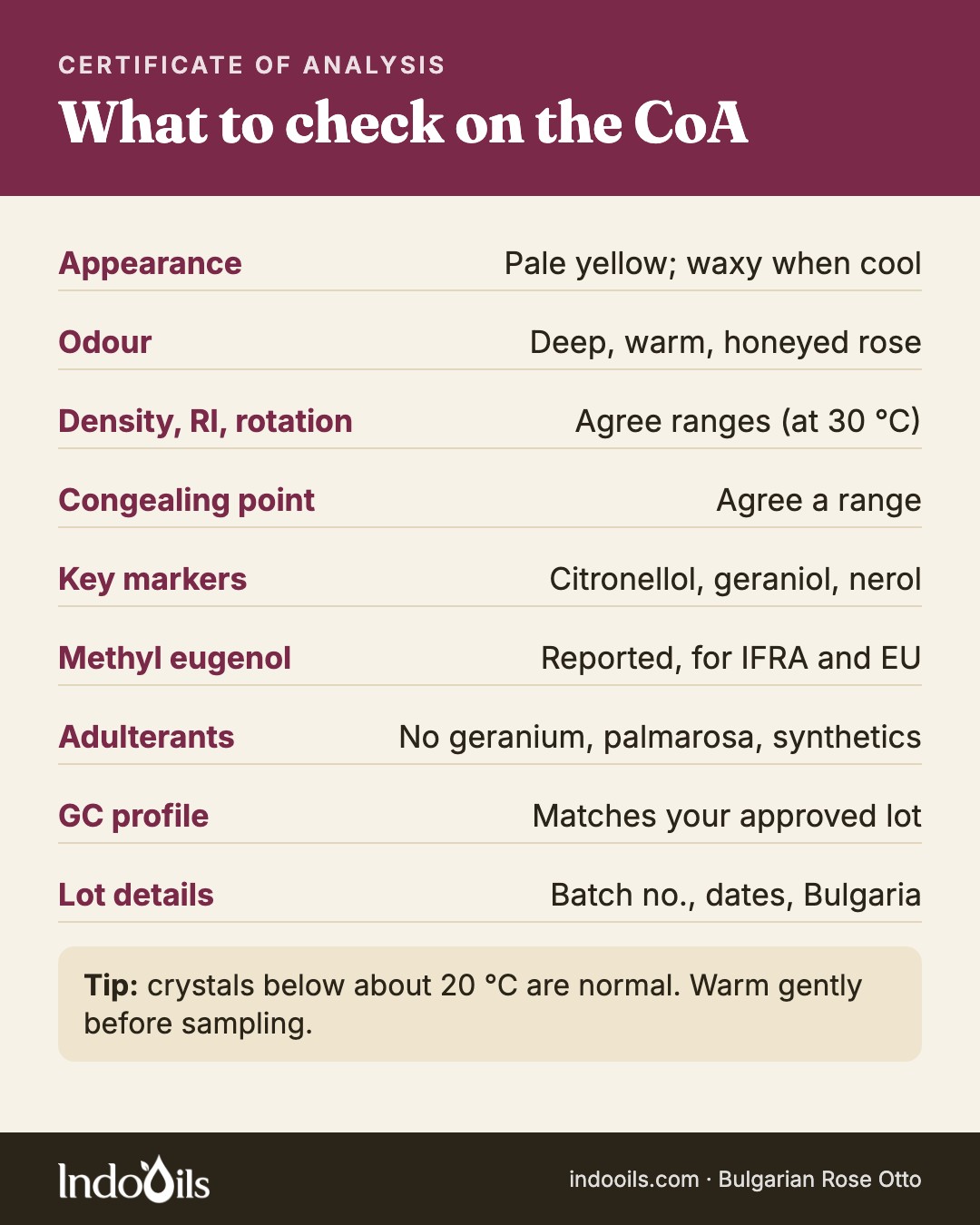
A good CoA for Bulgarian rose otto covers:
- Appearance: colourless to pale yellow liquid, turning waxy with fine crystals below about 20 °C.
- Odour: deep, warm and honeyed rose, matching your approved sample.
- Relative density, refractive index and optical rotation, within agreed ranges. Because otto is partly solid at room temperature, density and refractive index are measured at 30 °C. Typical figures are about 0.848–0.863 and 1.452–1.465, with a slightly negative rotation, but agree the exact ranges with your supplier from real lots.
- Congealing point: the temperature at which the waxes start to crystallise. It shows the oil is a true distilled otto with its natural waxes.
- Key markers from GC: citronellol, geraniol, nerol and phenylethyl alcohol, plus the stearoptenes.
- Methyl eugenol: reported as a number, because IFRA and EU limits depend on it.
- Lot details: batch number, dates of distillation and analysis, and origin.
Always warm the pack until the oil is completely clear before you take a sample. If you sample a partly solid oil, the waxes stay behind and the sample won't match the bulk.
Spotting cut and fake rose oil
Rose otto is worth many times more than most essential oils, so it is the most widely adulterated of them all. The usual tricks, and how a lab finds them:
- Stretching with geranium or palmarosa oil. Both are rich in geraniol and citronellol, and much cheaper. GC-MS finds their markers: geranium brings isomenthone and 10-epi-gamma-eudesmol, palmarosa an unusually high geraniol and geranyl acetate.
- Added aroma chemicals: synthetic citronellol, geraniol, phenylethyl alcohol or rose oxide. A profile that is "too clean", with the main compounds in range but the trace compounds missing, is a warning sign. Chiral GC helps: the citronellol in real rose oil is almost all one mirror-image form, while synthetic citronellol is usually a mixture.
- Dilution with jojoba, fractionated coconut oil, DPG or other solvents. GC-MS shows these clearly, and the density and odour strength change.
- Wrong origin. Turkish, Iranian or Indian otto sold as Bulgarian. The oils are similar, so origin rests on the paperwork and the supplier as much as on the lab. Ask for a certificate of origin, and buy from a supplier who can trace the lot to a Bulgarian distillery.
For high-value contracts, isotope tests (carbon-13 and deuterium ratios) can show whether the main compounds came from plants or from petrochemicals. Our quality assurance page explains how IndoOils tests each lot.
Where Bulgarian Rose Otto Is Used
Rose otto is a fragrance material first and foremost. Its main buyers are:
- Fine fragrance. It is the heart of rose, floral, chypre and oriental perfumes, and of rose soliflores. It gives body and a natural glow even in small amounts. It pairs naturally with Jasmine Sambac Absolute, Geranium Essential Oil, Ylang Ylang (Cananga) Essential Oil, Orris Absolute and Violet Leaf Absolute.
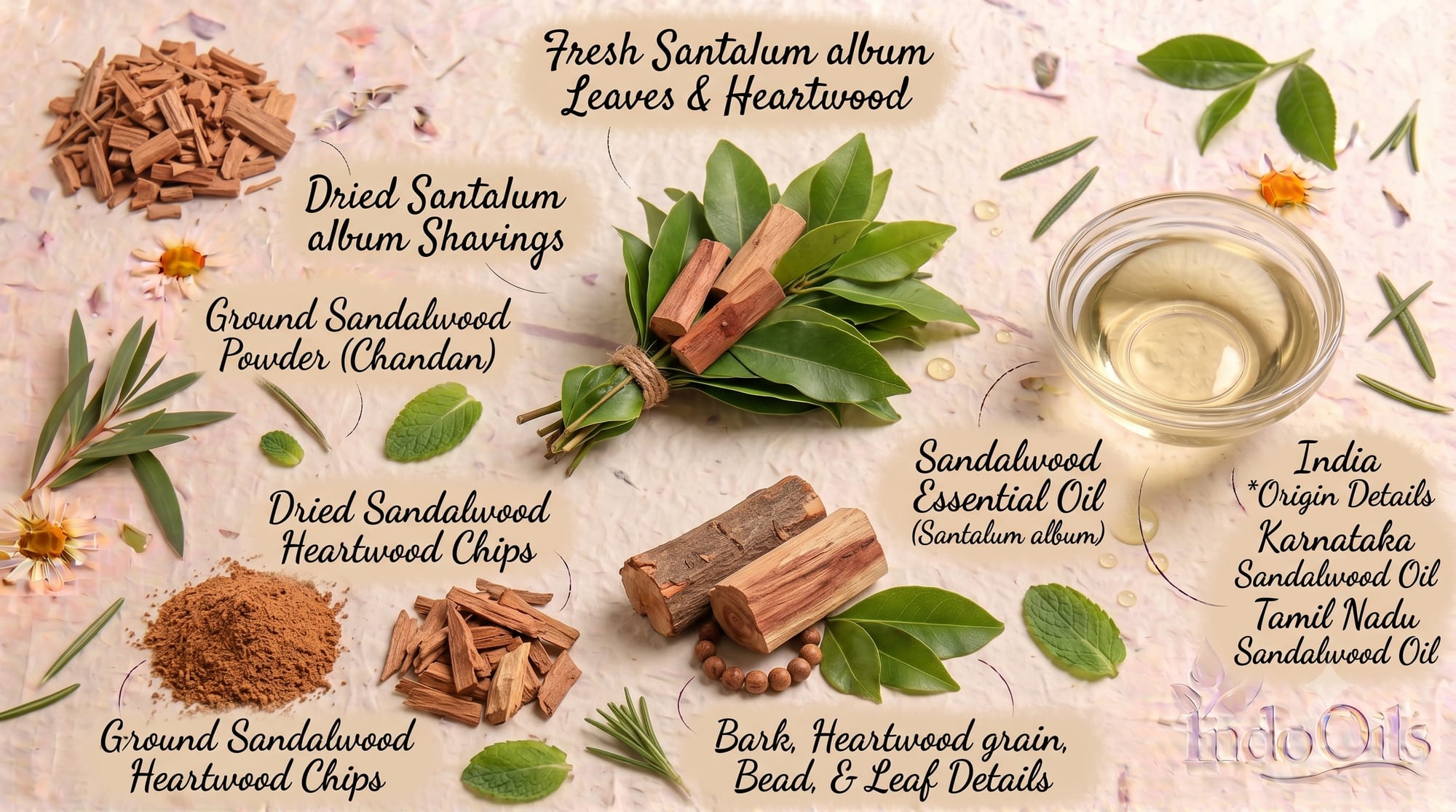
- Attars and Middle Eastern perfumery. Rose attars, perfume oils, oud blends and bakhoor, often with Sandalwood Essential Oil, Australian Sandalwood, Vetiver Oil and Saffron Essential Oil.
- Premium skin care. Face creams, serums, facial oils and toners, within IFRA limits. Natural and luxury brands use rose otto because a real rose ingredient on the label matters to their customers. See our cosmetics and personal care page.
- Personal care. Luxury soaps, shower gels, body lotions and hair care.
- Home fragrance. Luxury candles, reed diffusers and room sprays. See home care and fragrance. For a ready-made product, IndoOils also lists a Rose Diffuser Oil.
- Fragrance houses, which use natural rose to round out rose accords built from aroma chemicals.
It also works well with citrus top notes such as Bergamot (Calabrian) and Neroli (Orange Blossom); with Clary Sage and Lavender (France and Bulgaria); and with resins and balsams such as Benzoin Resinoid. Bulgaria also distils other fine oils, such as German Chamomile. The full absolute oils range includes other floral materials.
A practical note for formulators: the waxes in rose otto can cloud clear alcohol perfumes and toners when they get cold. Chill-filter the finished product, or test it at around 5 °C, before launch.
Safety, Labelling and Regulatory Rules
Handling
Rose otto is a concentrated natural material and is sold for manufacturing use only. The Safety Data Sheet for each lot gives its full GHS classification, but buyers should expect:
- Skin sensitisation: it may cause an allergic skin reaction. Wear gloves and eye protection.
- Skin and eye irritation from the undiluted oil.
- A hazard statement linked to methyl eugenol, which is classified as a possible carcinogen. Many rose oil SDSs carry it because of the small amount the oil contains naturally.
- Environmental hazard: harmful to aquatic life, so keep it out of drains.
Its flash point is usually above 60 °C, so it is not normally classed as a flammable liquid for transport, but check the SDS for each lot.
Cosmetics and fragrance
- IFRA. Every lot should come with an IFRA certificate giving the maximum use level in each product category. For rose otto these limits are driven mainly by its methyl eugenol, citronellol, geraniol and eugenol content.
- Methyl eugenol in the EU. The EU Cosmetics Regulation limits methyl eugenol in finished products, for example to 0.01 % in fine fragrance and 0.0002 % in leave-on creams. Use the figure on the CoA to calculate how much otto your formula can hold.
- EU allergens. Rose otto contains several listed fragrance allergens, including citronellol, geraniol, eugenol, linalool, farnesol and citral. Above 0.001 % in leave-on and 0.01 % in rinse-off products, they must be named on the label. Regulation (EU) 2023/1545 expanded the list and also names a number of natural extracts in their own right. The allergen declaration for each lot tells you exactly what to label. Our post on fragrance allergen labelling explains how this works.
- INCI. Use "Rosa Damascena Flower Oil" on ingredient lists, or include it in "Parfum" if it is part of a fragrance.
- REACH. Companies importing more than one tonne a year into the EU need a REACH registration for the oil, or must buy it from a registered importer.
Food and flavour
Rose (otto of roses) is on the US list of natural flavouring substances generally recognised as safe (21 CFR 182.20), and rose flavours are used in sweets, drinks and desserts across the Middle East and South Asia. But food use needs food-grade paperwork, and in the EU methyl eugenol may not be added to food as such and is limited in finished foods. IndoOils supplies rose otto for fragrance and personal care; ask us before planning any food use.
Documents to Ask For
For a bulk order of Bulgarian rose otto, expect:
- A Certificate of Analysis for the actual lot, with the constants above, the GC markers and methyl eugenol
- A GC-MS report from an independent laboratory
- A Safety Data Sheet in GHS format, with the flash point and transport classification
- An IFRA certificate and an EU allergen declaration
- A statement that nothing has been added (no carrier, solvent, other oil or synthetic material)
- A certificate of origin, showing the oil was distilled in Bulgaria
Our certifications and traceability pages describe how IndoOils documents every lot, and the downloads page has our standard documents.
Packing, Storage and Shelf Life
IndoOils supplies Bulgarian rose otto in 20 kg and 50 kg aluminium packs, each with its own batch number. Aluminium protects the oil from light and does not react with it.
To keep it at its best:
- Store packs closed, at 15–25 °C, away from sunlight and heat.
- Keep the headspace small. Once a pack is opened, blanket it with nitrogen or decant the oil into smaller full containers.
- Expect crystals or a solid, waxy oil below about 20 °C. This is normal. Warm the closed pack gently, to no more than 40 °C, until it is clear, then mix before sampling or weighing.
Rose otto keeps well. Shelf life is 36 months unopened; use opened packs within twelve months.
How to Order Bulgarian Rose Otto in Bulk
- Send your specification, or ask for ours: otto or absolute, origin, key markers, methyl eugenol limit and documents needed.
- Approve a sample. Request one through our sample request page and test it in your own lab and your own formula.
- Ask for a quotation through our bulk inquiry page, with your annual volume and delivery schedule. Supply follows the May–June harvest, so tell us your yearly needs early.
- Order: the minimum order is one pack (20 kg); 50 kg packs are also available.
If you sell rose products under your own brand, our private label and custom formulation services can blend, fill and label them for you.
Frequently Asked Questions
What is the difference between rose otto and rose absolute?
Rose otto is distilled with water and steam; rose absolute is extracted with a solvent and then washed with alcohol. Otto is pale and waxy and smells fresh, deep and honeyed. Absolute is red-orange and smells richer and closer to the fresh flower, because it keeps the phenylethyl alcohol that distillation loses. They have different specifications and are not interchangeable.
Why does Bulgarian rose otto turn solid?
Rose otto contains natural plant waxes called stearoptenes. Below about 20 °C they crystallise, so the oil turns cloudy or solid. It is normal, and a sign of a true distilled otto. Warm the closed pack gently and the oil turns clear again.
Why is rose otto so expensive?
Because it takes roughly three to four tonnes of hand-picked flowers to make one kilogram of oil, and the roses flower for only a few weeks a year. Prices move with the size of each year's crop.
Is Bulgarian rose oil better than Turkish rose oil?
Both are distilled from Rosa damascena in a similar way, and both are fine materials. Bulgarian otto is often described as softer and more rounded, and it carries a protected geographical indication in the EU. Which one suits you depends on your formula: compare samples in your own product.
Is rose otto safe to use in cosmetics?
Yes, within the limits on its IFRA certificate, the EU limits for methyl eugenol in finished products and the required allergen labelling. It may cause allergic skin reactions in some people, so it should never be used undiluted on skin.
What is the HSN code for rose oil?
India's tariff has a named line for rose oil, 33012938, with GST at 18 %. Confirm the code with your customs agent for your own shipments.
What is the minimum order?
One 20 kg pack. 50 kg packs are also available, and a sample can be sent before you order in bulk.
For more buyer's guides, see our posts on jasmine sambac absolute, sandalwood oil, Australian sandalwood, lavender oil, saffron oil and essential oils for cosmetics, or browse the full essential oils range.
Buying in bulk?
20 kg and 50 kg packs, with a certificate of analysis for every lot.
Tell us the product, quantity and destination, and we will come back with a quotation.