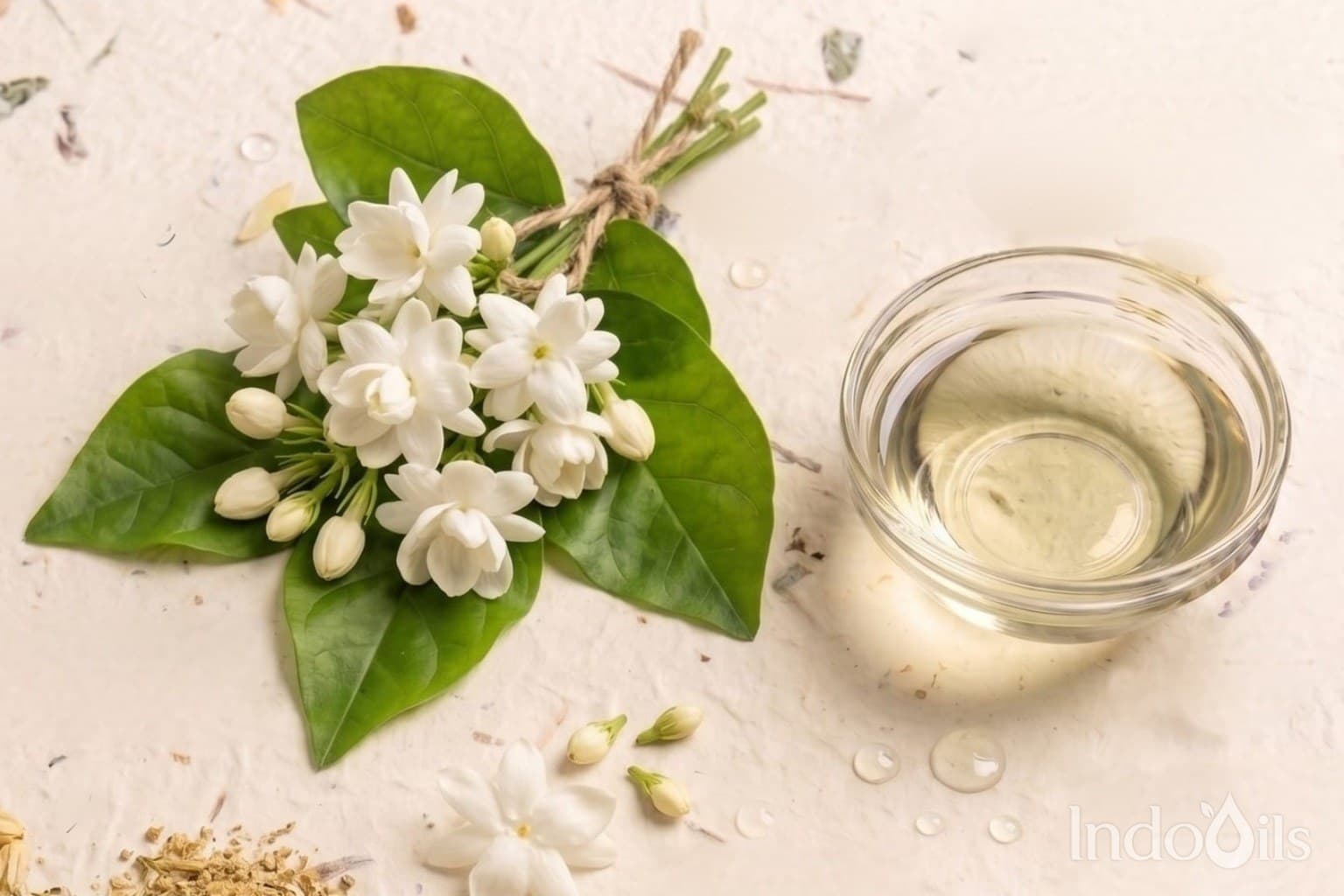
Few scents are as closely tied to India as jasmine sambac. Strung into garlands, pinned in hair, piled in temple baskets and sold by the kilo in flower markets at dawn, mogra is part of daily life across the south of the country. The same flower, extracted into an absolute, is one of the great white-flower materials of perfumery: rich, sweet and heady, with fruity, green and tea-like notes and a warm, indolic depth.
India grows more jasmine sambac than any other country, and almost all of it comes from Tamil Nadu. That gives Indian buyers and importers a real advantage: the absolute is made close to the fields, from flowers picked the same morning.
This guide covers Jasmine Sambac Absolute from IndoOils: what it is, how it is made, what is in it, which tests matter, which rules apply, where it is used and how to order it in bulk.
Sambac, Grandiflorum, Mogra: Getting the Name Right
"Jasmine" covers several species and several kinds of material, so the first job is to make sure supplier and buyer mean the same thing:
- Jasmine sambac (Jasminum sambac) is the subject of this guide. It is called mogra in Hindi and Marathi, malli or malligai in Tamil, and Arabian jasmine in English. It has rounded, often double white flowers and a rich, fruity, slightly green scent.
- Jasmine grandiflorum (Jasminum grandiflorum, also sold as J. officinale var. grandiflorum) is the "Spanish" or "royal" jasmine, called jathi malli in Tamil. It is grown in India, Egypt and once famously in Grasse. Its scent is softer and more classic, and its absolute has a different composition and specification.
- Jasmine auriculatum (mullai) is a third Indian species, extracted on a much smaller scale.
- Madurai malli is jasmine sambac from the Madurai region. It has a Geographical Indication (GI) tag in India for the flower.
Two other words cause confusion. "Jasmine oil" is often used loosely for the absolute, but it can also mean the absolute diluted in a carrier, or even a synthetic fragrance. And "jasmine essential oil" is technically wrong: jasmine flowers are too delicate to steam distil, so true jasmine is almost always an absolute.
Product identifiers
- Product: Jasmine Sambac Absolute
- Botanical name: Jasminum sambac (L.) Aiton, family Oleaceae
- INCI name: Jasminum Sambac Flower Extract
- CAS number: 91770-14-8
- HSN code: 33012990 (confirm with your customs agent)
- Origin: India (Tamil Nadu), stated per lot
- Plant part: fresh flowers
- Process: solvent extraction to a concrete, then alcohol washing to the absolute
- Packs: 20 kg and 50 kg aluminium, minimum order one pack
Absolute, Concrete, Diluted Oil and Attar
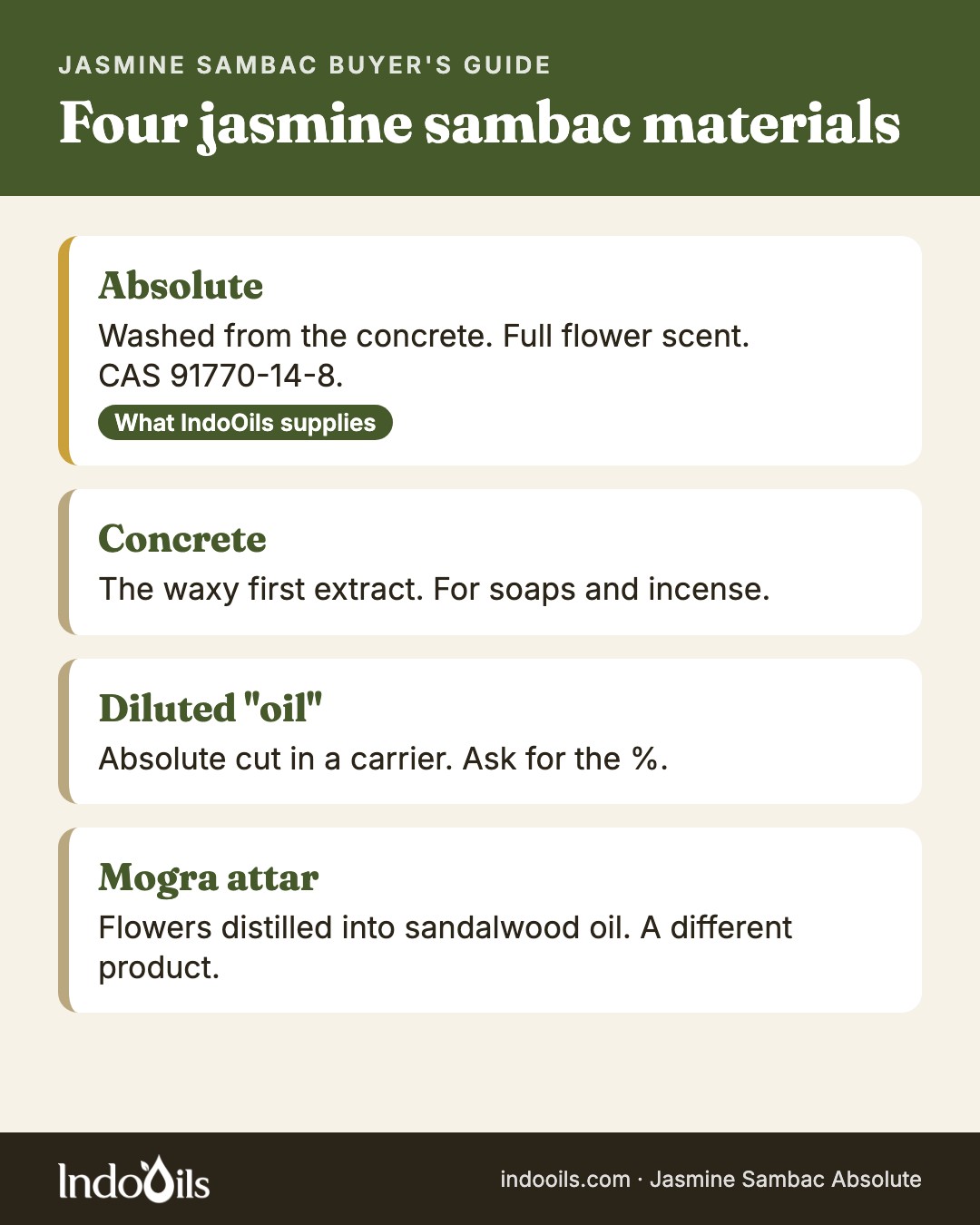
Jasmine sambac reaches the market in four main forms. They are priced very differently, so it matters which one you are quoting for:
- Absolute. The concentrated scent of the flower, made by washing the concrete with alcohol and removing the waxes. It is a thick, orange-brown liquid, fully soluble in perfumery alcohol. This is the material fine fragrance houses buy, and what IndoOils supplies.
- Concrete. The waxy, semi-solid first extract. It contains the scent plus plant waxes, so it is cheaper per kilogram but cannot be used in clear alcohol perfumes. Soap makers, incense makers and some attar makers use it.
- Diluted jasmine oil. Absolute cut in a carrier oil, solvent or diluent, often at 3 to 10 per cent. It is a legitimate product for retail and aromatherapy-style ranges, but it must be sold as a dilution, with the percentage stated. A low price for "pure jasmine oil" usually means this.
- Mogra attar. Fresh flowers hydro-distilled into a receiver of sandalwood oil, in the traditional way of Kannauj. It is a finished Indian perfume, not a raw material, and is a different product from the absolute.
There is also CO₂ extract of jasmine, made with supercritical carbon dioxide instead of a solvent, but very little sambac is made that way. And there are many synthetic jasmine bases built from benzyl acetate, hedione and other aroma chemicals; they have a place in perfumery, but they are not jasmine sambac absolute and must never be sold as such.
How Jasmine Sambac Absolute Is Made
Jasmine sambac flowers open in the evening and release their scent through the night. For extraction, they are picked by hand in the early morning as plump, closed buds, then trucked to the extraction unit while they are still fresh. Speed matters: a flower left for a day loses much of its scent.
The process has two stages:
- Concrete. The fresh flowers are loaded into extractors and washed several times with a food-grade solvent, usually hexane. The solvent dissolves the scent molecules along with plant waxes and colour. It is then evaporated off under vacuum and recovered, leaving the concrete.
- Absolute. The concrete is stirred into alcohol, which dissolves the scent but not most of the waxes. The mixture is chilled hard so the remaining waxes settle out, then filtered. The alcohol is removed under vacuum, leaving the absolute.
Yields are tiny. A tonne of flowers gives only a few kilograms of concrete, and only about half of the concrete becomes absolute. Roughly a tonne of flowers goes into about a kilogram of absolute, depending on the season and the flowers.
That is why the jasmine season matters so much. In Tamil Nadu the plants flower most heavily from about March to July and much less in the cool months. Extraction units compete with the fresh-flower trade for the same flowers. In the peak months, when flower-market prices fall, more flowers go to extraction; in winter, during the wedding season, fresh flowers become expensive and little absolute is made. Buyers who plan their annual volume early and buy in the main season get the steadiest supply.
What Is Inside Jasmine Sambac Absolute
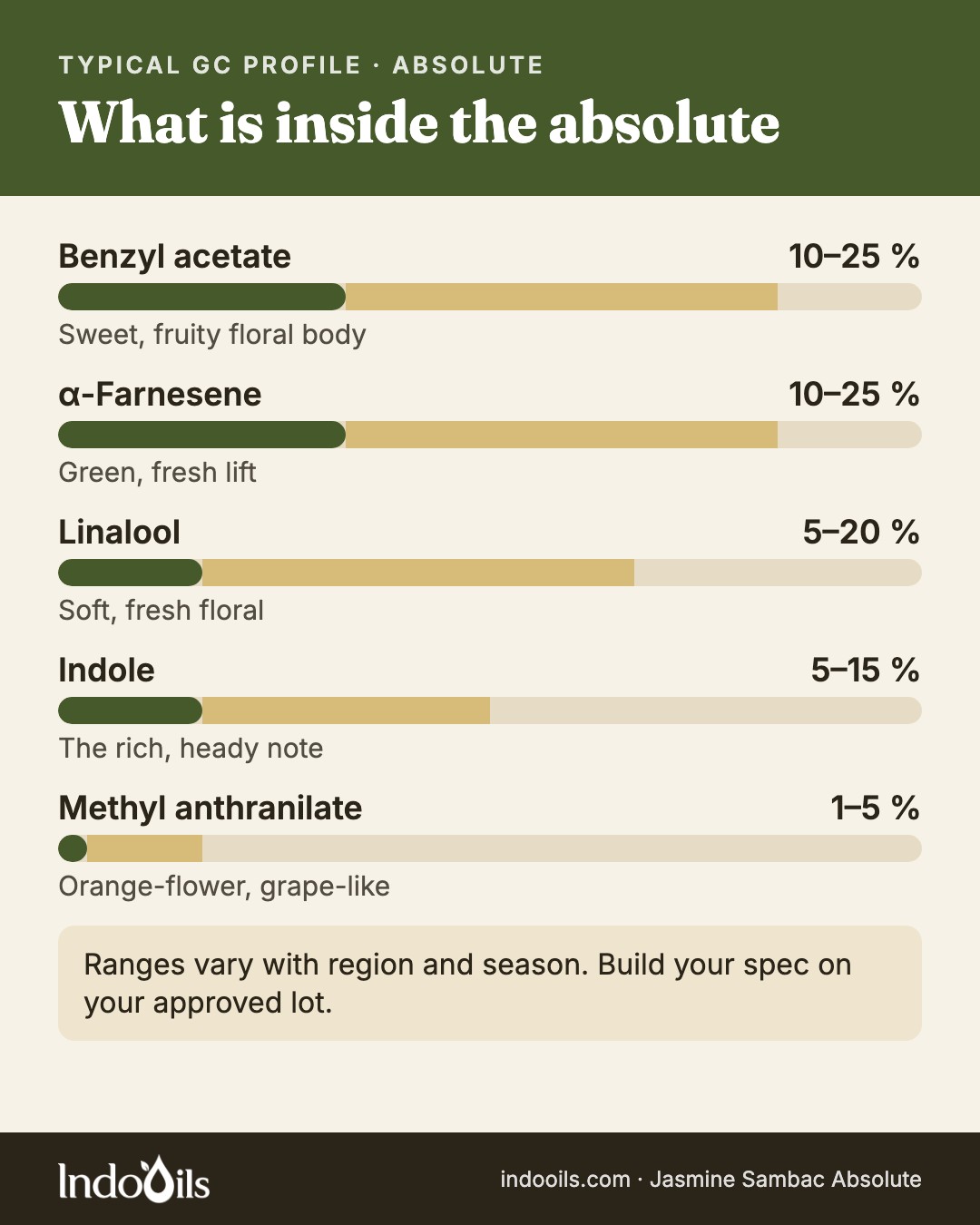
Jasmine sambac absolute contains hundreds of compounds, but a handful carry its character:
- Benzyl acetate: sweet, fruity and floral; the backbone of most jasmine scents.
- Alpha-farnesene: a green, fresh note that is much more prominent in sambac than in grandiflorum.
- Linalool: a soft, fresh floral note.
- Indole: the rich, heady, slightly animalic note that makes jasmine feel warm and alive. Pure indole smells unpleasant; in jasmine it gives depth.
- Methyl anthranilate: an orange-flower, grape-like note, typical of sambac.
- cis-3-Hexenyl benzoate, benzyl alcohol, methyl benzoate and methyl salicylate: smaller amounts that add green, sweet and fruity facets.
The ranges are wide because the absolute changes with the region, the season, the time of picking and the process. Published analyses of sambac absolutes from India, Egypt and China all show the same main compounds in different proportions. The practical lesson is to build your specification on the GC report of a lot you have approved, and to compare every new lot against it.
Compared with jasmine grandiflorum, sambac absolute has more farnesene, methyl anthranilate and indole and much less benzyl benzoate and cis-jasmone. That is why sambac smells fruitier, greener and more tea-like, and why the two are not interchangeable in a formula.
What to Check on the Certificate of Analysis
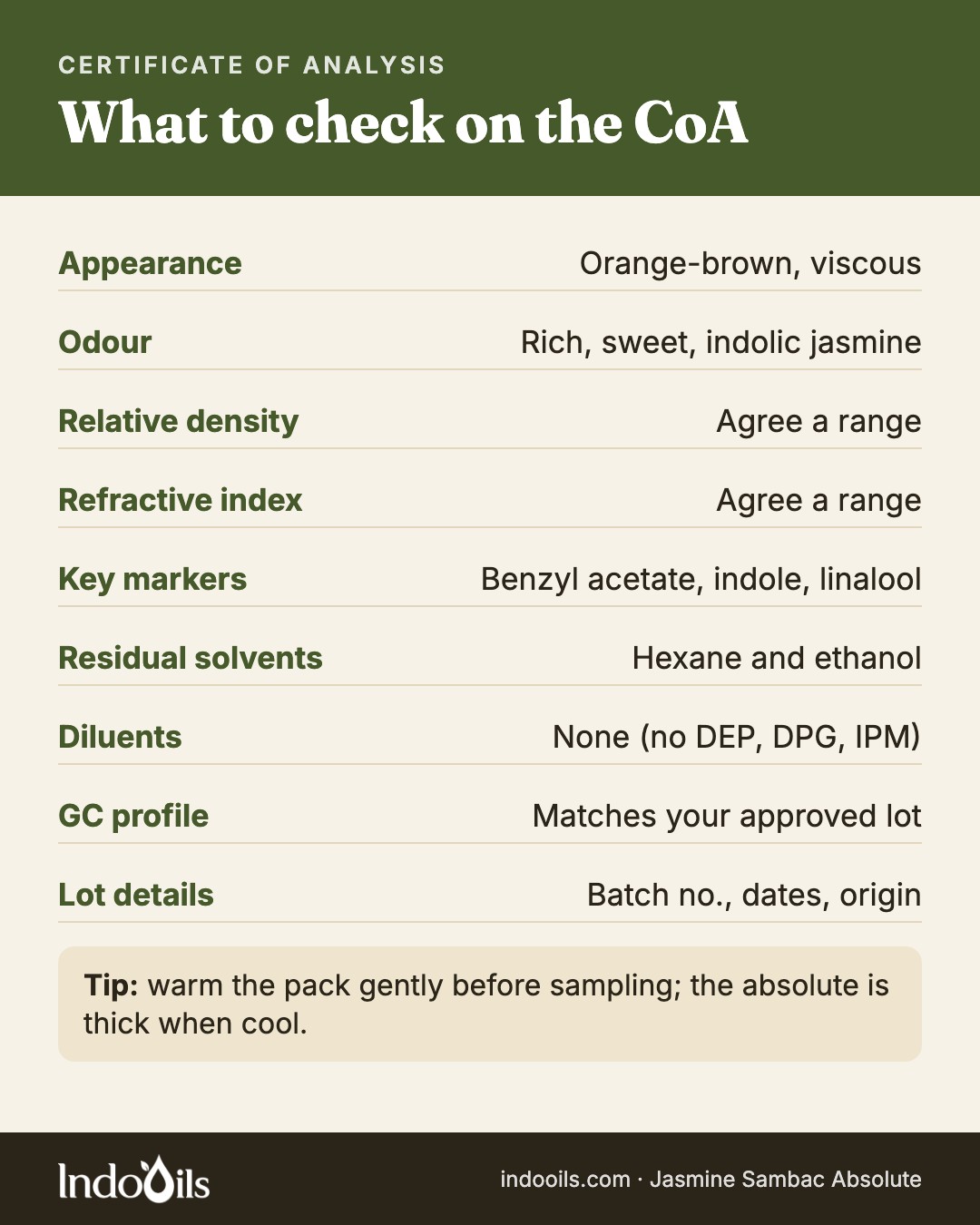
A good CoA for jasmine sambac absolute covers:
- Appearance: a viscous, orange-brown to reddish-brown liquid. It darkens with age, which is normal.
- Odour: rich, sweet and indolic jasmine, matching your approved sample.
- Relative density and refractive index, within agreed ranges. Typical figures are about 0.94–0.99 and 1.480–1.500 at 20 °C, but agree the exact ranges with your supplier from real lots.
- Key markers from GC: benzyl acetate, linalool, indole, alpha-farnesene and methyl anthranilate.
- Residual solvents: hexane from the first extraction and ethanol from the washing, both reported.
- No diluents: no diethyl phthalate (DEP), dipropylene glycol (DPG), isopropyl myristate (IPM) or carrier oil.
- Lot details: batch number, dates of manufacture and analysis, and origin.
Optical rotation is often not reported for absolutes, because they are too dark to read reliably. Do not reject a CoA for leaving it out.
Spotting cut and fake absolutes
Jasmine sambac absolute is valuable, so it is often adulterated. The usual tricks, and how a lab finds them:
- Dilution with DEP, DPG, IPM, benzyl benzoate or a carrier oil. GC-MS shows these clearly, and the density and odour strength fall.
- Added aroma chemicals: synthetic benzyl acetate, linalool, indole or methyl anthranilate to stretch a weak lot. A profile that is "too clean", with the main compounds high and the minor ones missing, is a warning sign.
- Compounds that should not be there: methyl dihydrojasmonate (hedione), hexyl cinnamic aldehyde or other synthetic jasmine materials in more than trace amounts point to a reconstituted product.
- Cutting with cheaper absolutes or concretes, or with ylang ylang oil.
For high-value contracts, two advanced tests help: chiral GC of linalool, since synthetic linalool has a different balance of its two mirror-image forms, and carbon-14 testing, which shows whether the carbon in the material is modern (from plants) or fossil (from petrochemicals). Our quality assurance page explains how IndoOils tests each lot.
Where Jasmine Sambac Absolute Is Used
Jasmine sambac absolute is a fragrance material first and foremost. Its main buyers are:
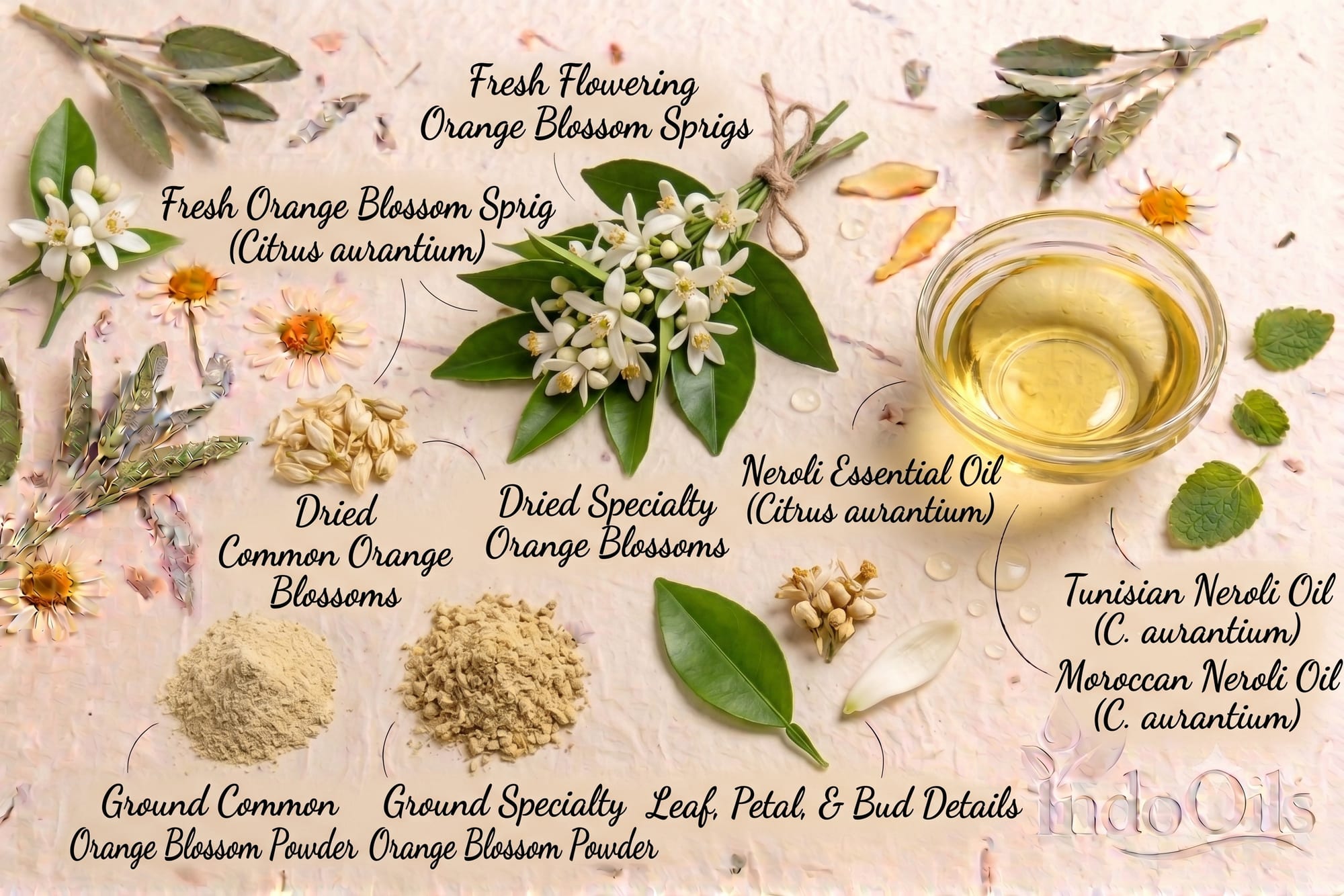
- Fine fragrance. It is the heart of white-floral, oriental and chypre perfumes, and of jasmine soliflores. It pairs naturally with other white flowers such as Neroli (Orange Blossom) Essential Oil, White Champaca Absolute, Ylang Ylang (Cananga) Essential Oil and Frangipani.
- Attars and Indian perfumery. Mogra perfumes, alcohol-free perfume oils and blends with Sandalwood Essential Oil, Vetiver Oil and Kewra Absolute.
- Personal care. Premium soaps, shower gels, lotions, creams and hair oils, within IFRA limits. Jasmine hair oils are a large traditional market in India and the Gulf. See our cosmetics and personal care page.
- Incense. Premium agarbatti, dhoop and bakhoor, where the concrete is also used.
- Home fragrance. Luxury candles, reed diffusers and room sprays. See home care and fragrance.
- Fragrance houses, which use natural jasmine to round out jasmine accords built from aroma chemicals.
It works well with rose, as in Rose Essential Oil Bulgaria or May Rose Absolute; with resins and balsams such as Benzoin Resinoid; and with citrus top notes such as Bergamot (Calabrian). For finished jasmine products, IndoOils also lists a Jasmine Grandiflorum Diffuser Oil, and the full absolute oils range includes orris, ambrette, blue lotus, marigold and other absolutes.
A practical note for formulators: indole and methyl anthranilate can slowly turn white soaps, creams and candles yellow or brown. Always run a colour and stability test in your own base before launch.
Safety, Labelling and Regulatory Rules
Handling
Jasmine sambac absolute is a concentrated natural material and is sold for manufacturing use only. The Safety Data Sheet for each lot gives its full GHS classification, but buyers should expect:
- Skin sensitisation: it may cause an allergic skin reaction. Wear gloves and eye protection.
- Skin and eye irritation from the undiluted material.
- Environmental hazard: harmful to aquatic life, so keep it out of drains.
Its flash point is usually well above 60 °C, so it is not normally classed as a flammable liquid for transport, but check the SDS for each lot.
Cosmetics and fragrance
- IFRA. Every lot should come with an IFRA certificate giving the maximum use level in each product category. These limits take account of the restricted compounds the absolute contains.
- EU allergens. Jasmine sambac absolute contains several listed fragrance allergens, including linalool, benzyl alcohol, benzyl benzoate, farnesol and eugenol. Above 0.001 % in leave-on and 0.01 % in rinse-off products, they must be named on the label. Regulation (EU) 2023/1545 expanded the list and also names a number of natural extracts in their own right. The allergen declaration for each lot tells you exactly what to label. Our post on fragrance allergen labelling explains how this works.
- INCI. Use "Jasminum Sambac Flower Extract" on ingredient lists, or include it in "Parfum" if it is part of a fragrance.
- REACH. Companies importing more than one tonne a year into the EU need a REACH registration for the absolute, or must buy it from a registered importer.
Food and flavour
Jasmine is on the US list of natural flavouring substances generally recognised as safe (21 CFR 182.20), and jasmine sambac is the flower behind jasmine tea. But an absolute sold for food needs food-grade production, residual-solvent limits and food paperwork. IndoOils supplies jasmine sambac absolute for fragrance and personal care; ask us before planning any food use.
Documents to Ask For
For a bulk order of jasmine sambac absolute, expect:
- A Certificate of Analysis for the actual lot, with the constants above, the GC markers and the residual solvents
- A GC-MS report from an independent laboratory
- A Safety Data Sheet in GHS format, with the flash point and transport classification
- An IFRA certificate and an EU allergen declaration
- A statement that nothing has been added (no diluent, carrier or synthetic material)
- A certificate of origin, showing that the absolute was made in India
Our certifications and traceability pages describe how IndoOils documents every lot, and the downloads page has our standard documents.
Packing, Storage and Shelf Life
IndoOils supplies jasmine sambac absolute in 20 kg and 50 kg aluminium packs, each with its own batch number. Aluminium protects the absolute from light and does not react with it.
To keep it at its best:
- Store packs closed, at 15–25 °C, away from sunlight and heat.
- Keep the headspace small. Once a pack is opened, blanket it with nitrogen or decant the absolute into smaller full containers.
- The absolute is thick when cool. Warm the closed pack gently, to no more than 40 °C, and mix before sampling or weighing.
- Expect the colour to deepen over time. That alone does not mean the material is off; judge it on odour and the GC profile.
Shelf life is 24 months unopened. Use opened packs within six months.
How to Order Jasmine Sambac Absolute in Bulk
- Send your specification, or ask for ours: absolute or concrete, key markers, residual-solvent limits, origin preference and documents needed.
- Approve a sample. Request one through our sample request page and test it in your own lab and your own fragrance.
- Ask for a quotation through our bulk inquiry page, with your annual volume and delivery schedule. Supply follows the flowering season, so tell us your yearly needs early.
- Order: the minimum order is one pack (20 kg); 50 kg packs are also available.
If you sell jasmine products under your own brand, our private label and custom formulation services can blend, fill and label them for you.
Frequently Asked Questions
Is jasmine sambac absolute the same as jasmine essential oil?
Not quite. Jasmine flowers are too delicate for steam distillation, so the scent is extracted with a solvent and the result is an absolute. "Jasmine essential oil" is a common name for it, but the correct term is absolute.
What is the difference between jasmine sambac and jasmine grandiflorum?
They are different species. Sambac (mogra) smells fruitier, greener and more tea-like, with more indole and methyl anthranilate. Grandiflorum smells softer and more classic, with more benzyl benzoate. Their absolutes have different specifications and are not interchangeable.
What is the difference between jasmine concrete and jasmine absolute?
The concrete is the first, waxy extract from the flowers. The absolute is made from the concrete by washing it with alcohol and removing the waxes. The absolute is cleaner, stronger and fully soluble in perfumery alcohol, and it costs more per kilogram.
Why is jasmine sambac absolute so expensive?
Because it takes roughly a tonne of hand-picked flowers to make about a kilogram of absolute, and the same flowers are in demand for garlands and temple offerings. Prices move with the flowering season and with fresh-flower demand.
Is jasmine sambac absolute safe to use in cosmetics?
Yes, within the limits on its IFRA certificate and with the required allergen labelling. It may cause allergic skin reactions in some people, so it should never be used undiluted on skin.
What is the HSN code for jasmine sambac absolute?
India's tariff has no named line for jasmine, so it falls under 33012990 ("other" essential oils, including concretes and absolutes), with GST at 18 %. Confirm the code with your customs agent for your own shipments.
What is the minimum order?
One 20 kg pack. 50 kg packs are also available, and a sample can be sent before you order in bulk.
For more buyer's guides, see our posts on sandalwood oil, vetiver oil, davana oil, saffron oil and essential oils for cosmetics, or browse the full absolute oils range.
Buying in bulk?
20 kg and 50 kg packs, with a certificate of analysis for every lot.
Tell us the product, quantity and destination, and we will come back with a quotation.